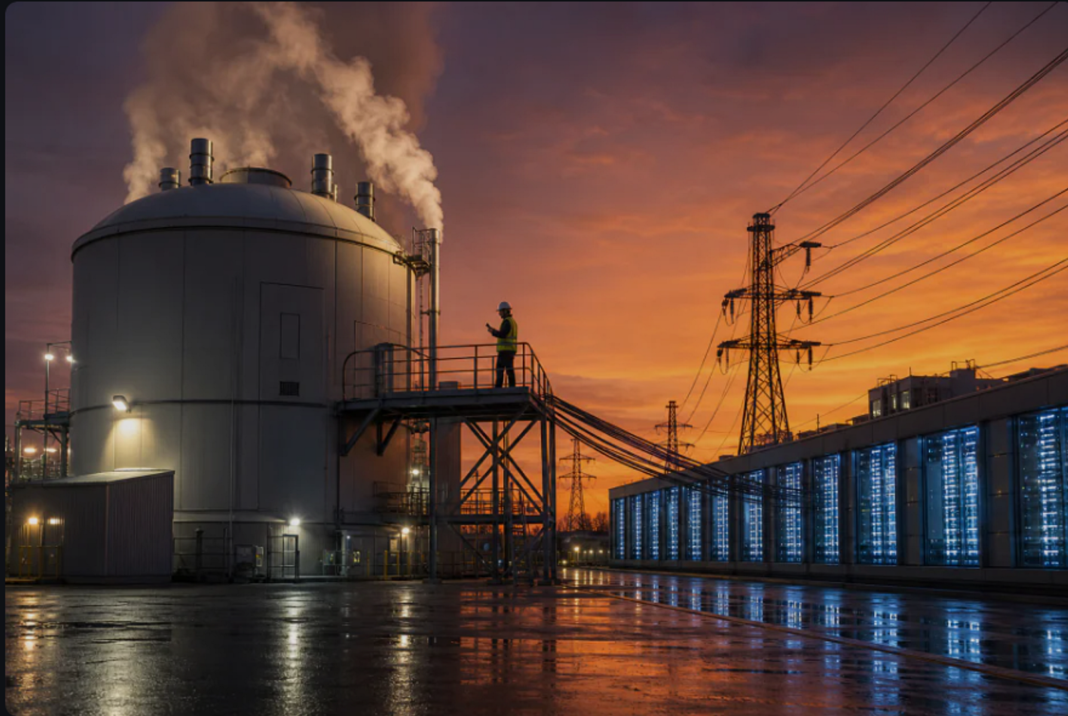
- Valar Atomics lifts 1 billion dollars (led by Sequoia) at a valuation of 6 billiontripled since February.
- Objective: mass produce nuclear microreactors to power AI data centers.
- Its test reactor reached criticality in June and powered an Nvidia Blackwell chip.
- But the history of SMRs is punctuated with broken promises and a bottleneck on uranium.
AI is hungry for electricity, and Silicon Valley is turning to the atom. On August 3, the start-up Valar Atomics announced a billion-dollar raise led by Sequoia to industrialize small nuclear reactors intended for data centers. A bold bet, in a sector where timetables have always slipped.
01 · The lifting
A billion for microreactors
The round, led by Shaun Maguire (Sequoia), values Valar Atomics at $6 billion, three times more than in February 2026. With a credit facility of $200 million, the company has a war chest of $1.2 billion. At its head, Isaiah Taylor, an atypical founder who left high school. Its technology: small reactors at high temperatureThe parameter which regulates the randomness of a model’s responses: closer to 0 it is deterministic, the higher it is creative. cooled with helium, with TRISO fuel. In June, its Ward 250 test reactor reached criticality and powered an Nvidia Blackwell system, while a deal with Nvidia is for a 30MW near-waterless AI facility.
02 · The contextThe context window: the maximum number of tokens that a model can process in a single request (eg: 200k, 1M). energy
Why nuclear for AI
Going from concept to operational reactor in seven months: this is the argument that Valar sells to its investors.According to TechCrunch, August 3, 2026
An AI data center requires power available 24 hours a day, with near 100% reliability. Solar and wind power, which are intermittent, impose prohibitive storage costs. Nuclear power therefore becomes the massive and carbon-free solution by default. Projections predict more than 200 terawatt hours consumed by data centers by 2030. Result: each tech giant has already signed at least one nuclear agreement.
MicrosoftRestart of Three Mile Island, 835 MW targeted by 2028, in a contract estimated at $16 billion.
GoogleSMR fleet with Kairos Power (500 MW) and up to 1,800 additional MW with Elementl.
Amazon$700 million invested in X-energy and an agreement around the Susquehanna power plant.
MetaCall for tenders from 1 to 4 GW, partnerships with Vistra, Oklo and TerraPower.
03 · The political context
Trump deregulates the atom
The timing is no coincidence. In May 2026, the Trump administration signed four decrees to deregulate nuclear power: reduction of impact studies, classification of AI data centers as “critical defense installations”. It is this framework that allows Valar to promise “industrial” production and record deadlines. But a decree can be canceled by the next administration, which weakens the structure.
04 · Doubts
The promises of SMR, a sea serpent
Skepticism is required. The NuScale case, an industry benchmark, had promised an SMR for 2026 at $3.6 billion, before the bill swelled to $9.3 billion for reduced capacity. Small modular reactors have been announced as “imminent” for twenty years. Second blind spot: uranium. Mines take ten to twenty years from discovery to production, and the price has reached record highs. Valar has not yet made public a supply agreement or detailed unit costs.
05 · The French issue
And France in all this?
France has an asset that American start-ups do not have: a nuclear fleet already there. In 2025, it exported 90 terawatt hours of carbon-free electricity. EDF and Mistral signed a partnership in May to put AI at the service of the maintenance and construction of EPR2 reactors, data hosted in the sovereign cloud. At the same time, the Campus IA project (Bpifrance, Mistral, MGX) targets 3 GW of low-carbon data centers in France by 2028. Where Valar relies on experimental reactors, France relies on an established infrastructure. See our map of AI data centers in Europe, our Mistral fact sheet and our report on VivaTech and AI data centers.
Sources
- TechCrunch, “Sequoia’s Shaun Maguire leads 1B round for nuclear startup Valar Atomics” (August 3, 2026)
- Bloomberg, “Sequoia leads 1 billion funding round for nuclear startup Valar”
- SiliconAngle, plans for mass production of SMR for AI
- EDF, EDF-Mistral partnership press release (May 2026)
- Forbes, “The AI boom is making nuclear power bankable again”
Frequently asked questions
- How much did Valar Atomics raise and at what valuation?
- Valar Atomics raised $1 billion on August 3, 2026, in a round led by Sequoia, at a valuation of $6 billion, tripled since February. With a $200 million credit facility, the company has a war chest of $1.2 billion.
- What is the connection between Valar Atomics and AI?
- Valar explicitly targets AI data centers, which are very electricity hungry. Its test reactor has already powered an Nvidia Blackwell chip, and an agreement with Nvidia is for a 30 MW near-waterless AI installation. Data centers are expected to consume more than 200 terawatt hours per year by 2030.
- What is an SMR?
- An SMR (small modular reactor) is a small modular nuclear reactor, designed to be mass-produced in a factory rather than built on site. Valar uses high-temperature helium-cooled reactors with TRISO fuel, touted as faster to deploy than large plants.
- Why are tech giants turning to nuclear power?
- Because AI data centers require continuously available and reliable electricity, which solar and wind cannot guarantee without expensive storage. Microsoft, Google, Amazon and Meta have all signed nuclear deals, for a total of around 9.8 GW of committed capacity.
- Should we believe the promises of Valar Atomics?
- With caution. Small reactors have been announced as imminent for twenty years, and the NuScale case saw its costs increase from 3.6 to 9.3 billion dollars. Added to this is a bottleneck on uranium, the mines of which take ten to twenty years to produce. Valar has not published its unit costs.
- What is France’s position on nuclear power for AI?
- France is banking on its existing fleet: it exported 90 terawatt hours of carbon-free electricity in 2025. EDF and Mistral have signed a partnership for AI for nuclear power, and the Campus IA project is targeting 3 GW of low-carbon data centers by 2028, an established rather than experimental infrastructure approach.