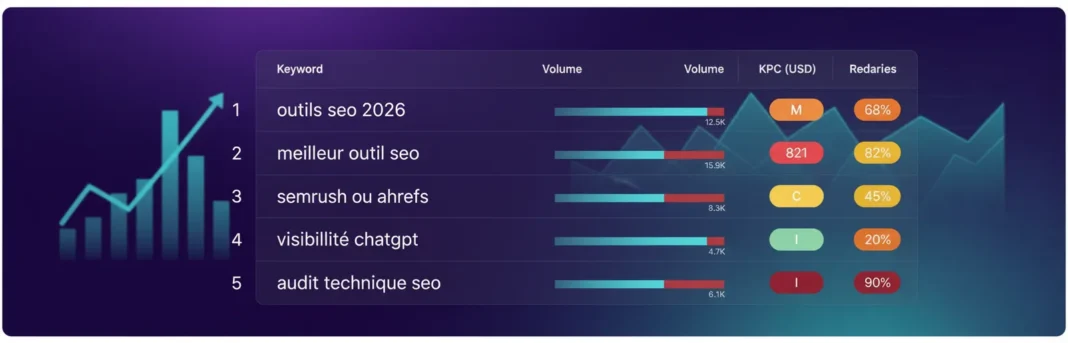
- → For most pros, one sequence is enough : Semrush (the most complete) or Ahrefs (the king of backlinks), around $120 to $130/month.
- → Small budget or freelance? SE Ranking offers most of the features for less than half the price, starting at around $52/month.
- → The technical audit is done very well with Screaming Frog (free up to 500 URLs) and Google Search Consolefree and essential.
- → The real disruption of 2026: monitor its visibility in ChatGPT and AI responses. Profound, Otterly.ai or the AI Toolkit from Semrush are opening this new front.
The market for SEO tools has never been so dense or so expensive. Between all-in-one suites costing several hundred dollars per month, technical crawlers, position trackers and the new wave of tools that measure your presence in AI, choosing is a headache. This guide decides: what each family of tools really does, which ones are worth their price in 2026, and which ones are free without compromise.
The good news is that you don’t need everything. The bad news is that publishers are pushing hard for stacking. Our sorting principle: a tool is only justified if it saves you time that you will value. Here’s how to build an effective toolbox, without overpaying.
≈ $117 · Semrush entry ticket per month
$29 · Ahrefs Starter, the cheapest of the big ones
$0 · Screaming Frog up to 500 URLs
$99 · AI Visibility Toolkit Semrush per month
01, How to choose
Before comparing brands, understand the missions. An SEO tool is used to answer four questions, and a fifth has just appeared. No need to pay for modules that you will never use.
| Family | What it measures | Representative tools | Essential ? |
|---|---|---|---|
| Keyword research | What people are looking for, volume and difficulty | Semrush, Ahrefs, SE Ranking | Yes |
| Technical audit | Errors that block SEO | Screaming Frog, Search Console | Yes |
| Position tracking | Your ranking day after day | SE Ranking, Semrush, Ahrefs | Recommended |
| Backlinks | Links that point to your site | Ahrefs, Semrush, Moz | According to the objective |
| AI visibility (GEOGenerative Engine Optimization, the optimization of content to be cited by AI response engines (ChatGPT, Perplexity, Gemini).) | Your quotes in ChatGPT, Perplexity, AI Overviews | Profound, Otterly.ai, AI Toolkit | New, 2026 |
The budget rule is simple. Below $50 per month, you combine free tools with an affordable subscription. Around $120, you get access to a complete professional suite. Beyond $250, you mainly pay for data volumes and user seats, useful for an agency, rarely for a single site. Start low, go up when a ceiling really bothers you.
02, Reference suites
Semrush and Ahrefs, the two heavyweights
These are the two names that everyone mentions, for good reasons. Each ended up covering all needs, but their DNA remains different: Semrush comes from global marketing, Ahrefs from backlinks. The right choice depends on what matters most to you.

Which one to choose? For pure netlinking and competitor spying, Ahrefs stays one step ahead. For a broad marketing toolbox that also covers advertising, social and AI visibility, with a free trial to decide, Semrush wins. Many agencies keep both, but a single site almost never needs both.
03, Value for money
SE Ranking, the smart alternative
Not everyone has $1,500 a year to put into a tool. This is where SE Ranking changes the game: it offers the essentials of a large suite at a price that is suitable for a freelancer or a small organization. Long underestimated, he has risen to the level of the greats in most common functions.
In the same logic of accessibility, two other names deserve a look. Mangools (KWFinder) seduces with its simplicity and low prices, perfect for starting keyword research without drowning in options. Ubersuggestby Neil Patel, offers a single-payment-for-life plan that may be suitable for occasional use, at the cost of less data. None replaces a real suite, but they help out at a low price.
04, Technical audit
Screaming Frog and Moz, the specialists
Beyond the suites, two tools play a separate role. One is the cult technical crawler, the other the pioneer who gave the profession its vocabulary. Neither of them tries to do everything, and that’s their strength.
05, The free ones
Free tools that are (often) enough
Before pulling out the credit card, know that a huge part of SEO work is done without spending a cent, with tools provided by Google and Microsoft. For a site just starting out, they cover the essentials.
Google Search Console the most important tool of all, and it’s free. It shows your real positions, your queries, your clicks, your indexed pages and the errors seen by Google. No paid tool replaces this first-hand data.
Google Analytics 4 to understand what visitors do once they arrive: page views, duration, conversions. The essential behavioral counterpart of Search Console.
Google Trends to spot trends, seasonality and relative interest in a topic. Valuable for deciding what to write and when.
Bing Webmaster Tools the equivalent of Search Console for Bing, with the bonus of free keyword research tools. And Bing powers part of ChatGPT’s responses, so not to be neglected.
Google Keyword Planner free with a Google Ads account, it gives search volumes by range. Less precise than the suites, but sufficient to frame a content strategy.
The truth that tool sellers don’t like to tell: with Search Console, Analytics, a free Screaming Frog and a little method, a motivated beginner is already 80% of the way there. Paid tools speed up and provide competitive insight, but they don’t do the work for you.
06, The GEO break
What’s new for 2026: being visible in AI
Here’s what sets this guide apart from the comparisons from two years ago. In 2026, a growing share of searches no longer go through a classic Google results page, but through an AI response: ChatGPT, Perplexity, Gemini, or the AI Overviews displayed at the top of Google. If your brand isn’t mentioned in these responses, you become invisible to an entire audience, and no traditional SEO tool will tell you that.
This is the terrain of GEO, Generative Engine Optimization. A new generation of tools has emerged to accurately measure your citations in AI, and major publishers are getting in on the action too. We detail the complete method in our guide to being visible in ChatGPT, but here are the tools you need to know.

Profound the most established pure player in visibility tracking in AI. It analyzes how and when your brand appears in ChatGPT, Perplexity and others, with a business focus. Prices on quote, rather high-end.
Otterly.ai more accessible, it tracks your mentions and share of voice in ChatGPT, Claude, Gemini and Perplexity, in many countries. A freemium plan allows you to test before committing.
Peec AI another young and well-rated player, focused on the analysis of brand performance in generative engines, designed for marketing teams.
Suite modules Semrush’s AI Visibility Toolkit, SE Ranking’s AEO Tracker and Ahrefs’ Brand Radar now integrate this tracking. Convenient if you want everything in one place, without additional subscription.
Should we get started right away? If your business depends on search and your customers already ask an AI their questions, yes. Otherwise, start by asking ChatGPT and Perplexity your key questions yourself to see if you show up. It’s free, instant, and that’s often enough to decide whether to invest in a dedicated tool. The basis of GEO remains, in any case, excellent SEO and clean technical foundations.
07, The Verdict
The complete comparison and our method
Here is the summary, indicative entry prices for 2026, to check on the official sites because they often change, especially in annual billing.

| Tool | Main use | Entrance fee | Ideal for |
|---|---|---|---|
| Semrush | All-in-one suite + AI visibility | ≈ $117/month | Have one tool for everything |
| Ahrefs | Backlinks, content, competition | $29/month (credits) | Netlinking and espionage |
| SE Ranking | Affordable full suite | ≈ $52/month | Freelancers, small businesses, small agencies |
| Screaming Frog | Technical audit (crawler) | Free ≤ 500 URLs | The technical diagnosis of a site |
| Moz Pro | Domain Authority, Basics | ≈ $49/month | Start and follow your DA |
| Search Console | Real Google data | Free | Everyone, without exception |
| Profound / Otterly | Visibility in AI (GEO) | Freemium on quote | Track your quotes in ChatGPT |
Rather than buying randomly, build your toolbox in stages. You’ll avoid paying for features you’ll never use.
1
Install the free ones
Search Console and Analytics from day one. Add Bing Webmaster Tools and the free version of Screaming Frog. Cost: $0. It’s non-negotiable.
2
Measure your real needs
After a few weeks, identify what you are really missing: keyword volumes, position tracking, competitive analysis. Pay only to fill an identified gap.
3
Choose a suite, just one
SE Ranking if budget matters, Semrush or Ahrefs if you use it intensively. One well-used suite is better than three half-used ones.
4
Open the GEO front
When visibility in AI becomes an issue, test Otterly.ai or the AI module of your suite. Start by querying ChatGPT yourself to gauge the need.
5
Reassess every year
Prices are rising, functions are changing, new players are arriving. Once a year, check that each subscription is still saving you time. Otherwise, cut.
The best SEO tool isn’t the most expensive or the most comprehensive, it’s the one you actually use. A disciplined freelancer with SE Ranking and Search Console will always beat a team that pays Semrush without opening it. Choose according to your use, your budget and your objectives, then spend most of your time producing good content: no tool will do it for you.
To go further: How to be visible in ChatGPT in 2026 (GEO guide) · Schema.org for GEO · The practical guide to the llms.txt file · AI model comparator