Updated June 23, 2026: Claude Fable 5 was suspended on June 12 by directive from the US government and remains unavailable. Our follow-up: Claude Fable 5 suspended by order of Washington.
- → Anthropic opens Claude Fable 5 to the public, the “restricted” version of Mythos, the model it deemed too dangerous
- → Same brain as Mythos: safeguards redirect less than 5% of sensitive requests to Opus 4.8
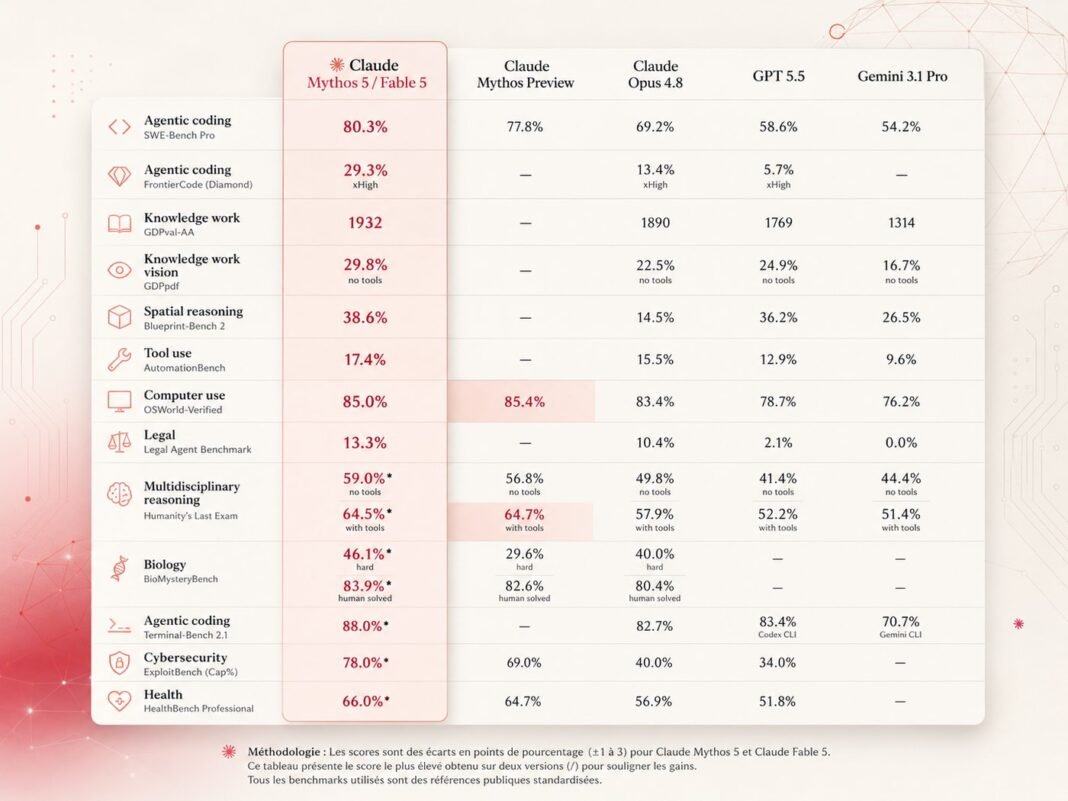
- → Records: 80.3% on SWE-BenchA benchmark that evaluates a model’s ability to solve real GitHub problems independently, like an engineer. Pro, far ahead of Opus 4.8 (69.2%), GPT-5.5 (58.6%) and Gemini 3.1 Pro (54.2%)
- → Available immediately (APIApplication Programming Interface, the programmatic access channel to a service or model.Claude Code, Pro/Max at no additional cost until June 22); API at $10 / $50 per million tokens
Two months ago, Anthropic caused a stir by unveiling Mythos, a model so good at finding security vulnerabilities that it refused to make it public. The verdict seemed final: too dangerous. And yet, since June 9, 2026, a version of this model is in everyone’s hands. Her name is Claude Fable 5, it’s the LLMLarge Language Model, a language model trained on billions of parameters to generate and understand text. the most powerful ever released to the general public, and it crushes the competition. Here’s what’s changing, simply.
01 · The observation
Mythos comes out of the closet, under the name Fable 5
Anthropic had been clear: Mythos would remain locked, reserved for hand-picked cyber defense organizations. The turnaround is spectacular. Fable 5 is Mythos made safe for the publicavailable directly in the Claude application, the API and Claude Code.
02 · The principle
Same brain, but with safeguards
Concretely, Fable 5 and Mythos 5 are the same model. What sets them apart is what they are allowed to do.
Fable 5 (general public) the same model, plus security classifiers that monitor each request in real time.
The trigger as soon as a request concerns offensive cybersecurity, biology, chemistry or distillationThe transfer of knowledge from a large model to a smaller one, to save cost and speed. models, it is redirected to Opus 4.8, less efficient in these areas.
Mythos 5 (restricted) without safeguards, always reserved for Project Glasswing organizations (AWS, Microsoft, Apple, CrowdStrike).
The result Anthropic ensures that the net only triggers in less than 5% of sessions. The rest of the time, Fable 5 runs at full power.
The effect is measurable: the success rate of automated cyber attacks drops to 5.4% on Fable 5compared to 83.2% on Opus 4.6. The guardrails work.
03 · Performance
Benchmarks that crush everything
The results are unambiguous. On SWE-Bench Pro, the benchmark test in software engineering, Fable 5 reached 80.3%, when Anthropic’s previous flagship, Opus 4.8, peaked at 69.2%. And the gap is widening on the hardest tasks.

04 · The proof
He finished Pokémon with simple screenshots
Beyond the numbers, a demonstration speaks for itself: Claude Fable 5 has finished Pokémon Fire Red relying solely on screenshots of the game, without maps or navigation aids. Previous versions of Claude required a complex support system to complete this. A good illustration of his ability to reason over time and act independently.
05 · Price and access
Where to try it, and how much it costs
Fable 5 is available now on the Claude API, in Claude Code and on Enterprise offers (AWS, Google Cloud, Microsoft Foundry). In the app, it appears at the very top of the model selector, above Opus 4.8.

On the API side, count $10 per million tokens in and $50 outdouble that of Opus 4.8. The rumor of a price of $25/$125 which circulated before the announcement was therefore exaggerated.
06 · The paradox
Anthropic’s splits
This is the most disturbing aspect of this release. Seven days before to launch Fable 5, Anthropic published a solemn appeal asking major laboratories to install a coordinated “emergency brake”.
Frontier models are advancing so fast that they may soon improve autonomously, without human intervention.
Anthropic, in its warning published a week before the release of Fable 5
A week after that warning, the company is putting the most capable model it has ever built into the public’s hands. Anthropic’s entire dilemma lies in this contradiction: warn of the risks, and continue to move forward anyway, because the competitors will not stop.
07 · Our opinion
Do you really have to go there?
For code and complex agentic tasks, Fable 5 is clearly a cut above everything else that exists: if you develop or manage agents, the trial is essential, especially since it is free in Pro and Max subscriptions until June 22.
For the rest, keep a cool head. When it comes to writing, summarizing or everyday questions, the gap with Opus 4.8 (half the price) is much smaller. Fable 5’s real payoff is on the really hard problems. It is up to everyone to judge whether the additional cost is justified for their use.
To go further
Return to the original model with our article Claude Mythos, AI too dangerous for the general public. For the previous public model, see Claude Opus 4.8. And to compare Fable 5 against GPT-5.5, Gemini and Mistral, use our comparison of AI models or the Claude sheet.
Frequently asked questions
- What is Claude Fable 5?
- Claude Fable 5 is the most powerful AI model ever made public by Anthropic, launched on June 9, 2026. It is the “secure” version of Mythos, the model that Anthropic refused to market due to its offensive cybersecurity capabilities. Fable 5 adds safeguards but retains the record-breaking performance of the original model.
- What is the difference between Fable 5 and Mythos 5?
- It’s exactly the same model. The only difference is the safeguards: Fable 5 includes security classifiers which, as soon as a query concerns offensive cybersecurity, biology, chemistry or model distillation, redirects it to Opus 4.8. Mythos 5, without these filters, remains reserved for Project Glasswing organizations.
- Is Fable 5 stronger than GPT-5.5 and Gemini?
- Yes, definitely, on code and agentic tasks. On SWE-Bench Pro, Fable 5 reached 80.3%, compared to 69.2% for Opus 4.8, 58.6% for GPT-5.5 and 54.2% for Gemini 3.1 Pro. The gap widens further on the most difficult tasks (FrontierCode Diamond: 29.3% compared to 13.4% for Opus 4.8).
- How much does Claude Fable 5 cost?
- On the API, Fable 5 costs $10 per million tokens for input and $50 for output, double that of Opus 4.8. In Pro, Max, Team and Enterprise subscriptions, it is included at no additional cost until June 22, 2026; after this date, its use will require credits.
- How to access Claude Fable 5?
- Fable 5 is available now on the Claude API, in Claude Code, on Enterprise offerings (AWS, Google Cloud, Microsoft Foundry) and in the Claude.ai application, where it appears at the top of the model selector, above Opus 4.8.
- Do the guardrails really restrict the model?
- Very little, according to Anthropic. The redirection mechanism to Opus 4.8 is only triggered in less than 5% of sessions, on specific sensitive subjects. In more than 95% of cases, Fable 5 runs at full power. The effect is above all security: the success rate of automated cyber attacks drops to 5.4%.
- Should we abandon Opus 4.8 for Fable 5?
- Not necessarily. For development, agents and very complex tasks, Fable 5 is clearly worth a look, especially since it is free in Pro and Max until June 22. But for writing, summarizing or daily use, the gap with Opus 4.8, half the API price, is much smaller.