
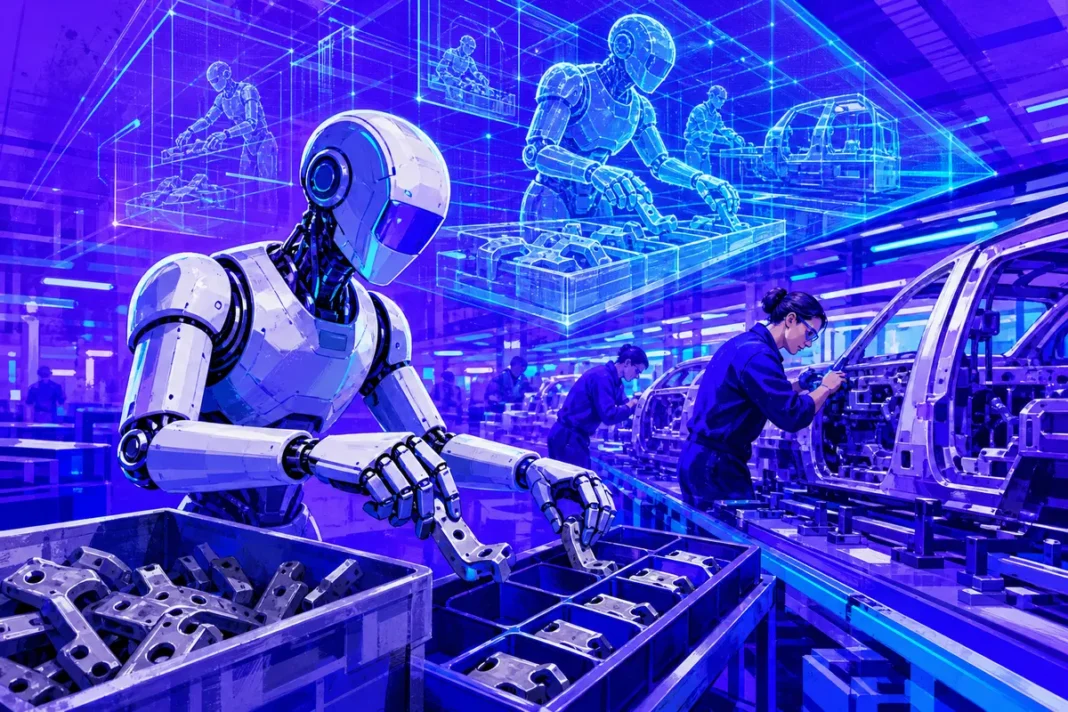
Serving food with tongs, tying a ribbon on a gift package, taking a liquid with a pipette: commonplace actions for a human, but formidable for a robot. Google DeepMind presented the November 10, 2026 Gemini Robotics 2.5its most advanced AI model for controlling robots, with a stated ambition: to bring them out of laboratories to work in real environments, alongside humans. First full-scale testing ground: production lines of Mercedes-Benz.
A “brain” for robots of all types
Gemini Robotics 2.5 is a so-called model vision-language-action. He watches the scene using the robot’s cameras, understands instructions formulated in everyday language and translates everything into arm and hand movements. Like previous versions of the range, launched by DeepMind in March 2025, it works on many types of robots, including humanoids.
According to DeepMind, this progress owes a lot to Gemini 4 Argonits large language model, used as an accelerator for robotics research. Argon generates thousands of simulated training variants from a single filmed scene, a kind of digital twins of the real environment. It also helps researchers understand, from videos, why a task failed, then test corrections in simulation and on real robots.
More skillful, more reliable, faster
DeepMind evaluated the model on over 200 distinct taskswhich combine the use of tools, the handling of flexible objects and the handling of fragile objects. The announced results, compared to previous versions:
| Indicator | Result announced by DeepMind |
|---|---|
| Success rate | From 30% to 100% higher, depending on the type of task |
| Speed of execution | Tasks completed 20-30% faster |
| Safety around obstacles | Safe completion up 33% |
| Safety around people | Safe completion up 43% |
| Parts preparation at Mercedes-Benz | 96% success |
These figures come from the company and its own assessments: no independent measurements have yet been published, and the precise conditions of each test are not detailed in the announcement.
Why are these gestures so difficult for a robot?
The tasks selected by DeepMind owe nothing to chance. Tying a ribbon or handling a fabric involves managing deformable objectswhose form changes with each movement and which a classic program cannot anticipate. Serving food with tongs requires using a tool, therefore controlling one object through another. Pipetting a liquid requires millimeter precision and great delicacy.
For these fine gestures, the model relies on increasingly sophisticated hands. DeepMind notably cites a humanoid equipped with a hand SharpaWaveequipped with five fingers and 22 degrees of freedom, that is to say 22 joints that can move independently. The model also works on simpler platforms, such as Franka Duo and its two-fingered pincers, according to SiliconANGLE. This ability to move from one robot to another without relearning everything is one of DeepMind’s key arguments compared to specialized approaches.
The full-scale test at Mercedes-Benz
The most telling passage concerns industry. With the American company Apptronik and the manufacturer Mercedes-BenzDeepMind made humanoid robots work Apollo 2 on active production lines, Kecskemetin Hungary, and Sindelfingenin Germany.
The chosen task is called “kitting”: sorting spare parts, taken from bulk bins, to arrange them in trays in the exact order required by each vehicle in the chain. Repetitive and physically demanding work. The robot grabs metal supports, places them in sequencing containers and corrects any omissions. On this pilot projecthe reaches 96% success.
“This is what we designed Apollo for: useful work alongside humans, in real industrial environments,” explains Jeff Cardenas, co-founder and boss of Apptronik. According to him, the models improved significantly within a few weeks of additional training and were transferred into production at Mercedes-Benz with very little loss of performance.
Safety, condition for leaving laboratories
A robot that moves around a workshop or a house must avoid obstacles and, above all, people. Gemini Robotics 2.5 uses a guidance by reasoning at the time of action to bypass physical dangers in real time, like the security filters that govern Gemini’s responses.
DeepMind also publishes a new open source test bench against “jailbreaks” specific to robotics, these disguised requests which seek to push a robot to perform a dangerous action. It brings together hundreds of trapped instructions spread across dozens of scenes. According to the company, Gemini 4 Argon resists it in 99.5% of casescompared to 82% for the previous generation of its reasoning model for robots.
Who can use Gemini Robotics 2.5?
The model is not offered to the general public. He is deployed to robotic partners from DeepMind, including Apptronik, Agile Robots And Boston Dynamicsaccording to SiliconANGLE. Companies that want to use it therefore go through these robot manufacturers, and not through an application or API open to all.
The same day, DeepMind also presented AlphaGenome 2a model that predicts how variations in DNA alter gene activity in different cell types, a tool intended for biomedical research and not clinical use. According to SiliconANGLE, it adapts directly to new data from individual cells, without retraining, and adds prediction of DNA methylation, a mechanism by which environment and lifestyle influence gene activity.
Towards versatile robots in the factory and elsewhere
With this version, DeepMind claims to be taking a step towards what it callsgeneral physical intelligence: robots capable of quickly learning various tasks, rather than machines programmed for a single gesture. The automotive industry, where repetitive preparation tasks abound, appears to be the first outlet, the stated objective being to free technicians for more complex assembly operations.
Several questions remain open: the cost of a humanoid equipped with this model, its reliability over months of continuous production and the way in which these robots will be integrated into work organizations. Competition is keen between AI laboratories and manufacturers of humanoid robots. The next deployments among DeepMind partners will show whether the gains measured in the laboratory are confirmed in the field.


