- THE GEOGenerative Engine Optimization, the optimization of content to be cited by AI response engines (ChatGPT, Perplexity, Gemini). (Generative Engine Optimization) targets your visibility in ChatGPT, Perplexity, Gemini and Claude, not your place in Google rankings.
- He doesn’t does not replace SEOit builds on it: 99% of the sources cited by Google’s AI summaries come from the organic top 10.
- THE zero-click drives down clicks, but remaining traffic converts up to 4.4 times better.
- The right indicator is no longer the volume of visits, it is the number of qualified leads.
You publish, you optimize, you go back to Google. And yet, some of your customers no longer type anything into a search bar. They open ChatGPT and ask, in French, like a colleague: “which service provider to redesign my site?” », “What solution to automate my invoicing? “. The answer comes out, synthetic, sometimes with company names. Only one question then matters to you: is yours part of this answer?
More and more leaders are asking themselves this question, and they are right. In France, the number of ChatGPT users is estimated at more than 18 million, and nearly four out of ten French people already use it for research. A significant portion of your future customers have therefore adopted a new reflex: querying artificial intelligence rather than browsing ten blue links.
This shift responds to a discipline with a somewhat dry name: GEO, for Generative Engine Optimization. The idea is simple: ensure that AIs quote you, recommend you and highlight you when an Internet user asks a question related to your profession. Here’s how this mechanism works, why your SEO remains its foundation, and how to get truly qualified prospects from it.
Your customers no longer just search for you on Google
For twenty years, SEO boiled down to an obsession: being on the first page of Google. On page one, you existed. Elsewhere, you were invisible. This world has not disappeared, but it has doubled.
Analysts anticipate a decline in dependence on conventional engines of around 25% by the end of 2026. The reason can be summed up in one word: conversation. Ask “what solutions to redo my firm’s showcase site in 2026?” » is more natural than guessing the keywords Google expects. The AI responds with a summary, comparisons, sometimes named recommendations.
Let’s take an HR consulting firm in Nantes. Yesterday, his potential client typed “HR advice Nantes”. Today, he writes to ChatGPT: “how to structure the recruitment of an SME of 30 people? » and discovers, throughout the response, approaches, methods, and sometimes actors. The firm that documented these topics has a chance of being cited. The others remain off-screen.
GEO, SEO in the era of generative engines
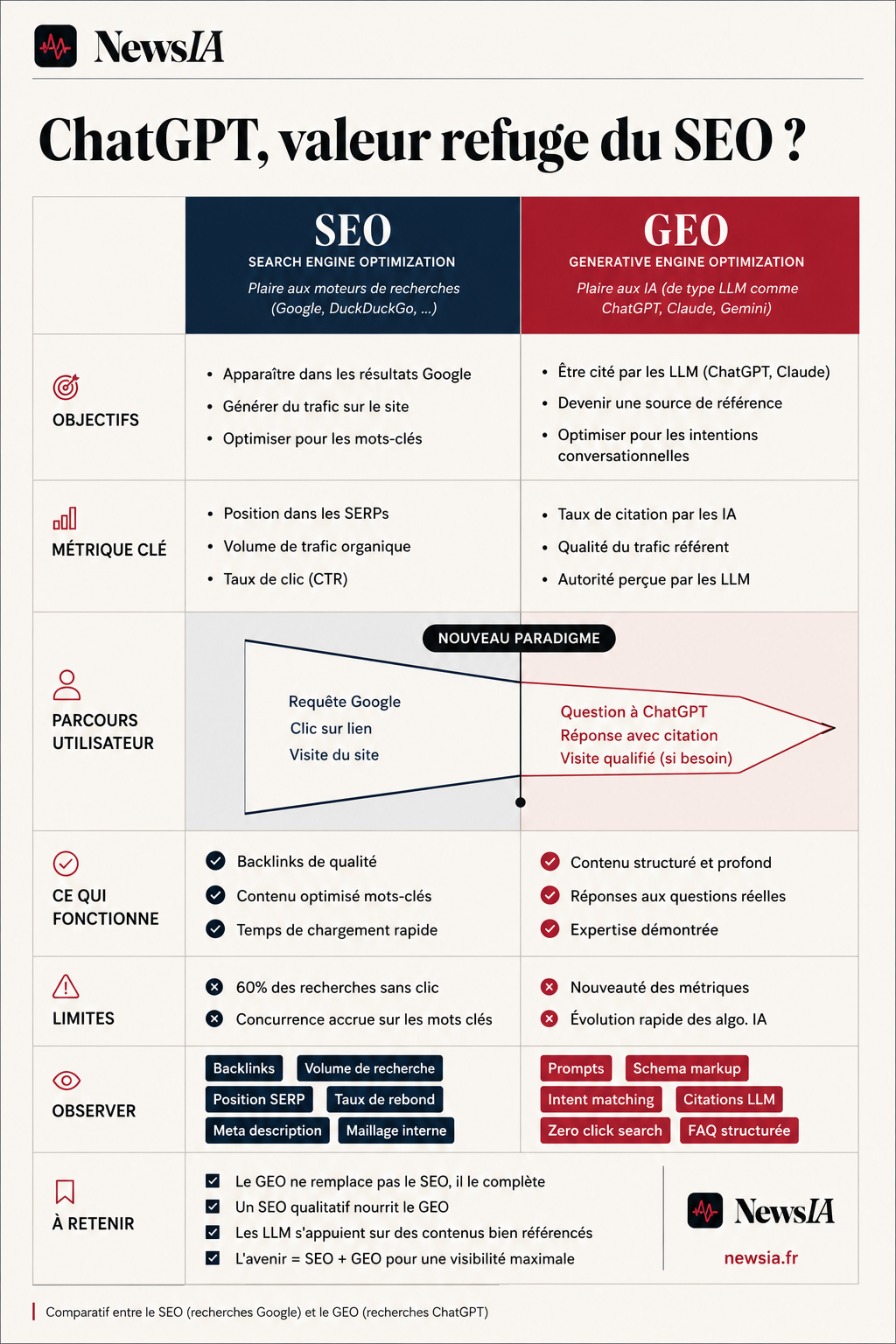
GEO consists of optimizing your content and your online presence to be cited, mentioned or recommended by a generative AI. The difference with SEO is structural. In SEO, you aim for a position in a ranking of 1 to 10. In GEO, there is no “position 1”: the AI composes a response from the sources it judges to be the most reliable, complete and relevant. Your objective is no longer to beat a ranking, but to enter the set of sources retained by the model.
| Criteria | SEO (Google) | GEO (ChatGPT, Perplexity, Gemini) |
|---|---|---|
| Objective | Rank in the top 10 | Be cited as a reliable source |
| Measure | Position, clicks, CTR | Quotes, mentions, share of voice |
| Answer | A list of links | A unique synthesis |
| Key lever | Keywords and backlinks | Clear answers and entity authority |
| Course | Query, click, site | Question, answer, sometimes click |
The market validates the trend: according to Valuates Reports, GEO services were worth $886 million in 2024 and are expected to reach $7.3 billion by 2031, an annual growth of 34%. It’s not a fashion, it’s a fundamental shift.
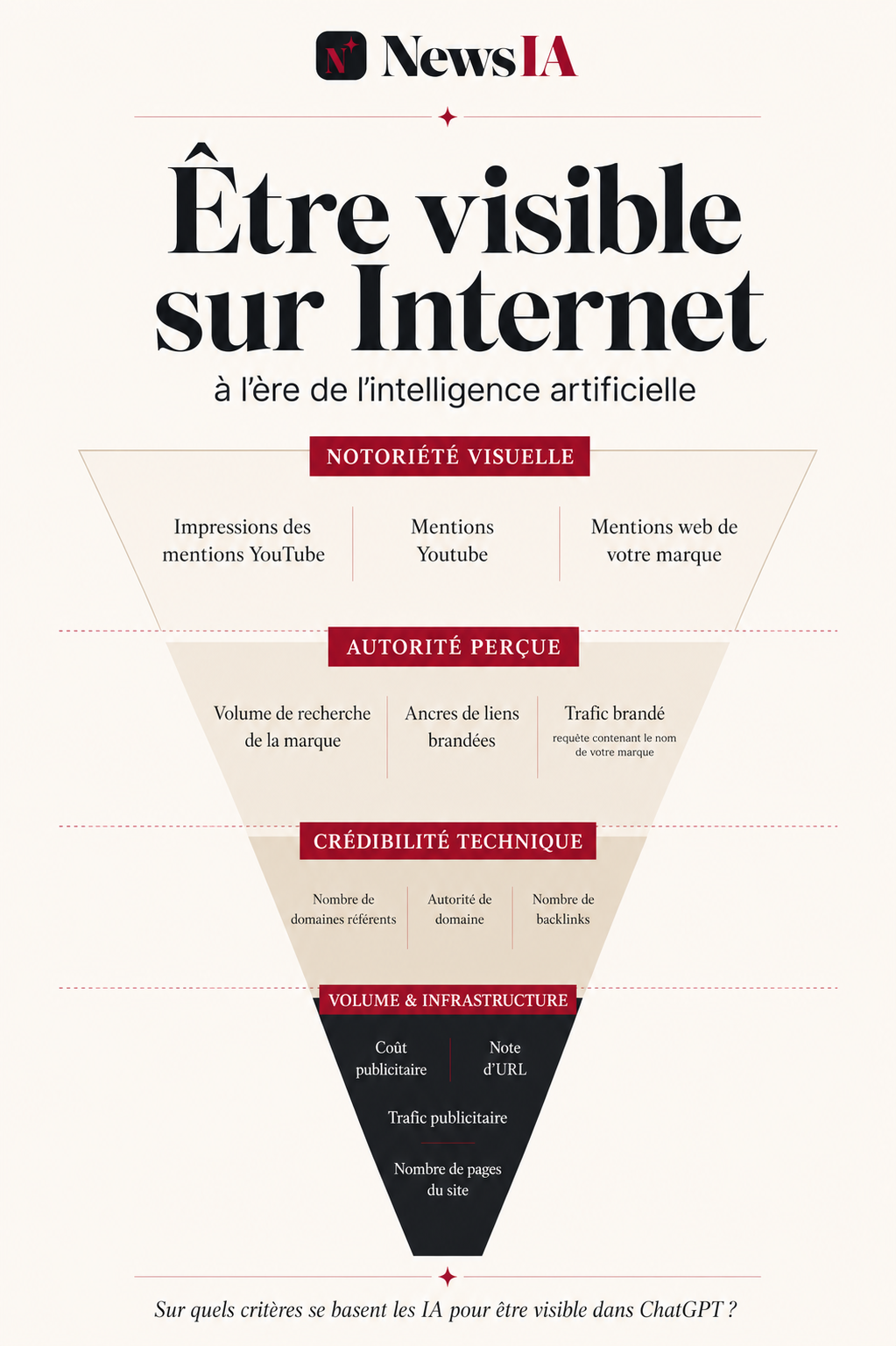
A model like ChatGPT or Claude does not classify, it reads the web in depth and synthesizes. To decide who to mention, he crosses several signals which stack up like the floors of a building.
The signals that decide a quote
-
Content depth
Editorial quality
Complete, structured articles that specifically answer a question, not generic showcase pages.
-
Off-site reputation
Mentions and reviews
Quotes on other sites, customer reviews, press, LinkedIn, YouTube: AI cross-checks what is said about you elsewhere.
-
Freshness
Up-to-date content
A guide updated in 2026 takes precedence over an article from 2021 that has never been touched up.
-
Identity consistency
Recognizable entity
Name, address, description identical everywhere: the AI must recognize a reliable and verifiable entity.
One number sums it all up: according to industry analyses, nearly 87% of ChatGPT citations correspond to sites already highly ranked on Bing, and 99% of Google’s AI summary sources come from the organic top 10. In other words, AI doesn’t reward a new game: it rewards those who already play the old game well.
Why SEO remains the foundation (and must remain so)
One might believe that the arrival of AI devalues classic SEO. It’s exactly the opposite. Think of GEO as a floor added to a building: without foundations, it collapses. SEO is that foundation.
AIs do not create information out of thin air. They rely on what exists online and find it via indexes similar to those of Google and Bing. A solid site, technically clean, with quality content and recognized authority, automatically has a greater chance of being cited.
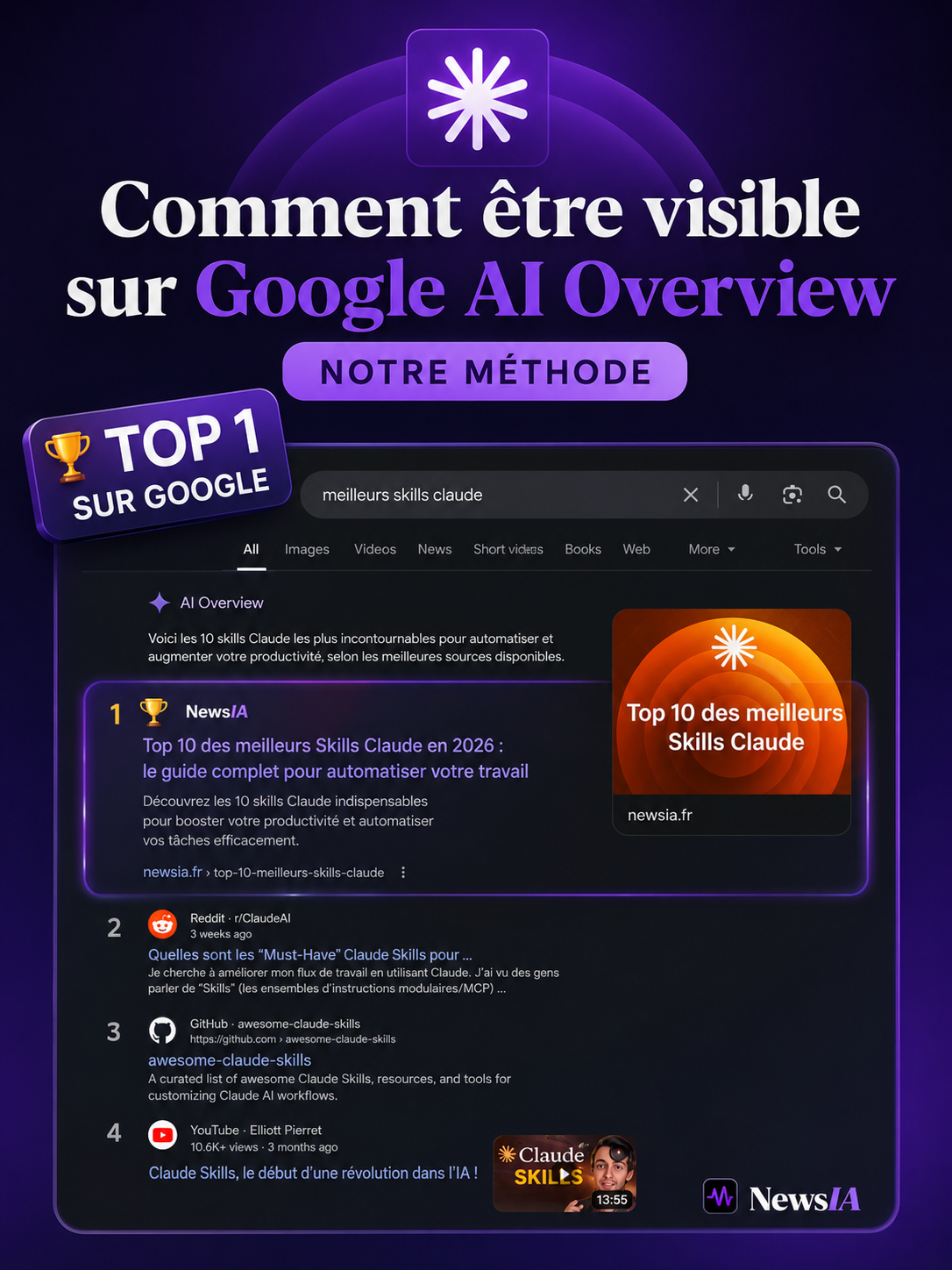
A concrete example from NewsIA: our guide Top 10 of the best Skills Claude ranks on the first page of Google for his query. As a result, it is also the one that assistants take up when asked about the subject. Good organic ranking is not a competitor to AI visibility, it is a condition for it.
Build GEO on SEO, not in its place
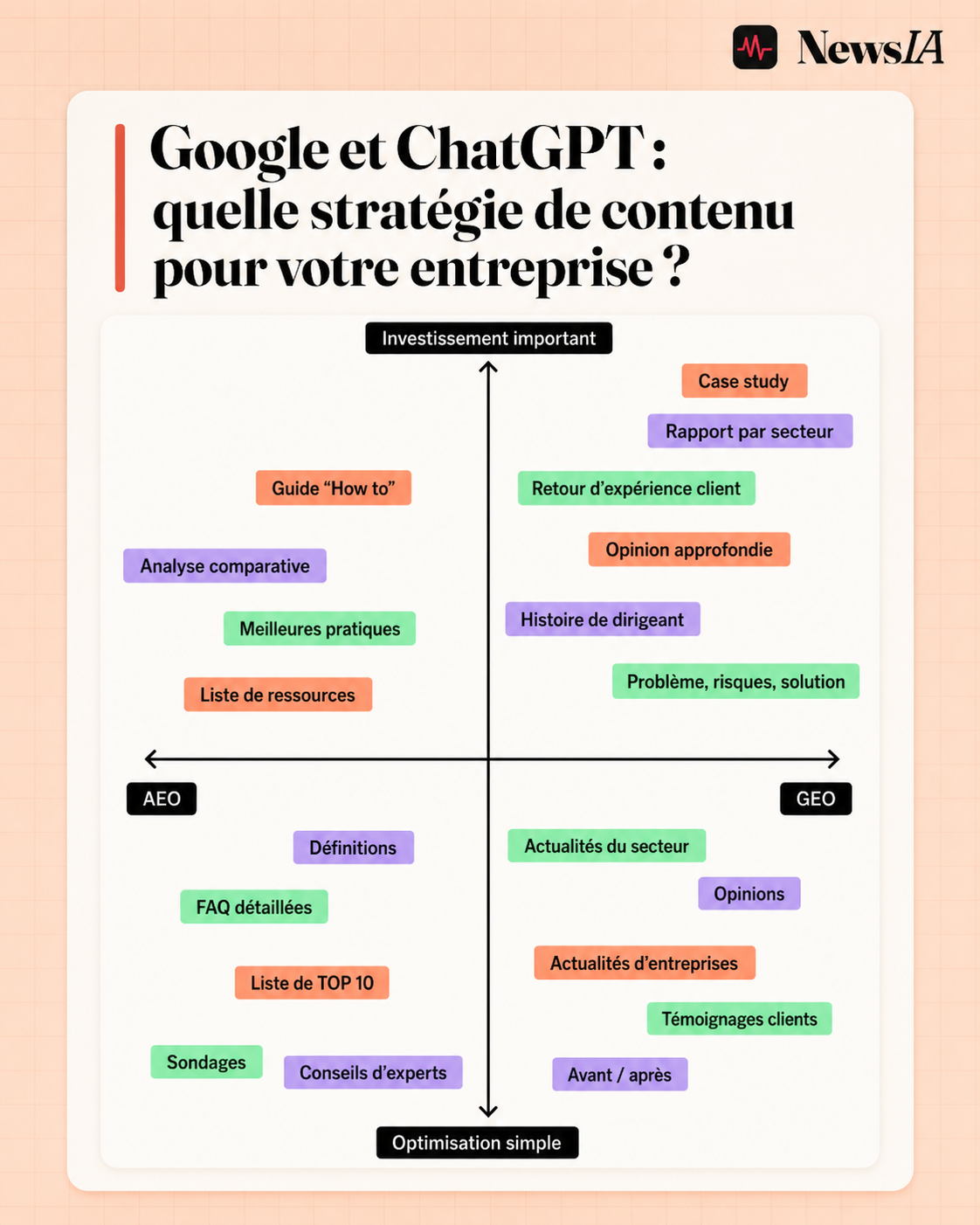
The right strategy is therefore not to choose between SEO and GEO, but to stack the second on top of the first. Stay a good student of Google: this is the condition to become visible to ChatGPT. Most of your SEO projects already serve, without additional effort, your AI visibility.
| What you already do in SEO | What it brings to GEO |
|---|---|
| Publish feature articles | Rich and quotable material for AI |
| Take care of tags and structure | Bot-readable content in templates |
| Obtain quality backlinks | Strengthened entity credibility |
| Collect customer reviews | Taken into account in the recommendations |
| Update your content | AIs favor fresh sources |
To dig deeper into the search engine landscape, our comparison of Perplexity, Gemini Search and ChatGPT Search shows how each cites their sources differently, which changes your priorities depending on your audience.
Zero-click: should we really worry about it?
It’s the fear of the moment. “Zero-click” refers to a search where the Internet user obtains his answer directly on the page, without visiting any site. The phenomenon is massive: according to industry studies, a majority of Google searches end without a click, and the proportion is still increasing on mobile. When an AI summary is displayed at the top, the click-through rate to traditional results drops sharply.
Two notions are then opposed, and they must be distinguished.
Your clicks are dropping
- Audience report shows fewer organic visits
- Some pages lose traffic after the arrival of AI summaries
- Natural reflex: conclude that visibility is collapsing
Your impressions explode
- Your brand is mentioned much more often, even without a click
- You gain entity notoriety, the fuel of GEO
- The visitor who clicks despite everything has already sorted
Impression is the number of times you are displayed or cited: your raw visibility. The click is the actual visit. With AI summaries, your impressions can climb while your clicks fall. Worrying at first glance, until you look at the right number.
The AI traffic paradox: fewer visitors, more customers
It’s not impressions or clicks that matter to your business, it’s the number of qualified leads. And this is where GEO turns the tables.
Studies converge: a visitor arriving via AI converts up to 4.4 times better than a visitor from traditional search. The reason is clear. Before clicking, he has already spoken with the model: he asked his questions, compared options, refined his needs. When it lands on your site, the discovery and comparison phases are behind it. He is no longer a curious person, he is an approaching buyer.
The right reflex. Stop judging your performance by traffic volume alone. Track the number of contact requests, quotes and leads. A visitor who discussed his project for ten minutes with ChatGPT before arriving at your home is worth ten curious visitors.
Traffic from AI assistants to commercial sites has also jumped by several hundred percent between 2024 and 2025. Fewer clicks, perhaps, but each one weighs more. The true indicator of success is not traffic, it’s leads.
Making your business visible in ChatGPT: the action plan

Enough theory. Here are the five levers to activate, in order, to exist in AI responses.
Step 1
Map the real questions
List what your customers really ask for, in natural language. Think questions, not keywords: “how to make a quote with AI?” » beats “quotation software” to be cited.
IntentionNatural language
Step 2
Post complete responses
Clear, structured and exhaustive content is much more likely to be used than a generic services page. One question, one page, one clear answer.
ContentDepth
Step 3
Expand your offsite presence
The AI also reads LinkedIn, your Google reviews, the press, YouTube, directories. The more your brand is mentioned on varied and credible sources, the more it becomes a reference in their eyes.
EntityFame
Step 4
Structure for machine reading
Hierarchical titles, lists, tables, question-and-answer sections, schema.org structured data (FAQPage, Organization). The more readable it is, the more easily the AI extracts and cites.
TechnicalSchema.org
Step 5
Measure the right indicators
Track your AI citations and leads, not just your clicks. Build your brand as an entity: this is the most underestimated and sustainable lever.
MeasureLeads
Test your AI visibility in 10 minutes

Before any action plan, take the test yourself. Open ChatGPT, Perplexity, or compare multiple models, and ask the questions a customer would ask.
- “Which service provider do you recommend for [votre métier] In [votre ville] ? »
- “How to choose a solution for [le problème que vous résolvez] ? »
- “Who are the best experts in [votre spécialité] ? »
If your business never appears, that’s the signal to act. If it appears, you have a base to consolidate. Note which sources the AI cites for you: these are your visibility competitors, and the grid of what you still have to produce. To get started without a budget, you can even test these queries with the best free AIs of 2026.
First honest reflex: there is no Search Console for ChatGPT yet. But you can manage your AI visibility with three complementary methods.
- The regular manual test. Ask the same questions from your industry every month to ChatGPT, Perplexity and Gemini. Note if you are cited, where, and what sources appear in your place. It’s your basic barometer, free and immediate.
- Tracking referral traffic. In Google Analytics 4, isolate sources like chatgpt.com, perplexity.ai or gemini.google.com. This traffic, still modest in volume, is by far the most qualified.
- Impressions of Google AI summaries. When an AI Overview is displayed, your impressions go up even without a click. Monitor queries in Search Console where your impressions climb while the CTR drops: this is a sign that you are already feeding AI responses.
On the technical side, the markup that most helps an AI extract and cite your content remains the schema.org FAQPage. Here is the minimum structure to place on your Q&A pages:
{
  "@context": "https://schema.org",
  "@type": "FAQPage",
  "mainEntity": [{
    "@type": "Question",
    "name": "Votre question exacte ?",
    "acceptedAnswer": {
      "@type": "Answer",
      "text": "Une réponse claire, complète et autonome, lisible hors contexte."
    }
  }]
}
Golden rule: a stand-alone answer, which is understandable without the rest of the page, is much more likely to be taken up as is by an assistant.
To go further on all the schemas that make AI cite a brand, read our complete schema.org guide for GEO, which details the seven schemas that matter, copy-and-paste JSON-LD examples and the fatal errors to avoid. And to prepare your site for IDE agents and the next wave of AI indexing, see also our practical guide LLMs.txt 2026. Complete sector case: our GEO guide for hotels and restaurants, with detailed Hotel and Restaurant diagrams, role of reviews and 30-60-90 day action plan.
What to remember
The research landscape is splitting. Google remains essential, and your SEO must remain solid. But ignoring ChatGPT’s hundreds of millions of weekly users and the rise of other assistants would be like ignoring the arrival of Google in the early 2000s.
GEO does not erase SEO: it adds a layer of visibility on top. Companies that position themselves there now, while the majority of their competitors have not moved, will take a lead that will be difficult to catch up with. As for zero-click, it is not a threat but a disguised opportunity: fewer curious visitors, more prospects educated and ready to decide. Exactly the traffic every leader should be aiming for.
French case studies well cited by LLMLarge Language Model, a language model trained on billions of parameters to generate and understand text. Today : Mistral AI (massive visibility thanks to a strategy open sourceSoftware whose source code, and sometimes the model weights, are freely published and reusable. + global tech press), Hugging Face (mentioned as a reference platform in almost all ChatGPT responses on open source models), and Owkin (topical health AI authority built via scientific publications + hospital partnerships). Three concrete GEO lessons to reverse-engineer.
The right tools to go faster: our comparison of the best SEO tools 2026 reviews Semrush, Ahrefs, SE Ranking and the new visibility tracking tools in AI.