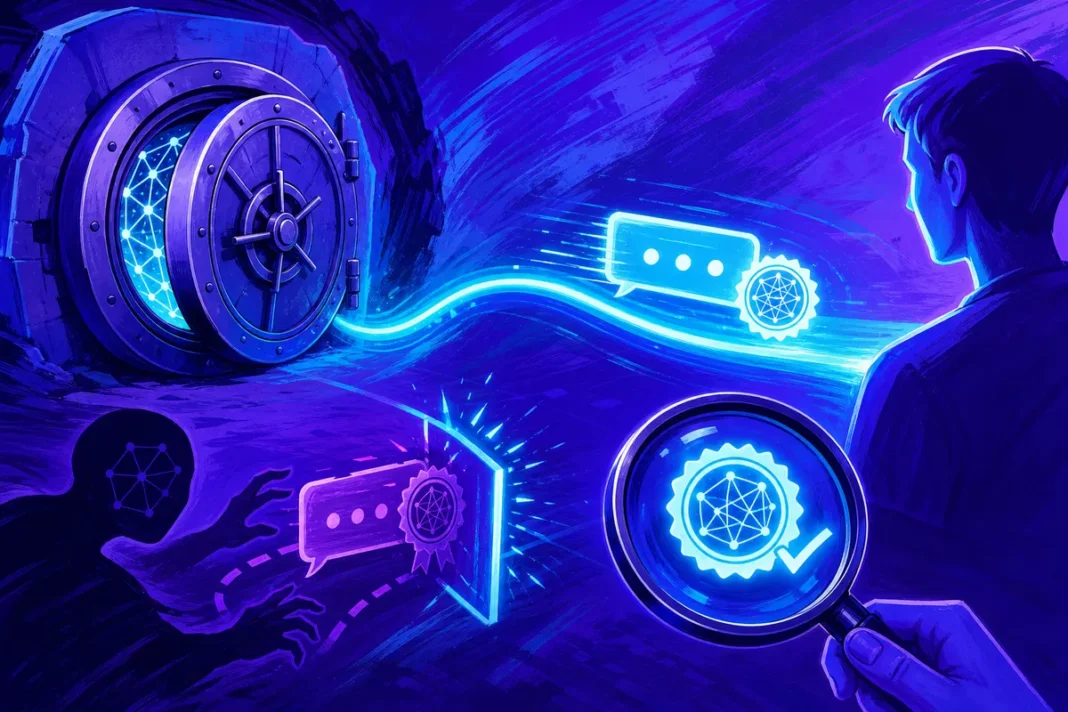
When we query an AI assistant, we trust the provider to use the advertised model. But nothing guarantees this: an intermediary service could substitute a cheaper model to reduce costs, or a hacker could modify the responses along the way. THE November 2, 2026Anthropic published FlashProvea research prototype which makes it possible to prove, thanks to cryptography, that a response was indeed produced by a given model, without revealing its secrets. A technical advance that could be of use to both users and regulators.
The problem: There is no proof which model responded
Anthropic starts with a simple comparison. When you talk to a friend in person, you have many ways to know that it’s really them. Faced with an AI model, we have almost none. Judging by the quality of the response alone is not enough.
The company cites several situations where a warranty would be useful:
- THE independent assessors who test a model before and after its release must be sure that the model tested is indeed the one that is served to users;
- THE customers who go through an intermediary service, a router which distributes requests to several providers, want the assurance of obtaining the model they are paying for;
- in case ofattackan attacker who modifies the response flow by impersonating a template cannot be detected from text alone.
The difficulty is twofold. The weights of the state-of-the-art models, i.e. the parameters that define them, are secret. And even knowing them, checking an answer would require running the model again, which requires resources beyond the reach of an ordinary user.
The solution: zero-disclosure proof
FlashProve builds on a family of cryptographic tools called zkSNARK. The principle: the supplier attaches to each response a short evidenceof a few megabytes, which the user can quickly check. If the response does not come from the advertised model, the check fails. The proof is said to zero disclosure of knowledge: it reveals nothing about the weights of the model.
Concretely, the supplier first publicly commits to a specific model, then demonstrates for each response that it was produced by this model. According to Anthropic, Claude contributed significantly to the design of the system, finding new ways to apply recent cryptographic tools.
Performance still expensive
Anthropic tested FlashProve on Llama 4 Maverick, a 400 billion parameter open Meta model. The results announced:
| Indicator | Result |
|---|---|
| Speed of production of evidence | Around 110 tokens per second on a single H100 chip |
| Proof size | About 19 megabytes for a request of 1024 tokens |
| Computational overhead | 70 to 95 times the calculation time needed to run the model |
This overhead remains high, but Anthropic claims that existing free systems were orders of magnitude slower. Producing evidence for each response from a general public service is therefore not yet possible on a large scale, but the gap is narrowing.
Formally verified guarantees
To prevent an error from slipping into such a complex system, Anthropic accompanied the prototype with formal proofs written in Lean, a language that allows you to mathematically verify the accuracy of reasoning. The company recognizes that Claude is very good at optimizing, but sometimes makes decisions that are difficult to evaluate: these formal proofs make it possible to audit the claimed security guarantees.
Anthropic publishes five elements: a presentation post, a technical report, a protocol specification written by Claude, the executable code with a proof generator and two checkers, as well as the formal proofs. Everything is broadcast under the Apache 2.0 free license. The project brings together researchers from Anthropic and several institutions, including the École Polytechnique Fédérale de Lausanne and MIT.
What could this be used for?
Anthropic describes several possible uses:
- Controlling the pace of AI development: a regulator could verify that a supplier is using its equipment to serve a declared model, and not to secretly train a more powerful model, even if this does not prove the absence of parallel training.
- Detect tampering: a client could spot that a response has been modified by an attacker.
- Prove the provenance of a text: a company could demonstrate that an analysis has been carried out by a specialized model, for example a security audit.
- Guarantee the use of authorized models: if a regulation requires only serving models deemed safe, proof could attest to this for each response.
These applications meet the concerns of regulators, who are looking for ways to verify suppliers’ commitments, at a time when the European regulation on AI imposes obligations on suppliers of large models.
Software or hardware: two complementary approaches
FlashProve is not the only way to verify the origin of a response. Many works are based on trusted execution environmentsprotected areas integrated into processors, which attest that a calculation has taken place as expected. Their security relies on the manufacturer’s ability to produce tamper-proof equipment.
Anthropic’s approach is purely software: its security relies on the difficulty of certain mathematical problems. Even if a vendor’s hardware, operating system, or infrastructure were compromised, an attacker would not be able to produce a valid proof for a false answer without solving a problem deemed impossible to compute. Anthropic believes that the two approaches, hardware and cryptographic, offer different guarantees and will each have their role.
What this could change for users
Ultimately, this type of proof could appear in services that provide access to multiple models, where the user chooses a model without being able to verify that it is actually served. A verification indicator, comparable to the padlock on secure sites, could signal that a response is accompanied by valid proof. Companies that pay for a high-end model would then be guaranteed not to receive responses from a less expensive model.
The limits of the prototype
Anthropic presents FlashProve as a intermediate workshared for others to improve. Several limitations are recognized: there is no guarantee that the fast code, the report and the formal proofs match perfectly; the proof concerns an integer version of the model and a deterministic generation mode, whereas real services often use floating point calculations and an element of chance in the choice of words; and the system assumes a precise architecture, known as a mixture of experts. Hiding the model architecture is not one of the objectives.
For users, the promise remains distant. But the approach opens an interesting path for AI transparency: moving from declared trust to verifiable trust. It also illustrates how AI models are now contributing to research themselves, a subject on which Anthropic has just published a warning in its stock prospectus.