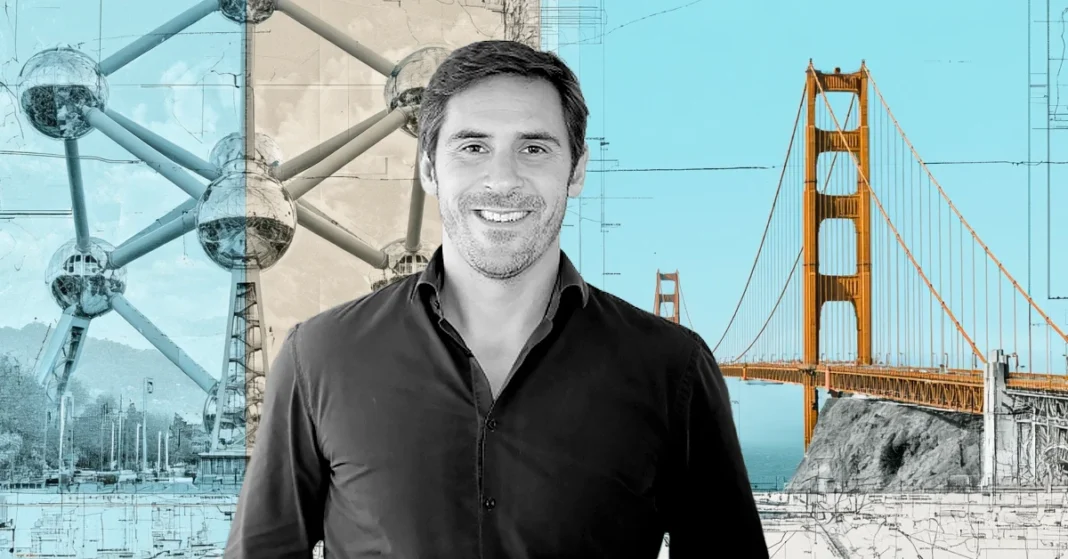
Thibaud Elzière wants to make Brussels a stronghold of European tech
At a time when the European tech spotlight traditionally turns towards Paris, London or Berlin, a new voice is rising to redraw the map of innovation: that of Thibaud Elzière. A key figure in French entrepreneurship — co-founder of renowned start-up studios like eFounders (now Hexa) and Fotolia — the entrepreneur set up shop in Brussels. With a clear and bold ambition: to transform the Belgian capital into an essential technological hub in Europe.
Brussels: the new El Dorado for entrepreneurs?
What pushes a serial entrepreneur to leave the bustle of Paris for Brussels? For Thibaud Elzière, the answer lies in a clever mix of quality of life, accessibility and underestimated dynamism.
Long perceived as the administrative capital of the European Union, Brussels suffered from a lack of image in the tech ecosystem. However, the city is full of assets: a multicultural and highly qualified population, a cost of living and business real estate that is often more accessible than in Paris or London, and a central geographical position.
Elzière does not just observe it: he proves it in action. By settling permanently in the Belgian metropolis, he is actively participating in the emergence of an uninhibited, ambitious and internationally oriented local tech community.
The Start-up Studios approach: replicating the magic recipe
The spearhead of this Brussels ambition is the model of start-up studio. With Hexa (formerly eFounders), Elzière has perfected an industrial method of creating companies: identifying B2B needs, designing software solutions (SaaS), recruiting the right founders and financing the first months.
By instilling this dynamic in Brussels, he hopes to reproduce the success encountered in Paris. Structures inspired by this model are emerging, promoting collective emulation. The goal? Do not wait for unicorns to be born by chance, but manufacture them on an assembly line, relying on local and international talents attracted by the “Elzière model”.
A booming ecosystem
Elzière’s vision is part of a broader movement. In recent years, Brussels has seen the emergence of an ecosystem of venture capital (VC) funds, accelerators and coworking spaces that are revitalizing the city. Tech figures and investors are starting to see it as a credible and refreshing alternative to saturated metropolises.
However, the challenge remains significant. To compete with established giants, Brussels must further strengthen its international visibility, attract more foreign capital and simplify certain administrative procedures. This is where Thibaud Elzière’s role as ambassador takes on its full meaning: his voice carries, his address book is international, and his credibility attracts attention (and investors) to Belgium.
Towards a decentralized European tech
Beyond the Belgian ambition, Thibaud Elzière’s approach raises a fundamental question for the future of tech on the Old Continent: should Europe concentrate its forces in two or three megacities, or focus on decentralization?
By wanting to make Brussels a stronghold of tech, Elzière is betting on the second option. It demonstrates that it is possible to build global businesses from ecosystems on a human scale. If its bet succeeds, Brussels could well become the symbol of a more diverse, more interconnected and resolutely conquering European tech.
Here is a rewritten, modern and fluid version of your content, optimized for the web and online reading:
Brussels must become the capital of European tech: the audacious bet of Thibaud Elzièره
The co-founder of HEXA wants to position Brussels on the European tech map. With his new project, WAT, he intends to attract international entrepreneurs and provide the Belgian capital with an ecosystem that matches its political weight.
While the European Parliament and the Commission sit a few metro stations apart, Thibaud Elzière wants to add a new essential address: the one where European founders decide to launch their business.
WAT(GARAGE): a springboard for 200 entrepreneurs
The first stage of this project takes root in Ixelles, in a former Renault garage located between the ULB and the VUB. This is where WAT(GARAGE) is preparing to bring together 200 entrepreneurs for a period of one year.
For 50 euros per month per personthe place offers:
- A fixed office
- Logistical assistance with installation
- Direct access to a network of more than 40 investment funds (including references such as Accel, Balderton and Lightspeed)
- No capital participation
This garage serves as a launching pad while awaiting the opening, at the end of 2027, of a permanent 10,000 m² site set up in a former power station. At the same time, Thibaud Elzière is developing with HEXA EUROPEXa project aimed at simplifying multi-country management (tax, finances, HR) for European startups.
A Brussels paradox: an economic heavyweight, a tech dwarf
The Brussels-Capital Region generated 103.3 billion euros of GDP in 2023 (more than 17% of the Belgian economy, according to IBSA). However, in StartupBlink’s 2026 global ranking, Brussels stagnates at the 75th placefar from London, Paris or Berlin.
Another anomaly: if the capital has more startups than Ghent, the cumulative value of Flemish companies is five times higher. A gap in dynamism that WAT intends to fill by creating solid bridges between local creators and the largest international funds.
Global inspirations and connections
Inspired by the historic success of Betagroup or Wintercircus in Ghent (the tech campus installed in a former circus), Thibaud Elzière’s vision goes beyond Belgian borders. At the beginning of the year, he opened a residence in San Francisco to connect his startup teams to the Silicon Valley ecosystem.
Political power at your fingertips
Unlike other technology hubs, Brussels offers a unique advantage: the immediate proximity of political decision-makers. This is where the European regulations governing the digital market are drawn up. A major strategic lever, still too little exploited by young start-ups, which WAT hopes to reactivate by connecting entrepreneurs to European authorities.
A long-standing love affair with Belgium
Originally from Aix-en-Provence, Thibaud Elzière moved to Belgium in the early 2000s. It was there that he launched Fotolia with Oleg Tscheltzoff, before co-founding the studio in 2011 with Quentin Nickmans. eFounders (now HEXA)which saw the birth of gems such as Front, Aircall and Spendesk.
An active investor in the local ecosystem, he notably supported the Brussels manufacturer of electric bicycles Cowboy from its start in 2018.
📌 WAT(GARAGE): In practice
- Applications: from November 23 to December 6, 2026
- Launch of the 1st cohort: January 18, 2027
- Place : Former Renault Plaine garage, Brussels
- Ability : 200 entrepreneurs (7 sectors targeted)
- Price: 50 € / month / person (without equity)