On November 20, 2026, an Anthropic mathematician announced that he and Claude had demonstrated the Riemann hypothesis, one of the most famous enigmas in mathematics. As soon as the announcement is made, eyes turn to P vs NP.
On November 20, 2026, a 4-page note shook the world of mathematics. Levent Alpöge, mathematician at Anthropic, claims to have demonstrated with Claude the Riemann hypothesis, the most famous enigma of the discipline, formulated in 1859. The proof lies in some 17 million lines of code written with the Lean proof assistant. The next day, the Lean and Mathlib communities confirmed that the code established the announced result. Several independent software programs controlled each step.
The reactions were not long in coming: on November 22, Alexandr Wang, director of AI at Meta, published a text on X with the straightforward title: “ Superintelligence is coming “. According to him, many physicists would consider that developing the atomic bomb was almost “homework” in comparison. But his text is above all a warning: the coming year will be decisive, and society must not “ hand over » to AI.
On the mathematics side, however, the story has only just begun. The proof has been verified by computer, but understanding the ideas is another project. At the University of Waterloo, mathematician Michael Rubinstein asked three AI models to reconstruct reasoning from code: their working paper still only explains part of it. The Clay Institute, which pledges a million dollars, still classifies the hypothesis as an open problem.
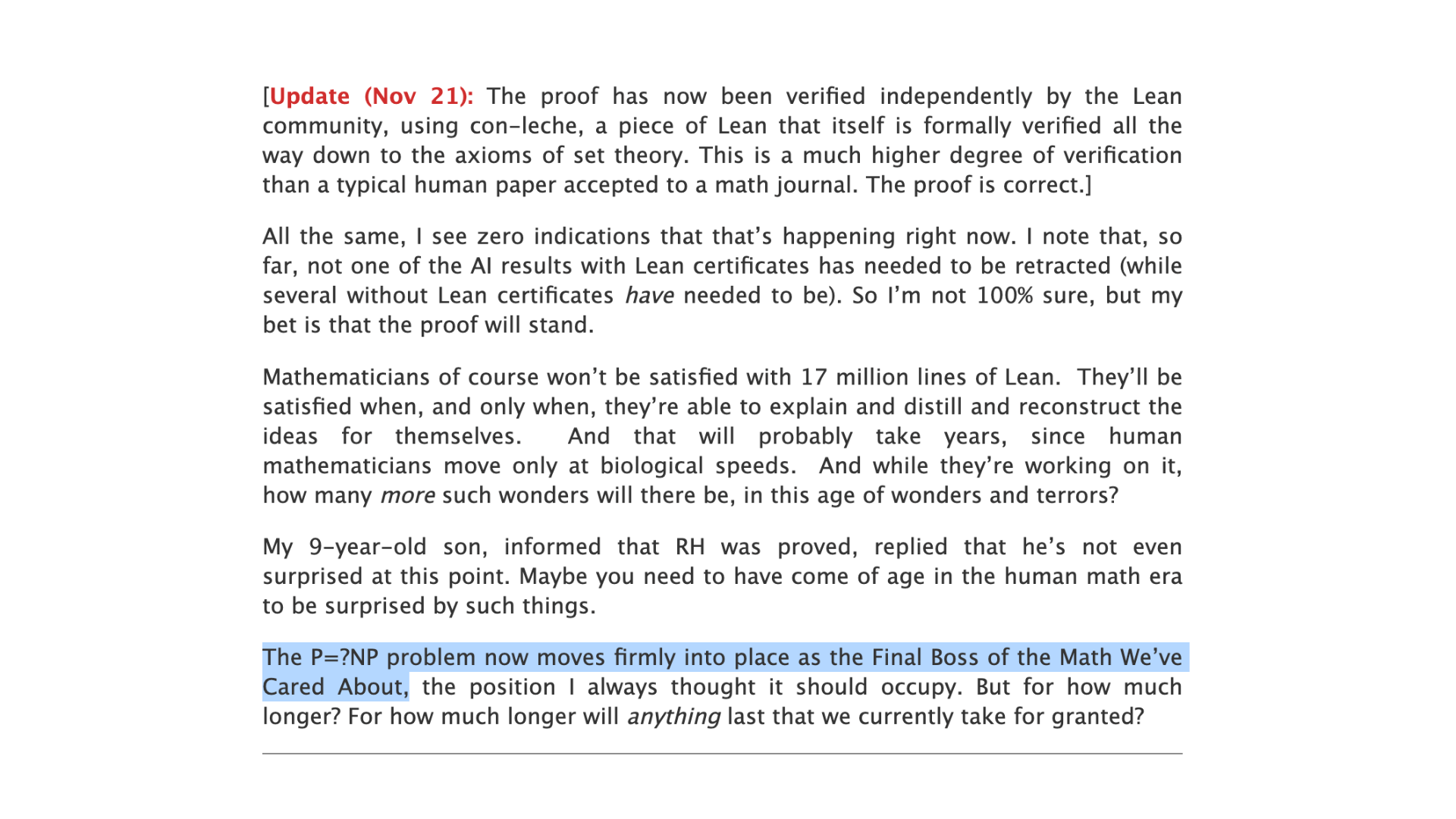
Meanwhile, others are already aiming for the next target. On his blog, on November 20, researcher Scott Aaronson makes P vs NP the “ final boss » big mathematical questions.

Black Friday: Proton Pass Plus at -60%
Until November 30, Proton Pass Plus is €1.99 per month for 12 months, or 60% off! Unlimited email address aliases to take advantage of promotional codes without filling your mailbox, unique password per site, encrypted safe. In short, a stress-free Black Friday!
P vs NP, a question that directly concerns machines
Independently formulated by Stephen Cook and Leonid Levin in the early 1970s, P vs NP is also one of the 7 problems of the millennium. Take a sudoku: checking a filled grid is quick, finding the solution can take much longer. Now imagine bigger and bigger grids. Is there a method that allows a computer to solve them quickly, regardless of their size? In computer science, quickly » has a precise meaning: the calculation time remains limited by a fixed power of the size of the problem. We talk about “ polynomial time “. P groups together the problems that a computer can solve within this time, NP those for which it can verify a solution within this time. Are these two families actually the same?
Unlike Riemann, P vs NP is a question of pure computer science, about how long a computer needs to solve a problem. For laboratories that build machines that reason, it’s playing at home. And the issue is very concrete: a good part of cryptography is based on problems that are easy to verify but hard to solve. If P = NP, with an algorithm usable in practice, this foundation would wobble.
OpenAI does not hide its ambitions: on September 1, 2026, the company launched an evaluation of its model on all the still open millennium problems, P vs NP included, before focusing its efforts on Navier-Stokes, for which it claimed a solution on September 8.
A first lock would have already been broken
What really fuels the speculation has passed more quietly. At the end of October, OpenAI, then Anthropic, each announced that they had faulted the “ exponential time hypothesis » (ETH), formulated in 1999. It concerns 3-SAT, an emblematic problem of the NP class: determining whether a series of logical constraints can be satisfied at the same time, each relating to at most three variables.
According to this hypothesis, even the best algorithm would need, in the worst case, a time which increases exponentially with the number of variables. The two laboratories say they have each found an algorithm that passes below this threshold. The authors of the hypothesis are coordinating, with Ryan Williams of MIT, the independent review of this work, which is still ongoing.
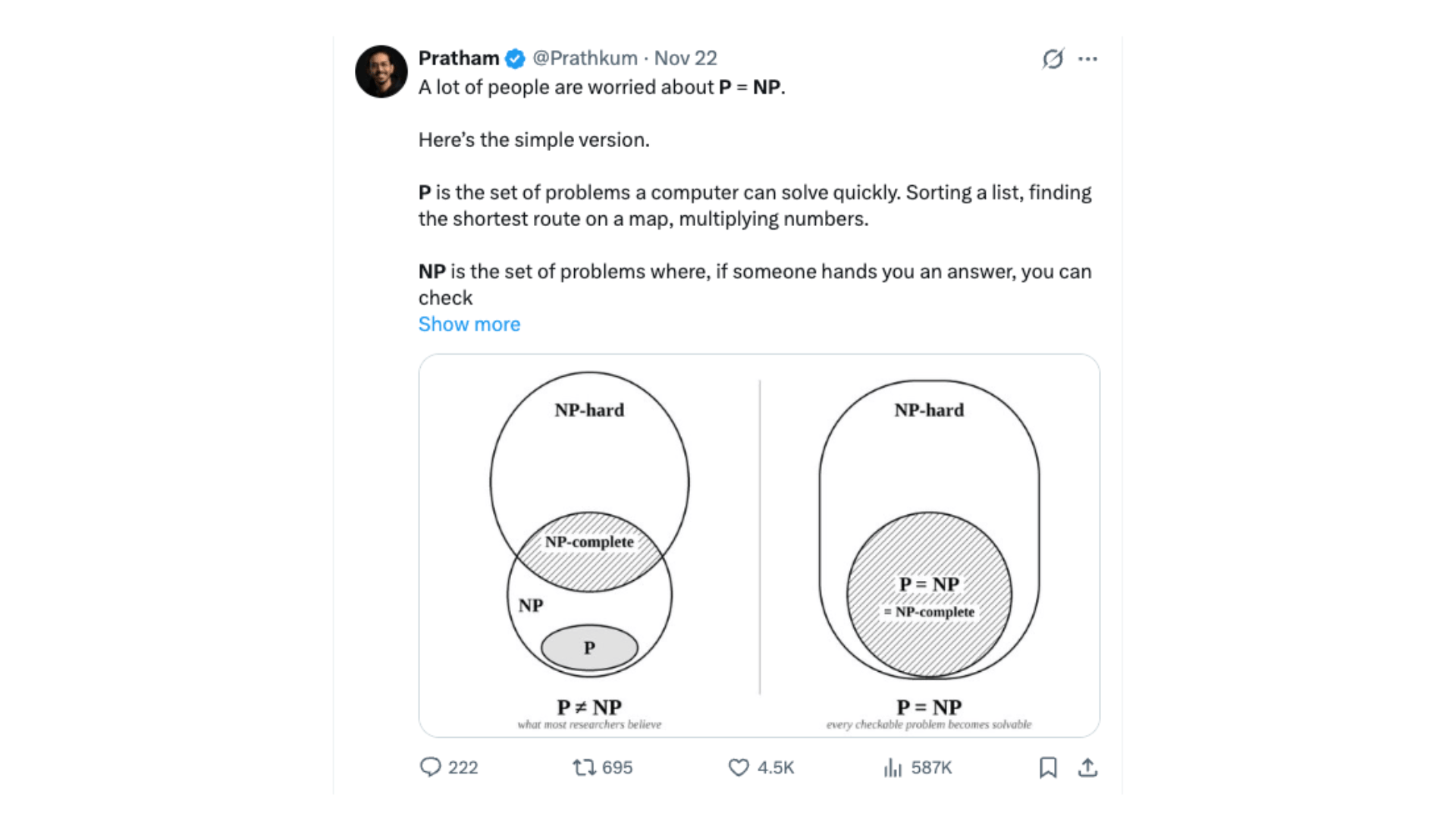
Even if these results are confirmed, the P vs NP question will remain open. For 3-SAT, the two teams announce a calculation time “ subexponential “. Demonstrating that the same algorithm can solve all cases of 3-SAT in polynomial time would prove that P = NP. At this stage, neither team claims such a result.
The two laboratories would still have shown that their models found algorithms whose existence was excluded by a nearly 30-year-old hypothesis. Enough to raise a question: how far can AI go in the search for faster algorithms?
Emanuele Viola, specialist in complexity, has defended at least since 2018 a very minority conviction: P = NP. In a post from Communications of the ACMpublished on his blog on November 17, he explains that these results confirm his idea. According to him, researchers have often underestimated what efficient algorithms can accomplish.
In a survey published in 2019 by William Gasarch, 88% of 124 respondents leaned towards P ≠ NP. If Emanuele Viola is right, an AI could one day find an algorithm that solves all cases of 3-SAT in polynomial time and prove that it delivers on that promise. If the majority is correct, this algorithm does not exist. It still needs to be demonstrated.
All the tech news at a glance
Add Numerama to your home screen and stay connected to the future!