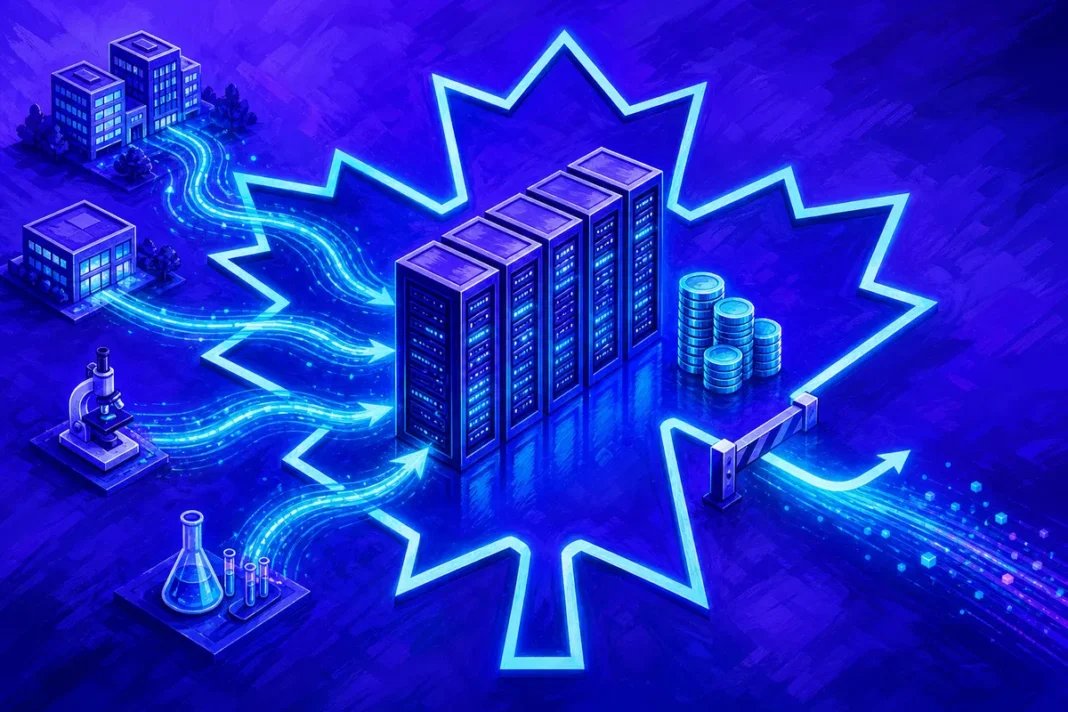
Training an AI model requires computing power, and it’s expensive. THE November 26, 2026the Canadian government announced in Toronto the addition of 700 million Canadian dollars to his Computing Access Fund for AIbringing its total envelope to a billion. Special feature of this system: the money does not finance the purchase of machines, but the payment of calculation invoices, on one strict condition, that the servers are located in Canada.
A fund that pays bills, not machines
The fund, created in December 2024 with an initial endowment of 300 million Canadian dollars, is aimed at small and medium businesses Canadian companies that develop AI products or services. It reimburses part of their cloud computing service contracts: model training, inference, i.e. the use of an already trained model, and refinement.
| Device element | Detail |
|---|---|
| New envelope | 700 million Canadian dollars, for a total of one billion |
| Target beneficiaries | Canadian businesses with fewer than 500 full-time equivalent employees |
| Covered expenses | Cloud computing contracts, from 100,000 to 5 million Canadian dollars |
| Support rate | Up to 80% with a sovereign supplier, up to 50% with a Canadian-based supplier |
| Project deadlines | March 31, 2030 |
The eligibility conditions are specific: be registered in Canada, have research and development teams in the country, present a marketing plan and demonstrate income or investor interest. An exception is provided for unincorporated Indigenous businesses that are at least 51% Indigenous-owned. Only one application is accepted per business number.
The clause that counts: the calculation must remain in Canada
This is the heart of the device. Beneficiaries must resort to Canadian computing service providersdefined by criteria and not by a list of names: the company must be incorporated in Canada, operate an infrastructure located in CanadaAnd process and store data in Canada. A Canadian subsidiary of an international group may therefore be eligible, provided that the infrastructure and data do not leave the country.
The support rate further favors so-called suppliers sovereignsowned by Canadian interests and whose governance is in Canada: up to 80% of the costs covered, compared to 50% for other suppliers established in the country.
The Canadian Minister of Artificial Intelligence and Digital Innovation, Evan Solomonsummarizes the logic in a formula: “Canadian ideas need Canadian computing power. » He adds that encouraging the use of domestic suppliers creates the demand that supports investment in infrastructure owned, operated and governed in Canada.
What the fund finances, and what it does not finance
Covered expenses
- Cloud computing contracts for training and inference
- Storage and Compute Licensing
- Operational Monitoring and Computing Security
- Data migration to a sovereign provider
Outside the device
- Buying chips or building data centers
- Computing hosted outside of Canada
- Companies with 500 or more employees
- Projects without a marketing plan
Why calculation is an obstacle for start-ups
To understand the benefit of the system, we must measure what this expense represents. Training or refining a model uses graphics processors rented by the hour for days, sometimes weeks. A young company that wants to adapt a model to its field, medical imaging or contract analysis for example, faces an invoice that arrives before the first revenues.
This is precisely the period that the fund is targeting: the one where the technology works but where the company cannot yet pay for its scaling up. By covering up to 80% of the bill, the State lowers the entry barrier without replacing the market.
A first assessment, and a call for health projects
The government published, on the same day, the list of 45 companies supported during the initial phase, for more 52 million Canadian dollars. With previous commitments, the fund totals more than 118 million for 89 companiesspread across the country, from Toronto to Vancouver via Montreal, Ottawa and Calgary, and in various sectors: health, finance, professional services, industry, agriculture, mining.
The new call for projects primarily targets health and life sciences. The choice of this sector is not neutral: health concentrates both significant computing needs and strong requirements for data localization, two reasons which justify public support. The timetable is tight: a declaration of interest is expected before December 17, 2026and the complete files, upon invitation, before the January 4, 2027. Funding decisions are announced within 90 business days of closing and are final. Support takes the form of a contribution which may be non-refundable, repayable or repayable under conditions, depending on the evaluation of the file.
What Canada is looking to build
This fund is part of a broader strategy. The government presents it as one of the means of expanding access to sovereign computing, in support of a budgetary commitment aimed at putting into service 500 megawatts of sovereign computing capacity. He suggests that the adoption of AI could contribute up to 200 billion Canadian dollars in growth by 2034 and help create up to 250,000 jobs by 2031. These projections come from the government itself and are based on adoption assumptions that it does not detail in its press release.
The approach extends other initiatives, including the entry of the Canadian state into the capital of the AI company Cohere for 1.6 billion Canadian dollars at the end of October 2026. It contrasts with the European approach, more focused on calls for research projects like those of Horizon Europe and on the construction of shared AI factories.
A strategy that has its limits
The interest of the mechanism lies in its dual action: it helps companies pay for an expense item that is holding them back, while guaranteeing a backlog of orders for national hosts. Public money thus simultaneously supports demand and supply.
Its limits are just as visible. The fund does not build data centers or finance chips: it subsidizes the use of infrastructure that must already exist, and Canada has much less than its southern neighbor, where the largest sites are concentrated. The obligation to host in the country can also increase costs or restrict the technical choice of companies, particularly when specialized capacities are lacking. Finally, support of up to 5 million Canadian dollars in computing expenses remains modest compared to the budgets of the major players in the sector.
For French and European companies, experience is especially valuable as a point of comparison. It shows that a State can direct the demand for computing towards its own infrastructures without prohibiting anything, simply through the use of subsidy rates. The result will be measured by a simple question: in three years, will Canadian start-ups have found the capacity they need locally?
Frequently asked questions
What is the Canada AI Computing Access Fund?
Created in December 2024 with 300 million Canadian dollars, it helps Canadian companies pay their bills for computing power for artificial intelligence. The government added 700 million on November 26, 2026, bringing the total to one billion. These are contributions paid on cloud computing contracts, not the purchase of hardware.
Who can benefit from it and under what conditions?
Companies registered in Canada, with fewer than 500 full-time equivalent employees, with research teams in the country and a commercialization plan. Nonprofit organizations and certain educational institutions may also be eligible. Computational costs presented must be between 100,000 and 5 million Canadian dollars.
Why does the calculation need to be hosted in Canada?
The government wants the data and processing of Canadian companies to remain on national territory, and to create demand that supports investment in local infrastructure. Providers must be incorporated in Canada, operate their infrastructure, and process and store data there. The support rate is higher with a provider owned and governed in Canada.
What are the next deadlines for applying?
The new call for projects focuses on health and life sciences. An expression of interest must be filed by December 17, 2026 at 11:59 p.m. Eastern Time, and then invited applicants submit a complete package by January 4, 2027. The department aims for funding decisions within 90 business days of closing.
Sources
References consulted for the writing of this article. The addresses are provided for information purposes only and are not links.
- Government of Canada, $700 million expansion of the AI Computing Access Fund, November 26, 2026www.canada.ca/en/innovation-science-economic-development/news/2026/11/government-of-canada-boosts-the-ai-compute-access-fund-with-700-million-expansion.html
- Government of Canada, information document on the 45 companies supportedwww.canada.ca/en/innovation-science-economic-development/news/2026/11/backgrounder-government-of-canada-announces-support-for-45-canadian-companies-through-the-ai-compute-access-fund.html
- ISED Canada, AI Computing Access Fund Program Guideised-isde.canada.ca/site/ised/en/canadian-sovereign-ai-compute-strategy/ai-compute-access-fund/program-guide-ai-compute-access-fund
- ISED Canada, AI Computing Access Fund pageised-isde.canada.ca/site/ised/en/canadian-sovereign-ai-compute-strategy/ai-compute-access-fund
Report an error or inaccuracy in this article