Introduction
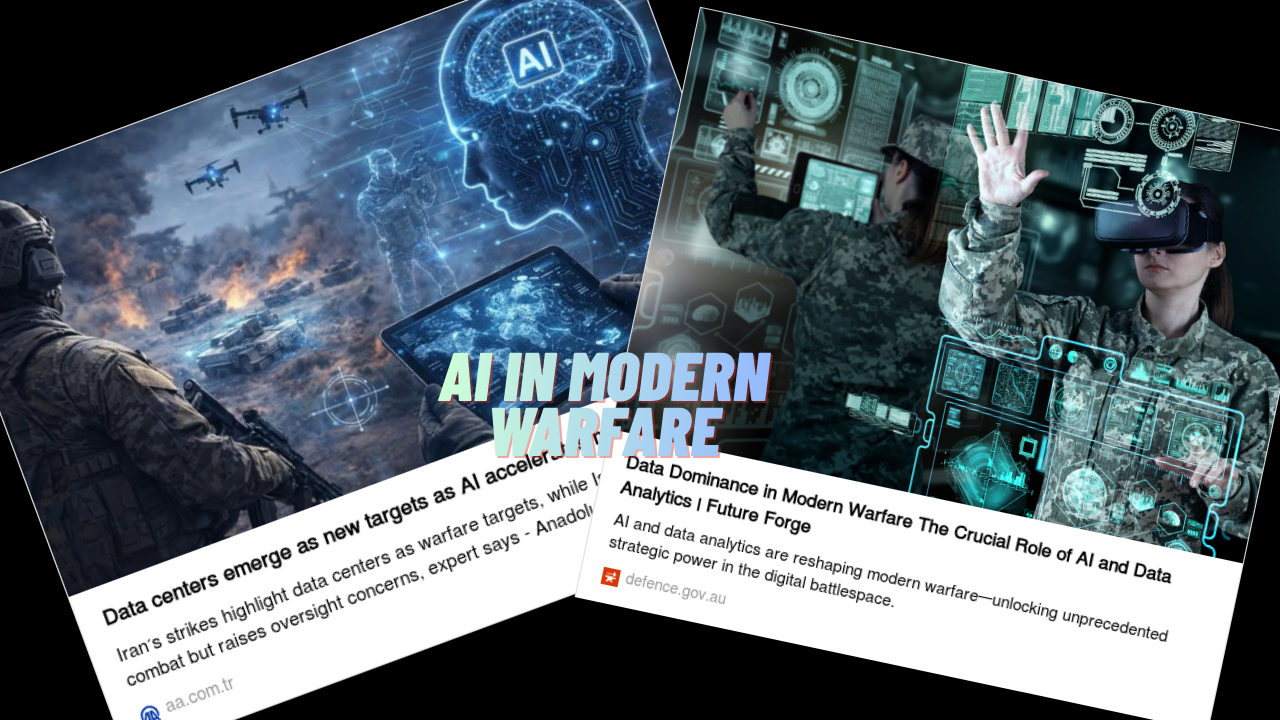
Artificial Intelligence (AI) is rapidly transforming modern warfare. From predictive maintenance of jets to autonomous surveillance swarms, militaries are exploring AI to boost speed, precision, and resilience. In this article, I unpack where AI is used today, how it changes decision-making, the ethical and legal landmines it reveals, and what safeguards we need next.
1. The Battlefield Stack: Where AI Shows Up
- Intelligence, Surveillance, and Reconnaissance (ISR):
- Automated target recognition from satellite, drone, and ground sensors
- Multi-sensor data fusion to spot patterns and anomalies faster than human analysts
- Real-time translation and transcription to accelerate SIGINT and HUMINT workflows
- Command and Control (C2):
- Decision-support systems that prioritize threats, suggest courses of action, and simulate outcomes
- Battlespace visualization with AI-assisted wargaming and red-teaming
- Autonomous and Semi-Autonomous Platforms:
- Unmanned aerial, surface, and underwater vehicles for reconnaissance, mine countermeasures, and logistics
- Loyal wingman drones that team with crewed aircraft under human-on-the-loop control
- Uncrewed ground vehicles (UGVs) for route clearance, perimeter security, and resupply
- Cyber and Electronic Warfare:
- Anomaly detection for network defense and rapid malware triage
- Adaptive jamming and spectrum management using reinforcement learning
- Deception and honeypot orchestration powered by generative models
- Logistics and Sustainment:
- Predictive maintenance on aircraft, ships, and armored vehicles to reduce downtime
- Intelligent routing for fuel, munitions, and humanitarian aid under contested conditions
- Supply chain risk scoring to flag counterfeit or compromised components
- Training and Simulation:
- AI-driven adversaries in virtual environments that learn from player behavior
- Digital twins for platforms and battle networks to rehearse missions and test upgrades
2. How AI Changes the Tempo: From Sensing to Deciding
- OODA Loop Acceleration: AI compresses Observe–Orient–Decide–Act cycles by filtering noise, ranking options, and automating routine tasks. I see its biggest impact in ISR triage and fires deconfliction.
- Human–Machine Teaming: Rather than replacing commanders, AI augments them—surfacing outliers, generating alternatives, and handling execution details under defined rules.
- From Deterministic to Probabilistic: AI thrives on probabilities; militaries must adapt doctrine to embrace uncertainty bands, confidence levels, and graceful degradation when data is denied.
3. The Hard Problems: Ethics, Law, and Accountability
- Meaningful Human Control: Ensure humans authorize target selection and lethal effects for any system capable of force, with clear fail-safes and abort options.
- Bias and Civilian Harm: Training data can skew detection; require rigorous validation across environments, adversaries, and demographics, plus post-strike assessments.
- Explainability and Auditability: Log model inputs, outputs, and overrides; design forensic trails that survive battlefield chaos.
- Compliance with International Humanitarian Law (IHL): Codify AI use so it upholds distinction, proportionality, and military necessity.
- Escalation Risks: Fast, opaque systems can misread intent. Build guardrails, confidence-building measures, and human-in-the-loop for crisis stability.
4. Case Snapshots (Non-Exhaustive)
- Counter-UAS Defense: AI classifies drones by signature and behavior, pairing sensors to shooters for rapid interception in urban skies.
- Maritime Swarms: Autonomous boats cooperate to screen harbors, map mines, and shadow high-value units while sharing sensor data.
- Artillery Fire Control: Computer vision helps spot launch flashes and impacts, cueing counter-battery fire with reduced sensor-to-shooter latency.
- Disaster Response in Conflict Zones: AI plans safe corridors, prioritizes medevac, and predicts infrastructure failure under fire.
5. Building Trustworthy Military AI
- Governance: Establish doctrine that defines roles, authorities, and red lines; adopt model cards and risk tiers by mission criticality.
- Testing and Evaluation: Use adversarial testing, red teaming, and scenario fuzzing; measure robustness to spoofing, jamming, and data drift.
- Safety Engineering: Layer safety interlocks, geofencing, and dynamic no-strike lists; require graceful failover to manual control.
- Data Stewardship: Curate datasets with provenance controls; simulate denied, deceptive, and degraded conditions.
- Interoperability: Align interfaces and metadata so coalition forces can share AI outputs securely and consistently.
6. The Road Ahead
- Edge AI: More autonomy at the tactical edge with low-power chips and on-device learning under intermittent comms.
- Generative AI: Faster mission planning, synthetic training data, and deception detection—but also new attack surfaces.
- Neuro-symbolic Approaches: Blending statistical learning with logical rules to improve reliability and explainability.
- Norms and Treaties: Expect more bilateral and multilateral efforts to bound autonomous weapons, transparency, and incident hotlines.
Conclusion
AI is already woven into the military toolkit, but its value depends on careful design, testing, and governance. I advocate a pragmatic path: accelerate applications that save lives and reduce miscalculation, while keeping humans responsible for force decisions. With that balance, we can harness AI’s speed without surrendering our judgment.
A Comparative Overview of National AI Capabilities: India, the United States, and Israel
Introduction
Artificial Intelligence (AI) has become a strategic backbone for national competitiveness, security, and economic growth. This concise paper presents a comparative overview of AI capabilities in three influential ecosystems: India, the United States, and Israel. I focus on talent pipelines, research and patents, startup and investment dynamics, public-sector adoption, infrastructure, and defense applications.
1. Talent and Education
- United States: The U.S. leads in top-tier AI education and research output, anchored by institutions like MIT, Stanford, CMU, and Berkeley. It attracts global PhD talent and retains a strong industry-academia loop through labs at Google, OpenAI, Meta, Microsoft, and NVIDIA.
- India: India supplies one of the world’s largest pools of software engineers and data scientists. Elite institutes (IITs, IISc, IIITs) and growing applied AI programs feed domestic startups and global tech centers. Upskilling platforms and government-backed skilling missions widen the base.
- Israel: Israel’s talent pipeline is bolstered by elite technical units from the Israel Defense Forces (e.g., Unit 8200) and strong university programs (Technion, Weizmann). The ecosystem emphasizes practical, security-oriented AI skills.
2. Research, Publications, and Patents
- United States: Dominant in state-of-the-art breakthroughs (foundation models, RLHF, scalable training). High citation impact and substantial corporate-authored research. Patenting is active across chips, model architectures, and applications.
- India: Rapidly growing publication volume in applied ML (vision, NLP for Indic languages, healthcare). Patents focus on sectoral solutions (fintech, agri-tech, health-tech) with rising contributions from public research labs and startups.
- Israel: Strong in cybersecurity AI, edge intelligence, and robotics. Notable output in anomaly detection, autonomous systems, and sensor fusion, often with dual-use civilian-defense applications.
3. Startup Ecosystems and Investment
- United States: The most mature AI startup market, spanning foundation model companies, AI infrastructure (chips, data platforms, MLOps), vertical AI (biotech, finance), and autonomy. Venture capital is deep; large exits and acquisitions are common.
- India: Vibrant, cost-efficient startups in healthcare, fintech, logistics, agritech, and vernacular AI. Global capability centers of multinationals accelerate knowledge transfer. Funding is improving, with a tilt toward applied AI and SaaS exports.
- Israel: Highly concentrated, defense- and security-adjacent innovation with rapid commercialization cycles. AI startups excel in cybersecurity, vision-based systems, drones, and medical imaging, attracting strong global VC interest.
4. Government Strategy and Public-Sector Adoption
- United States: Federal initiatives support foundational research, semiconductor leadership, responsible AI, and standards. State agencies and the DoD procure AI for logistics, intelligence, and autonomy, under evolving governance frameworks.
- India: National AI initiatives emphasize inclusive growth—language AI, agriculture, health, education, and digital public goods. Policy tools include sandboxes, data platforms, and skilling missions; states run pilots in governance, welfare delivery, and smart mobility.
- Israel: A national AI program prioritizes defense-readiness, industry R&D, and academic excellence, with streamlined tech transfer mechanisms. Public services adopt AI for smart cities, border security, and healthcare triage.
5. Compute, Data, and Infrastructure
- United States: Leads in hyperscale compute (NVIDIA, AMD hardware; AWS, Azure, Google Cloud) and custom AI accelerators. Access to massive datasets and data-center networks enables frontier model training.
- India: Expanding sovereign compute via national AI missions and cloud credits; widespread adoption of open-source tools. Large, diverse datasets in healthcare, agriculture, and e-governance support applied AI.
- Israel: Strong edge-compute and specialized hardware expertise, with secure, mission-critical deployments. Focus on data curation for high-sensitivity environments.
6. Defense and National Security
- United States: Advanced programs in intelligence analysis, autonomous systems, cyber defense, and command-and-control augmentation. Robust ethical and legal oversight remains a work in progress.
- India: Emphasis on surveillance, border management, UAVs, and decision support for disaster response. Indigenous development is rising through defense labs and private partnerships.
- Israel: Deep integration of AI into ISR (intelligence, surveillance, reconnaissance), missile defense, and precision targeting. Extensive experience with real-time, constrained-edge deployments.
7. Responsible AI and Regulation
- United States: Movement toward risk-based governance, algorithmic accountability, and sectoral rules; influential NIST frameworks guide industry best practices.
- India: Draft frameworks focus on safety, bias mitigation, and graded regulation to protect innovation while managing risks, with emphasis on language inclusion and public-good use cases.
- Israel: Pragmatic, security-aware approaches prioritize robustness, privacy, and export controls, often aligning with U.S. and EU partners.
Comparative Strengths and Gaps (Summary)
- United States: Strength—frontier research, compute, capital. Gap—governance fragmentation, workforce visa constraints, concentration risk.
- India: Strength—scale of talent, cost-efficiency, applied public-sector AI. Gap—frontier compute access, early-stage deep-tech funding, academia–industry integration.
- Israel: Strength—security-grade innovation, rapid commercialization, niche hardware/edge AI. Gap—domestic market size, compute scale, talent retention.
Outlook
I expect the U.S. to maintain frontier leadership, India to widen its applied AI footprint across public goods and SaaS, and Israel to deepen dual-use, mission-critical AI niches. Collaboration opportunities span multilingual foundation models, privacy-preserving analytics, semiconductor R&D, and safety benchmarks.