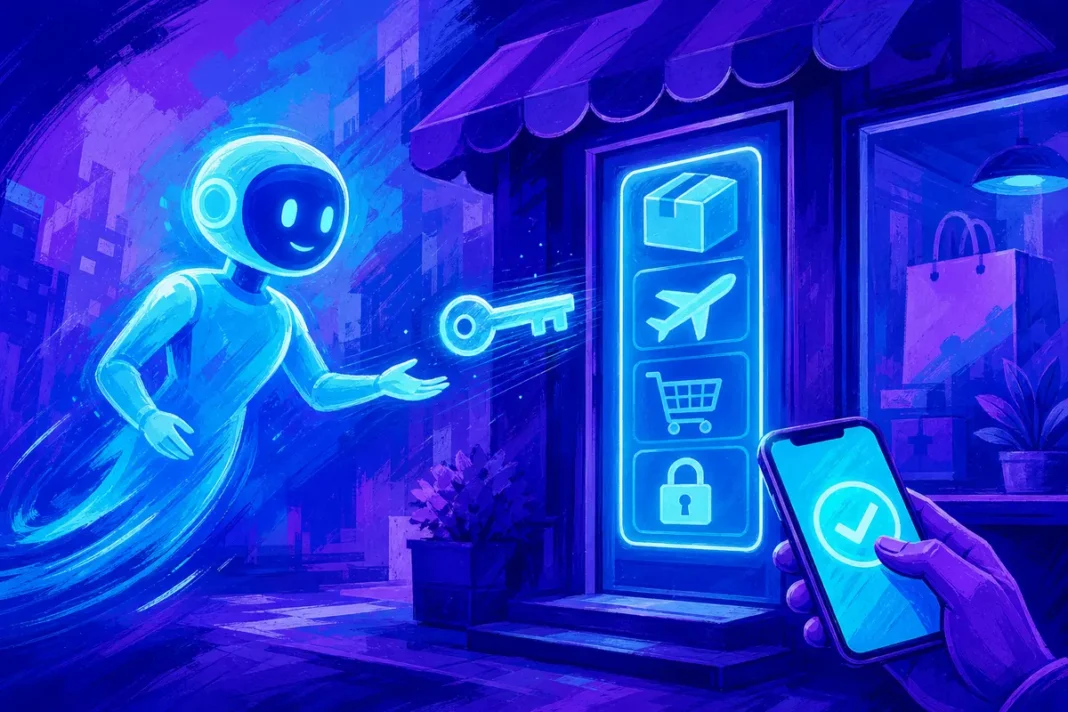
AI agents, these assistants capable of acting in their user’s place, face a very concrete problem: company sites were not designed for them. Should we block them, let them do it, or give them rules? The American start-up Sierra offers a response with Personal Agent Protocol version 1.0nicknamed Poppypublished in November 2026. This open standard allows a company to indicate to an agent who it represents and what it has the right to do. With two weight supports: Shopifywhich activated it for all its stores, and Metawhose agent Muse is now looking for it as a priority.
Instructions for use by agents
Until now, an AI agent who wanted to track an order or book a ticket often had to navigate a site designed for humans: click, fill out forms, guess where the information is. It’s slow, fragile, and companies don’t know who they’re dealing with.
Poppy changes the logic. The company publishes a file which describes, in a standard format, what an agent can do at home: view an order, check a price, book a flight, open a customer service request. The customer, for his part, connects with his usual identifiers and chooses what his agent can access. The company then knows in whose name the agent is acting, and within what limits.
Technically, Poppy relies on existing standards rather than inventing new ones: OAuththe authorization mechanism used when connecting to a service with a third-party account, OpenAPIwhich describes programming interfaces, and MCPthe protocol that has become the benchmark for connecting AI models to tools. The agent can thus go through the website, through the company’s programming interface or communicate directly with the company’s customer service agent.
A standard is only as good as its adoption. On this point, Poppy leaves with a rare lead:
- Shopify activated the protocol for all stores of its platform, present in more than 175 countries according to the Futurum firm. Merchants don’t have to do anything: each store automatically publishes its Poppy file. The protocol handles agent arrival and identification, while Shopify’s shopping system takes care of shopping cart and checkout;
- Meta made Poppy his agent’s first instinct Muse: on each site it visits, it first checks if the protocol is available.
Sierra also claims more than 100 partner companiesafter the arrival of 60 new ones when version 1.0 was released. Among them are Delta Air Lines, Hyatt, Intuit, Salesforce, Cisco, Twilio, Wayfair, Zoominsurers Aflac And Travelers or the cooperative bank Navy Federal Credit Union. Sierra also provides a free implementation kitwith a validation tool, so that any company can adopt the protocol alone.
First concrete uses
A few companies have already put Poppy into operation. They clearly illustrate the philosophy of the protocol: the agent can prepare and propose, but actions that involve money remain subject to validation.
| Business | Sector | What the agent can do |
|---|---|---|
| Mercury | Online banking for businesses | View balances and initiate payments, which remain subject to account approval rules |
| Turkish Airlines | Air transport | Check rates and find business class upgrades, which the customer approves before paying |
| Synchrony | Financial Services | Among the first operational partners |
| Shopify Stores | Online commerce | Support the purchase, with the obligation to request the customer’s agreement before certain actions |
It is this safeguard that distinguishes Poppy from simple automated access: the extension dedicated to commerce, co-written by Shopify, requires the agent to ask for customer consent before certain actions.
Why businesses need it
Faced with AI agents, many companies have so far chosen defense. Some airlines, such as United Airlines, block reservation agents, and banks refuse to allow an agent to log into accounts with customer credentials. The reasons are understandable: impossible to know if the agent is really acting for the account holder, risk of fraud, loss of direct relationship with the customer.
Poppy offers a third way between blocking and total opening: the company sets the rules itself. She decides on authorized actions, knows who is behind the agent and keeps control of sensitive operations. For Sierra, a specialist in customer service agents, the issue is also commercial: the more personal agents multiply, the more companies will need agents capable of responding to them. The company, managed by Bret Taylorformer co-CEO of Salesforce, would exceed $400 million in annual recurring revenueaccording to Futurum.
The limits of a still young standard
Despite its version 1.0 name, Poppy is not fixed. As The Next Web notes, the specification is still marked as a draft and authorizes modifications that could break existing installations. Companies that adopt it now therefore take the risk of having to adapt their integration.
The schedule was also very quick: announced on October 6, 2026published in draft form on October 9, the protocol was upgraded to version 1.0 approximately five weeks later, after tests carried out by the first partners. A speed that contrasts with that of traditional standardization organizations, but which leaves little perspective on security.
Finally, Poppy is not alone. Visa And MasterCard are developing their own systems to regulate purchases made by agents, and OpenAI has launched its own payment system with ChatGPT Wallet for Dots agents. Several standards could coexist, or compete, before a model becomes established.
And in France?
No announcement specifically concerns France. But activation by Shopify applies to all of its merchants, including French stores that use the platform. In practice, the effect for a French consumer will mainly depend on the availability of AI agents capable of using the protocol, such as Muse, in their country.
Towards a web with two audiences
Poppy illustrates a fundamental transformation: online sites and services will soon have to address two audiences, humans and the agents who act on their behalf. The question is no longer whether AI agents will make purchases, book trips or contact customer services, but according to what rules. By proposing that companies set them, with the explicit agreement of the customer, Sierra and its partners are laying a foundation stone. It remains to be seen whether this standard will prevail in the face of competing initiatives, and whether the promised safeguards will stand up to fraud and agent errors.