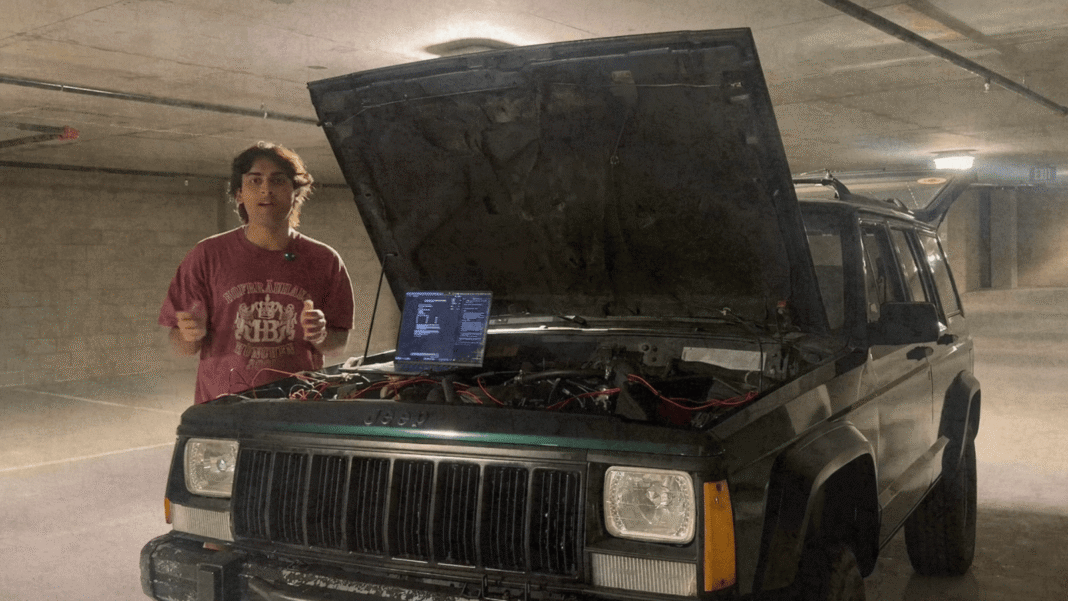
To pass the pollution control to his old Jeep Cherokee, an American videographer plugged ClaudeCode then Codex into the on-board computer.
For several weeks, Muhammad Zulali had been facing a problem.
His 1994 Jeep Cherokee failed the California emissions test, required to renew the registration, and each new visit to the technician cost him a hundred dollars.
Rather than continuing to change parts at random, the man who specifies that he is not a mechanic spent almost a week having two programming agents work on the engine computer, first Claude Code from Anthropic, then Codex from OpenAI.
He recounted the experience in a YouTube video posted on November 10, which neared 1.5 million views in less than a week. A success that we also owe to the result of the experiment: the Jeep ended up passing its test.
A car too old for current diagnostic tools
Before its owner embarked on this crazy experiment, the problem had been identified. At 25 mph (about 40 km/h), the Jeep was emitting too much nitrogen oxides (NOx), pollutants that form when the engine receives too much air relative to fuel.

Black Friday: your digital serenity at -61%
Secure your purchases during Black Friday with the best offer of the year. Find the good deals, Bitdefender takes care of the scams.
The owner first replaced the lambda sensor, which measures oxygen in the exhaust, but then the car failed at 15 mph (around 24 km/h).
To understand what was happening in the engine, it was necessary to interrogate the computer, which is not easy on a 1994 model. The vehicle predates the OBD-II standard, which today allows a simple reader to be connected under the steering wheel, and the Chrysler diagnostic tool of the time is almost impossible to find.
It is to overcome this limitation that Muhammad Zulali turned to ClaudeCode. The Anthropic agent identified the car’s communications protocol, an old and slow format called SCI.
To make the calculator and the laptop communicate, an Arduino Nano card was enough. This small programmable electronic circuit, sold for around $3, was installed on an experiment board, a plate that allows components to be connected without soldering. The first try did nothing, because a resistance weakened the signal too much. On Claude’s advice, the videographer removed it and got his first reading at 1:30 a.m. It was just the coolant temperature and battery voltage, but he finally had hope of diagnosing the problem instead of randomly changing parts.
Claude took control of the fuel pump
Still, the first measurements seemed inconsistent. According to Claude, the on-board computer injected 22% more fuel than normal. However, an engine that receives more gasoline should not release too much NOx, since these pollutants appear precisely when it is lacking. To find out for sure, Muhammad Zulali took to the road with his laptop in the passenger seat while Claude recorded everything the car transmitted. Continuing his checks the next day, he noticed that the gasoline was reaching the engine with abnormally low pressure.

Claude then offered to turn on the fuel pump himself. Skeptical, the owner let him try, and the agent ran the pump for about ten seconds, until the videographer, worried, asked him to stop. “ This was the first time Claude actually did something inside the computer to cause change. “, he explained. Until then, AI had just read data.
After further tests, Claude understood that the trail was false. The software used to translate the data for this model, Chrysler Scanner, interpreted it backwards, and the on-board computer was actually removing gasoline instead of adding it.
Claude therefore copied and sifted through the on-board computer program. He discovered that the Jeep was running a version designed for California, which slightly reduced the fuel dose precisely under the emissions control conditions. However, it was impossible to install another version, because the box had been manufactured four months before Chrysler made it reprogrammable.
Codex, OpenAI’s programming agent, then found a way around the obstacle by running its own code inside the on-board computer. After several attempts, the Jeep was validated, without the video specifying exactly what this code modified. Muhammad Zulali claims to have been satisfied with the connections and driving, without a mechanic or dealer tools.
Between fascination and fear
On Hacker News, several commentators were especially struck by the fact that Muhammad Zulali let Claude operate the fuel pump directly. An engineer working on quadruped robots explained that his team prohibits agents from operating equipment without authorization, including using instruction files. Others pointed out that a written instruction is not always enough. For real protection, technical locks are required, such as an isolated environment without access to the equipment or a physical emergency stop button.
The wave of concern did not stop there. Another user said that Claude had knocked out the ABS and traction control of his car while it was driving, on a circuit that he presented as safe. According to him, these models alternate between strokes of genius and gross errors in automotive electronics; he figures them, somewhat arbitrarily, at 30% and 70%.
For her part, Zulali encourages her audience to repeat the experience. He posted the code and wiring diagram on GitHub, specifying that it is an amateur project, use at your own risk.

All the tech news at a glance
Add Numerama to your home screen and stay connected to the future!