Google envisions cybersecurity for 2027 where teams of specialized agents would take charge of part of the defense work. This scenario, however, requires controls over their access, actions and deployment: without precautions, automation could also increase the possibilities of attack.
Companies should audit their autonomous workflows
Software flaws, faulty configurations, bypasses, indirect prompt injections: the integration of agents can expose companies to several categories of risks. The race to have an AI-driven corporate image can relegate security checks to the back burner when adding features to applications or services. The attack surface could then expand beyond what had been anticipated, including when AI is adopted to defend systems.
Auditing infrastructure and networks is therefore becoming a central precaution when facing adversaries who also have AI, from inexperienced hackers to groups supported by states. Penetration tests and offensive simulations of red teams should include agents, still absent from the perimeter of many teams a few years ago. As companies embrace the principle of integrating AI into their products and processes, corresponding vulnerabilities should be spotted and then patched before an attacker exploits them.
The recommendation for security managers is to have autonomous workflows reviewed before going to production. The results of these tests should then be linked to threat intelligence. This combination should be used to strengthen network protections and harden classifiers against new attacks.
Google wants to contain the proliferation of agents
Google sees the proliferation of agents as a future form of shadow IT, with its attendant risks. Often intended to work alone under human control, these systems can become high-value access points for hackers when thousands of them operate in different environments. For 2027, the company instead envisions coordinated collectives, capable of quickly handling many defense tasks.
Isolated agents equipped with general directives are considered insufficient in the face of adversaries assisted by AI, capable of compromising terminals more quickly, entering a network, circulating there or initiating data theft. The recommended model is based on orchestrated specialists: everyone should have their own training, professional knowledge, memory and tools, with limited autonomy. A central coordinator should determine when to request a human decision. This organization would require supervision to contain the uncontrolled multiplication of agents.
Their governance also involves an individual identity, comparable to that of an employee, to include them in a zero-trust architecture and limit compromises. Heather Adkins, vice president of security engineering at Google, recommends applying this logic to the transactions themselves, beyond the network. Even under zero trust, an agent could retain excessive freedom: every transaction and every authorization would therefore have to be verified. The rights assigned should be minimal and revocable after an incident or when the agent no longer has any use.
The evening letterFree · 7 p.m.
Are you following the race for AI models?
Each output (GPT, Claude, Gemini, Mistral, etc.) decrypted the same evening, in 5 minutes. Free.
Included upon registration: our selection of the best AI guides & comparisons.
Choose your pace
Free · No spam · Unsubscribe in 1 click
The preservation of a history specific to each agent is also recommended, without manual management being practicable. Google is considering authorization adjusted by autonomous reasoning in real time. An operation accepted on a Tuesday could thus be refused on Wednesday if its context appears abnormal.
Google advocates linking production to code
Software protection must also keep pace with the acceleration of its writing and deployment by AI. Google predicts that by 2027, controls will need to be continuous within the delivery pipeline. Patches waiting several days and a security check reserved for the end of development are considered unsuitable: programming and security should move forward together, with agents, to preserve security despite the pace.
The threat to components does not date from this acceleration, as the SolarWinds attack in 2020 showed. Sandra Joyce, vice president of Google Threat Intelligence, says that cybercriminals are now contaminating libraries as well as open source code. However, programming assistants often automatically incorporate these components into code bases.
Google recommends connecting production environments directly to software sources. Defenders could thus link an observed exposure to the line concerned and check whether it is actually usable. The recommended objective is to provide an already tested patch at an automated pace, without stopping production.
Google plans already educated alerts for analysts
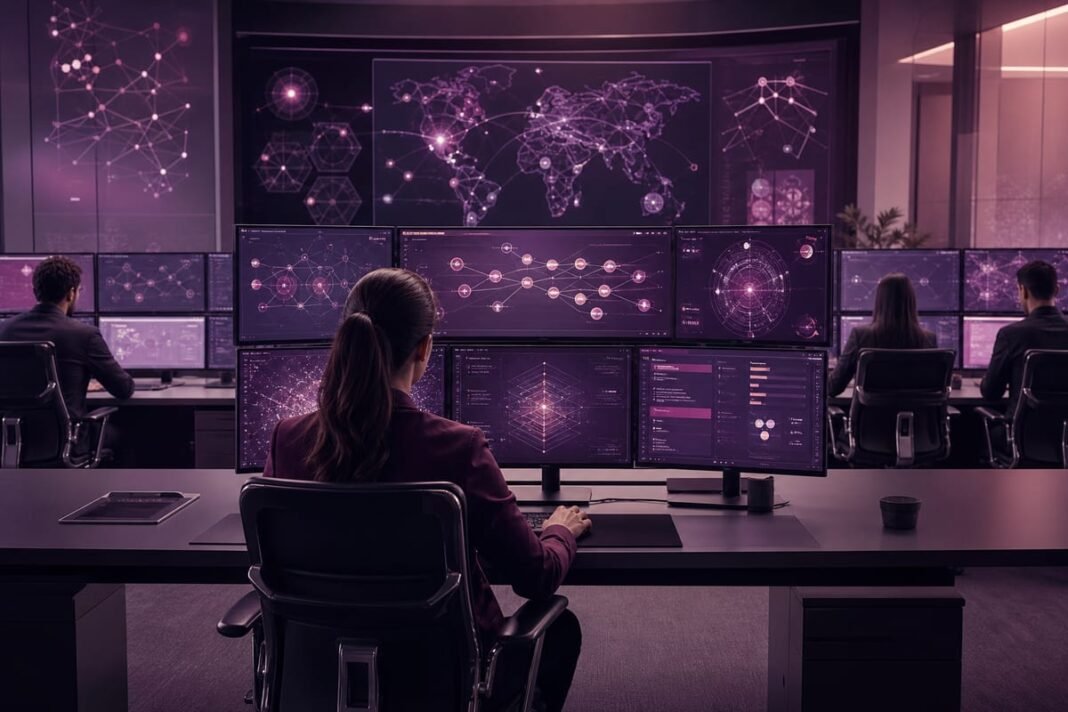
In security operations centers, or SOCs, the repetitive sorting of reports mobilizes specialists while many alerts are useless or correspond to false positives. The teams already know the fatigue associated with this load. Faced with autonomous threats capable of recognizing a network, penetrating it and then circulating within a few minutes, consulting traces scattered between several systems and several days or weeks old does not make it possible to keep up.
Google anticipates the disappearance of the queue of pending alerts in its Cloud CISO Outlook forecast for 2027. Ramya Chitrakar, vice president of engineering at Google Cloud Security, believes that analysts will then be able to direct results rather than continue reporting. The proposed change is to produce the alert after the automated work, instead of making it the starting point for human intervention. Agents would enrich the data, reconcile it, and triage to deliver a verified conclusion rather than an unprocessed ticket.
Specialists could monitor this processing and control automatic interventions, with more availability for other missions. Speed and processing volume are already the main motivations for companies considering AI for security. According to security experts, agentic capabilities are rapidly surpassing those of traditional SOCs on both dimensions, as both defenders and attackers employ the technology.
At the start of the year, there were still few organizations using language models and agents in their cybersecurity operations, particularly to identify and correct vulnerabilities. Google claims that these uses are now being deployed massively. The company predicts large-scale agent influence on security in 2027.