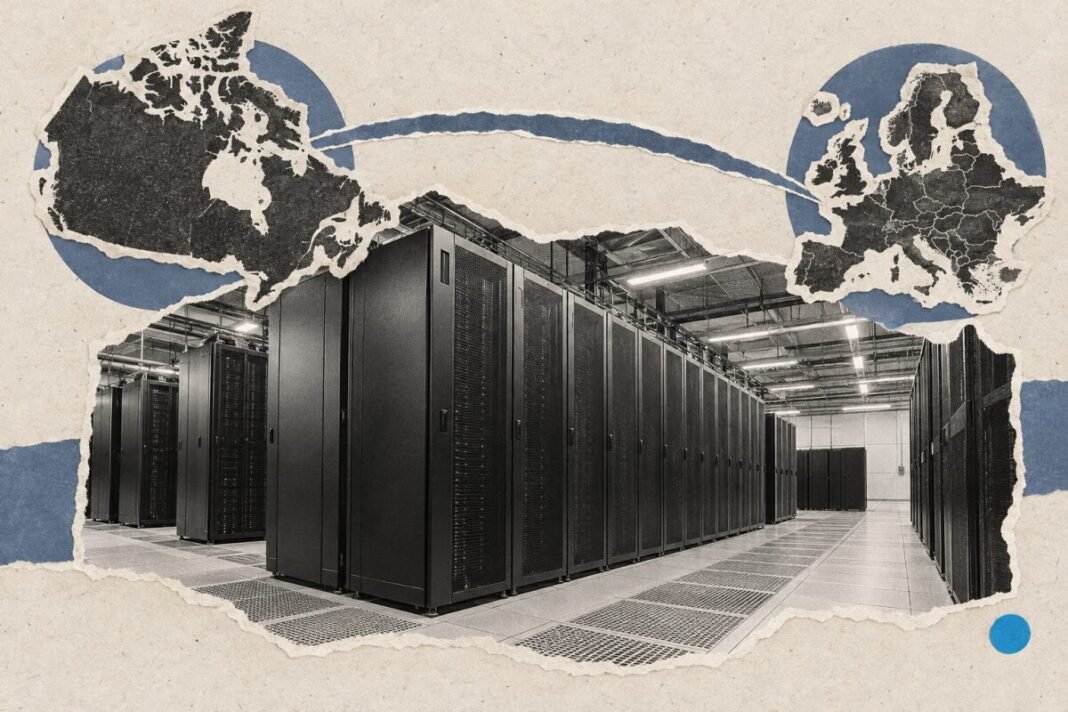
On October 30, 2026, in Montreal, the 21st summit between the European Union and Canada concluded with a joint declaration launching an “Alliance for the Future”. Among today’s announcements, one line directly concerns AI infrastructure: the leaders welcome “Canada’s participation in the European Joint Undertaking for High-Performance Computing (EuroHPC JU)”, which must “strengthen the links between our supercomputing resources” and prepare for further integration of AI innovation ecosystems.
The Joint Undertaking confirmed the same day, in its own press release, that Canada had officially become its 39th participating state. In her statement after the summit, Ursula von der Leyen summarized the measure in one sentence: “we are opening the European supercomputing infrastructure to Canada”.
A seat on the EuroHPC board of directors
EuroHPC JU is an entity under European law which pools funds from the Union and participating States to purchase supercomputers and finance research in intensive computing. It has already acquired 12 supercomputers spread across Europe, including JUPITER in Germany and Alice Recoque in France, presented by the joint venture as the first European exascale systems. It also supervises 19 AI Factories and 13 branches. Regulation (EU) 2026/150, which entered into force on January 20, 2026, expanded its mandate to AI gigafactories and quantum technologies.
Participating state status first provides a seat on the board of directors. According to the Joint Undertaking’s governance page, this council, composed of the Commission and one representative per participating state, is responsible for strategic choices and financing decisions, including all public procurement. As of November 2, 2026, this page already lists Canada, represented by Nipun Vats, with Sheila Kennedy as alternate. Ottawa will therefore sit where decisions are made on the purchases of machines, the selection of AI factories and the implementation of gigafactories. The real weight of this vote will depend on the conditions of participation, which have not been published.
Canada thus joins the eleven other participating states outside the Union, including the United Kingdom, Switzerland, Norway, Turkey and Israel. It is the only member from the American continent.
Access for researchers and start-ups, still not very detailed
The EuroHPC press release indicates that Canada will be able, “like other participating states”, to access HPC, AI and quantum computing resources provided by the joint venture, and that its scientists will be able to collaborate with their European counterparts. Evan Solomon, Canadian Minister of Artificial Intelligence and Digital Innovation, speaks of “new possibilities for Canadian researchers and innovators”.
Free access, reserved for the public sector, research and SMEs, involves calls for proposals evaluated by independent experts; other commercial uses are billed on a per-use basis. On the AI factory side, the “industrial innovation” route offers three levels (Playground, Fast Lane up to 50,000 GPU hours, Large Scale beyond), open free to SMEs and AI start-ups. The AI Factory FAQ lists applicants based in a “Participating State” among those eligible, but the list of countries displayed below this answer, which covers machines acquired before 2020, did not yet mention Canada as of November 2.
EuroHPC’s access policy (December 2025 version) links eligibility to the program that funded each machine: Horizon 2020 for pre-exascale and petascale systems, Horizon Europe or the Digital Europe program for exascale and mid-range systems. Canada has been associated with Horizon Europe since 2024, recalls the joint undertaking. On paper, the access policy opens machines acquired after 2020 to countries associated with this program, including JUPITER, Alice Recoque and AI factories, but the lists of eligible countries displayed by EuroHPC do not yet mention Canada. The same policy provides for another regime for countries with which the Commission has signed a digital partnership involving intensive computing activities: access can be granted by the board of directors according to a principle of reciprocity, the time offered on European machines having to be compensated by equivalent time on supercomputers in the partner country. Canada has a digital partnership with the Union, which Roberto Viola, director general of DG CNECT, cites in the EuroHPC press release, but none of the announcements indicate whether it covers supercomputing. Neither the joint declaration nor the EuroHPC press release details the concrete application of these rules in Canada, nor the amount of a possible Canadian financial contribution.
Public calculation becomes a tool for EU external partnerships
Canadian membership is not isolated. On September 23, 2026, EuroHPC JU already launched the EU-Latin America and Caribbean AI supercomputing network, linked to the Global Gateway strategy and coordinated by the Barcelona Supercomputing Center, with Inria among the seven European partners. The format differs: a two-year cooperation project with seven Latin American countries on one side, a full seat on the council on the other.
For the editorial staff, these two close announcements show that the Union is now using its computing infrastructure as an instrument of its partnership policy, from a seat on the council for a G7 member to the cooperation project for Latin America. Anders Dam Jensen, executive director of EuroHPC JU, presents the membership as a reflection of “the growing importance of international partnerships” in building a sovereign European supercomputing ecosystem. On the Canadian side, the gain is a capacity to influence infrastructure to which Ottawa has, to date, announced no quantified contribution.
For French users, nothing changes in the short term: access calls remain open under the same conditions, and the French AI factory remains in the network. The effect will play out at the council, where one more voice will weigh in on the location and timetable of future machines, and on the access criteria for gigafactories, which Europe wants to use as a catch-up lever, as ActuIA detailed in September regarding the European AI financing strategy. Several countries have already used these machines to train their national language models, like the Portuguese example analyzed in July.
The rest of the digital portion of the summit
The joint declaration also announces the conclusion of substantive negotiations for an agreement on digital trade, presented by Ursula von der Leyen as “the digital arm of CETA”. It sets guidelines: cooperation on access to large computing infrastructures for AI, “including AI factories”, with particular attention to start-ups, SMEs, researchers and administrations, and work towards mutual recognition of the conformity assessment results of AI systems. This last point is only an objective at this stage. The two memoranda of understanding on AI and on digital credentials cited in the text date from December 8, 2025, signed during the first Canada-EU Digital Partnership Council.
The next visible step will be the publication of the calls for access mentioning Canada among the eligible countries, and the first meeting of the EuroHPC board of directors at which its representative will sit.
Our articles will be prioritized in Google’s “Featured” section.