Archives: this column appeared in ActuIA n° 19 (September-December 2025). It is followed by an editorial note dated October 2026.
The Roberval Prize
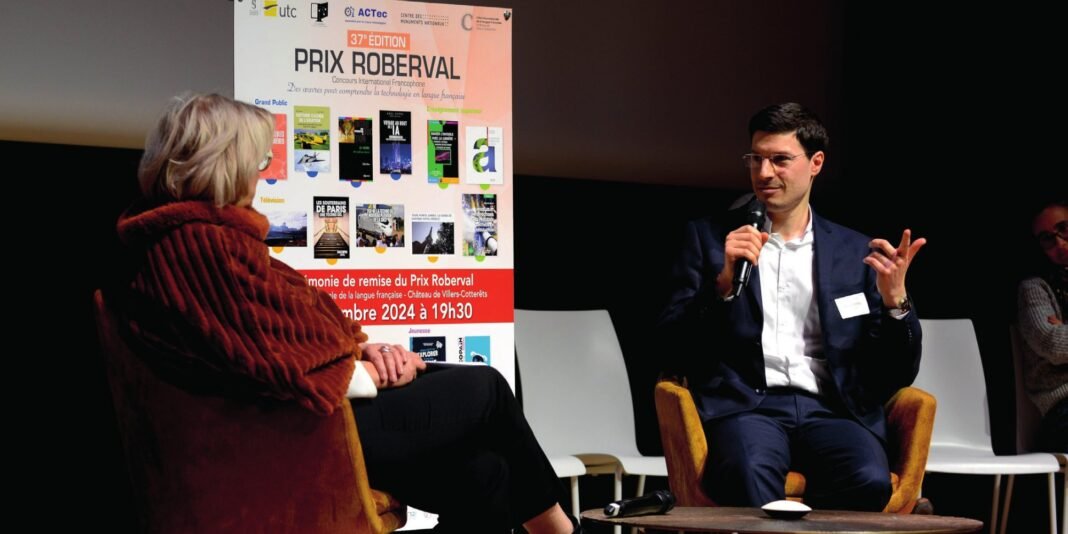
On December 7, 2024, in the amphitheater of the Cité internationale de la langue française, in the superb renovated Renaissance castle of Villers-Cotterêts, the Roberval prize award ceremony took place. This is a French-speaking prize rewarding works of scientific mediation.
My second work, Journey to the end of AIcompeted there. This is an essay whose purpose is to explain to a wider audience what artificial intelligence is and to make people feel what its consequences will be in our daily lives, so that they are protected, if they wish, from the potential abuses to which its uses expose us. As one of the jury members wrote in a comment on a LinkedIn post that I published afterwards: “What drives us at the Roberval Prize is making technology accessible, so that everyone understands it, chooses, and uses it wisely instead of being its toy. » The perfection of this sentence, which clearly sums up exactly why I wrote this work, was almost shocking.
At the end of the ceremony, my book was named winner of the 2024 Roberval Prize in the premier category (General Public). A little earlier, in order to present works and authors to listeners in a lively way, each finalist is invited on stage to answer a question asked by a member of the jury. Out of consideration for the other candidates, and especially the spectators, a short answer (let’s say not too long) is expected. Mine lasted a few minutes and articulated the main ideas which will be discussed in detail here. But actually, what was the question? (We wouldn’t dare say “the prompt.”)
The question
Here it is: “Will AI be able to produce theory? You write that ChatGPT understands nothing, that it does not state the truth, that it only manipulates syntax, the purely formal side of the language. Whose act! You explain, rightly, that a theory can not only enrich the universe of data, but act as an “ontological winch”, capable of revealing new elements. The richness of theorization is infinitely greater than that of induction, or even deduction.
I always agree! But by analogy, and as a researcher, I realize that I was built like an AI. It is by ingesting all the work of my predecessors that I was able to formulate new questions, even theories.
So I ask you the question: do you think, as an expert, that AI produces or will produce theory? »
With this question, we immediately find ourselves at the heart of what fuels the hope of some and the fear of others, namely the possibility of seeing the emergence of a strong AI, whose intellectual capacity would compete with ours to the point of overthrowing it in its current domination.
It’s a question of disguised foresight. The most formidable. But to arrive at this reformulation, perhaps we should do like AI and imitate the so-called reasoning of ChatGPT, “step by step”?
The two main methods of designing models
Let’s start by dissecting the mechanism that drives the question: a formal opposition between the creation of theories and the way of learning inherent to modern artificial intelligence, with its deep neural networks processing, in an “energy-hungry” appetite that nothing seems likely to hinder, its deluge of data gleaned from the internet in a legality that numerous copyright lawsuits invite to call into question. This AI proceeds by induction, that is to say generalization from examples supposed to represent the phenomenon studied. The result of this algorithmic calculation is a model that is then used for prediction and content generation.
Contrary to this practice, the major physical theories, from Galilean mechanics to the standard model, including quantum physics and the theories of special and then general relativity, have, until now, not followed this methodology.
They were also made with little data. The theory of Darwinian evolution is distinguished by its explanatory power even though its author only had a very limited number of findings and observations. Better yet, gravitational waves, predicted by Einstein’s theory of general relativity, were only detected precisely because they were one of the consequences of said theory. Otherwise, it would really take a crazy coincidence and some amazing patrons to think about and finance the construction of an interferometer several kilometers long in order to measure what, exactly? Here, the data was accumulated because a theory had previously predicted it, and in turn was used to validate it. This is the so-called “hypothetico-deductive” method of hard sciences. The formal opposite, therefore, of the inductive inference implemented by data science.
We can see, from these examples, why the physicist Étienne Klein could write, in his style, that the theoretical gesture acts like an “ontological winch”: the theory, once formulated by a thought, acts like a harpoon capable of pulling new concepts into it. While the data, you must have thought about measuring it before obtaining the model by deep learning. Causality is a really boring thing.
Can the new be found in the rags of Time?
Very good, but the question conceals other drivers. After all, if science has been constructed like this until now, why couldn’t it change its regime? Would past performances be, as in AI, only good enough to be reproduced? What, ultimately, is a new theory? What does it mark? Undoubtedly a bifurcation in the state of knowledge. It represents a radical novelty, a major advance, a horizon surpassed, a threshold crossed. We see it: numerous images, in language, evoke this happy event. But how rare and difficult to access it is! Precious, like certain legendary rings of power, it is also well known to another class of human beings, not keen on science but on the arts.
For a creation to become a work of art, what is needed other than this little something extra, this salutary renewal (which sometimes caused a scandal, unless this is always the case, a necessary condition in some way)? This is the difference between a firefighter painter, excellent in reproducing the same pictorial mannerism, and a Picasso (even if we may not appreciate his works). The opposition, in the question, between scientific theory and AI is thus nourished by a deeper correlative question: that of the very nature of creation, possibly artistic, perceived as the possibility of bringing about the new, the non-present in the data, in the observables. This is also where she comes to sow trouble: “as a researcher […]I was built like an AI. It is by ingesting all the work of my predecessors that I was able to formulate new questions. » What if it was true? Don’t we spend our time polishing and re-polishing the bones of our ancestors? Unless this is a fallacy? Besides, who knows what’s going on in the twists and turns of our brains?
We will therefore avoid commenting on the functioning of our internal mechanisms, if we want to remain scientifically rigorous. We must therefore look at what is accessible to analysis: AI. It creates a learned model from data.
This model is not a copy of the training set, but a kind of abstract synthesis in high-dimensional space. Using this model between two points appearing in its learning base gives you a form of interpolation, that is to say a point which did not exist in the base. New, in short. However, is it really a creation?
On the (temporary?) privilege of thought
So of course, we can retort that the machine only proceeds by imitation (we too, this is the argument suggested); that she did not conceive herself (neither do we); that it has no autonomy (we do have a certain freedom, but an honorable philosophical tradition nevertheless deprives us of free will). And to lend oneself to this imaginary dialogue:
“You too imitate what you see (the past) and perhaps react to it by releasing a new point, like an AI, which you will qualify as a new concept!
Yes, I draw on the past, but on a tiny part of it, compared to machine learning, and above all I do not make a model from that! »
We said that to stay “regular”, we should not use hypotheses about the way our cognition is carried out. Certainly, but we can still account for a major difference with AI: we don’t learn like that. No need to see a million cats to declare that the animal in front of us, and which we see for the third time, is one! So, of course we learn from established knowledge of the past, but we don’t make a model from that knowledge. We carry out a thought.
And finally the question from my interrogator is the question to 1042 dollars, which amounts to saying: will AI, one day, reach the stage of strong AI, that is to say, will it be capable of producing a thought process?
Amusingly, the study of this thorny question is rather found in my first book, in which I gave arguments in favor and reviewed those in defense. There is, a priori, no reason to exclude this possibility. The argument in favor of a positive answer is materialist: why should we be the only ones in the universe (that is to say the only combination of atoms) who can produce thought? What form of pretension, of “racism” ultimately, do we have in maintaining the opposite? On the other hand, it is doubtful that machine learning, that is to say the learning of a model by induction from data from the past, is capable of producing one.
Who knows what will happen in five hundred years? So let’s be generously pragmatic: AI is a very nice tool capable of intelligently processing mounds of data and extracting something useful (if not pleasant). Let us not quarrel over the question of whether this is a creation ex nihilo or a pale imitation. Let us instead use it to produce new answers, to combine this force with ours in order to find, why not, new theories. The task is vast. Time is always running out. So, let’s get to work, volunteers!
Axel Cypel
Editor’s note, October 2026
Recent advances in AI in mathematics give new scope to Axel Cypel’s question. On October 26, 2026, OpenAI announced a refutation of the exponential time hypothesis, a theoretical computer science conjecture. Anthropic also published a result attributed to a Claude search model. Both laboratories provided formalizations in the Lean proof assistant; OpenAI organized a review of its result with outside researchers. ActuIA detailed these announcements and their scope.
Such a refutation relies on the construction of an algorithm and the demonstration of its properties. If confirmed, it constitutes an original theoretical result. The contributions of AI are not limited to refutations: Google Research has described mathematical structures discovered with AlphaEvolve, then integrated into demonstrations to establish new results.
Is producing an unprecedented result already thinking? The question crosses Axel Cypel’s platform. A valid proof establishes a result; it does not decide, by itself, the nature of the process which produced it. These advances provide material for discussing the limits that the author envisages for machine learning, while clarifying his conclusion: combining the capabilities of AI with human work to search for new theories.
Our articles will be prioritized in Google’s “Featured” section.