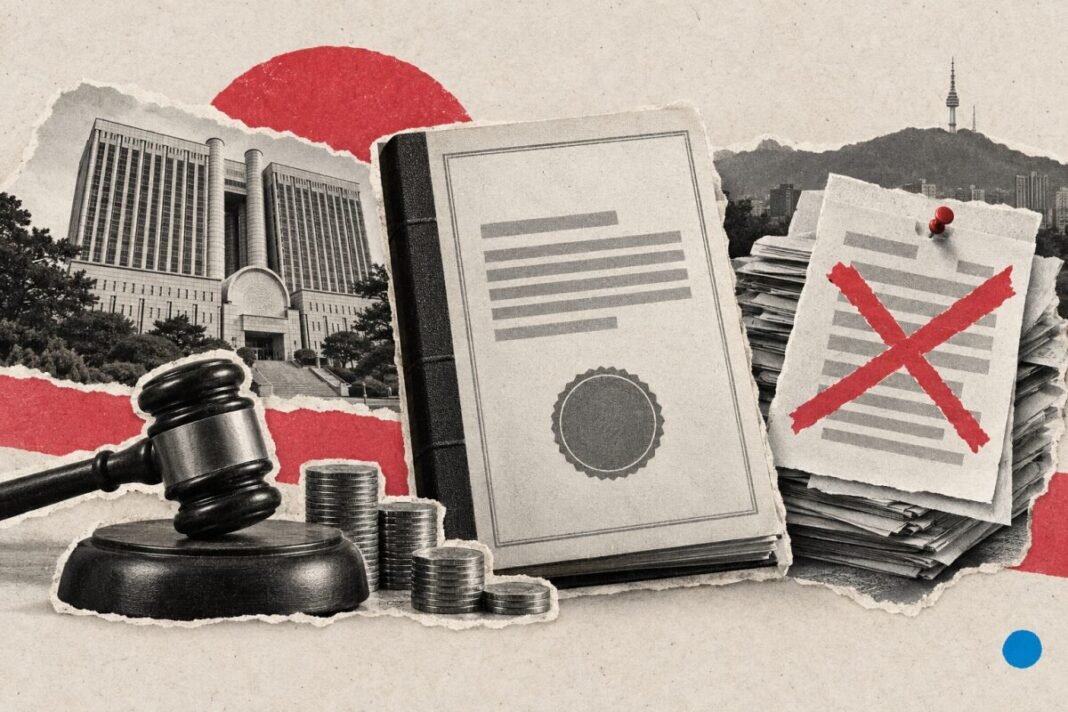
On November 2, 2026, the National Courts Administration of South Korea (법원행정처), the management body attached to the Supreme Court, published the results of an investigation into erroneous references produced by AI in court filings. Conducted from October 6 to 16 among judges from all jurisdictions, it collected 360 responses. Around 80% of responding magistrates responsible for civil, family and administrative cases say they have already seen citations of false or non-existent decisions.
The institution considers it necessary to modify the civil procedure code and the criminal procedure code to create a legal basis, in particular for a fine. She will consult with the Ministry of Justice and send an opinion to the National Assembly.
From untraceable judgments to false judgments of the Supreme Court
Among the judges who answered the question on the types of errors, approximately 240 according to the published percentages, 196 (80.7%) saw cited a decision which does not exist, 159 (65.4%) a distorted decision, 41 (16.9%) a false or non-existent legal text and 10 (4.1%) a false or non-existent article or work of doctrine. The same judge could check several boxes. The document does not specify either the number of magistrates requested or the response rate.
The examples cited by the judicial administration go beyond the poorly copied reference. Parties have filed fake AI-generated judgments using the formatting of Supreme Court rulings. Others put forward legal reasoning unknown to the judges, accompanied by a Supreme Court case number that no research could find. Some writings modified what a true decision had ruled or cited it in a sense contrary to its scope. In still others there were fragments of the conversation with the AI or notes on litigation strategy.
This last case is already documented in France: in an order of December 9, 2025, the administrative court of Grenoble ruled on a request where the exchange with the chatbot had remained in the text filed, as ActuIA reported in its article on administrative justice in the face of appeals drafted by IA.
69.5% of judges appoint the litigants themselves
On the origin of false references, 164 respondents (69.5%) named the parties acting themselves, 136 (57.6%) lawyers, whether they represent a party or provide criminal defense. The press release emphasizes this second figure: the invented references also appear in number in lawyers’ writings.
Two leading foreign cases targeted professionals. On June 22, 2023, in New York, Federal Judge P. Kevin Castel ruled in Mata v. Avianca imposes a penalty of $5,000, jointly and severally, on two lawyers and their firm, based on Rule 11 of the Federal Civil Procedure. This rule also applies to litigants without a lawyer, who represent approximately six out of ten American decisions in the Damien Charlotin database mentioned below.
On June 6, 2025, the Divisional Court of the High Court of England and Wales delivered the Ayinde judgment, which recalls the range of possible responses: public admonishment, order to pay costs, striking out the case, referral to the regulator, contempt of court, referral to the police. In the Al-Haroun file, attached to the previous one, 18 of the 45 references submitted did not exist. The client had produced them with publicly available AI tools, legal search engines and online sources, and his lawyer took them without checking. The judges clarified that their examination focused on the conduct of lawyers rather than that of litigants.
A legal basis to be created, measures still under study
At this stage, the press release sets neither the amount nor the timetable nor the authority which would pronounce the sanction, and does not say who would be targeted. The term used, 과태료, designates a non-criminal financial penalty in Korean law.
- What the judges ask : 91.7% of respondents consider an institutional response necessary, including 64.8% “very necessary”. Among the proposed measures, 61.4% retain a legal basis for the fine, 61.1% an obligation to verify the cited decisions, 60.6% an obligation to declare the use of AI and 55.4% sanctions, such as disciplinary referral to lawyers in the event of repeated false citations.
- What the judicial administration announces : the need for a legal basis, in particular for a fine, in the two procedural codes; consultation with the Ministry of Justice and other administrations concerned; an opinion transmitted to the National Assembly.
- What she studies : a warning on the precautions for using AI in the electronic procedure portal.
The obligation to declare the use of AI does not appear in the announced suites. The obligation to verify quotes appears in the subtitle of the press release, but the section devoted to follow-up only translates it for the moment as a reminder addressed to the lawyers and the parties. The text justifies the approach by the cost for the other party, forced to verify and refute imaginary references, which weighs especially on the one who pleads without a lawyer, and by the lengthening of the procedures.
Eight Korean decisions identified, nearly 200 judges confronted
As of October 31, 2026, the date of its last update, the AI Hallucination Cases database maintained by researcher Damien Charlotin lists 2,246 court decisions around the world, including 1,517 in the United States, 14 in France and 8 in South Korea. It essentially retains decisions where the court found, explicitly or implicitly, that a party had relied on hallucinatory content, and itself indicates that it does not cover all false citations filed before the courts.
Eight decisions published on one side, around 80% of responding civil, family and administrative judges faced with the problem on the other: the gap gives an idea of what the compilations of case law do not see. A false reference dismissed during proceedings does not necessarily give rise to a published decision.
French administrative courts already have a general tool. On June 4, 2026, the Grenoble administrative court sentenced an applicant without a lawyer to a fine of 200 euros for abusive appeal, on the basis of article R. 741-12 of the administrative justice code, which caps this fine at 10,000 euros. His brief of more than 300 pages, “obviously generated in support of artificial intelligence”, cited inapplicable texts and non-existent decisions. Korea chose to first measure the phenomenon among judges, then ask the legislator for its own basis. The 14 French decisions from the Charlotin database are all dated December 2025 or later.
Our articles will be prioritized in Google’s “Featured” section.