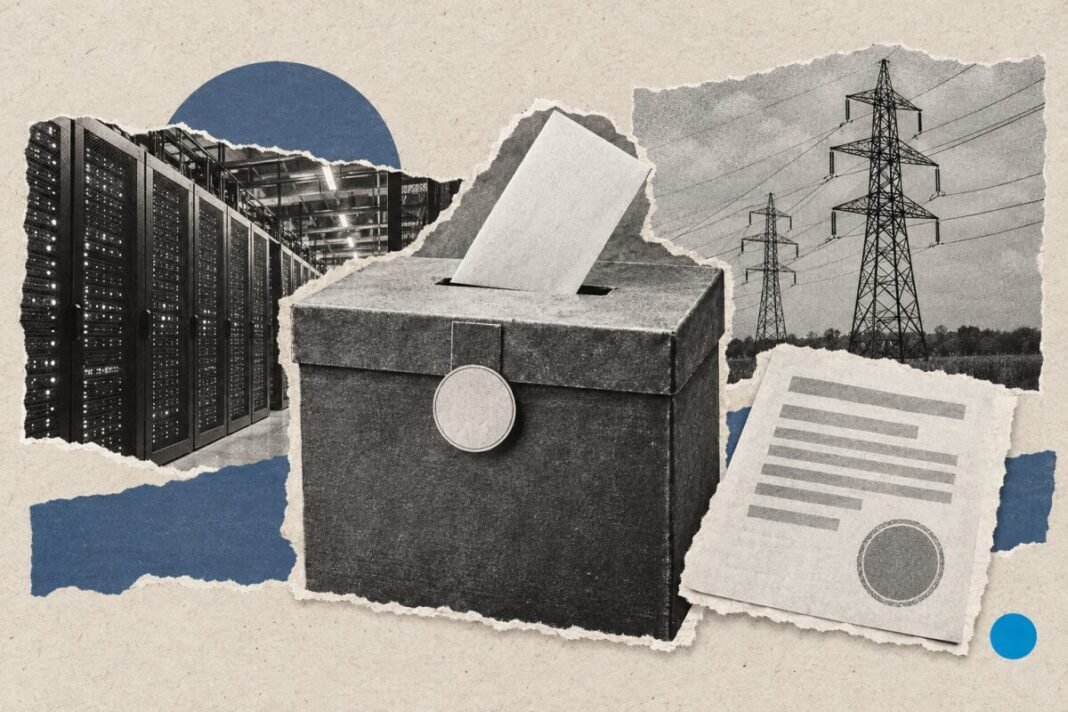
Joliet, Illinois, had written the question itself: Should its voters advise the city to approve the construction of AI data centers? On November 3, 2026, 79% answered no. Boulder City, Nevada, requested authorization to host them in the Eldorado Valley: 71% no. In Monroeville, Ohio, and Downe, New Jersey, the municipal councils requested a simple favorable opinion; they received 88% and 87% refusals. That day, ten states voted on local consultations devoted to data centers. Ballotpedia counted 47 trenches since January in its November 13 survey, most of them on the 3rd: voters chose to limit these installations in 46 of them. Four more votes are planned for December.
The exception is in a town of around 800 inhabitants. In Harwood, North Dakota, where operator Applied Digital is building a campus for Oracle, an initiative called for enhanced review of industrial projects; the mayor and the chamber of commerce called for a vote against, and 76% of voters followed them, reports The Bond Buyer.
Ohio has voted twenty-one times
Ohio concentrates 21 of these 47 measures. In Trenton, Issue 17 bans data centers larger than 25 megawatts with 80% of the vote and blocks, according to public radio WYSO, the annexation of land for a 1,000 megawatt Amazon project. Piqua voted for the same ban against a Meta project, Hubbard against “Project Milo”. In Ashville, 82% of voters rejected the village’s negotiation framework with operator EdgeConneX for two data centers.
In two of these cities, the vote was against the elected officials. The Trenton City Council required 820 signatures to put the ban to voters. On September 1, the Ohio Supreme Court ruled that 128 was enough; the petition numbered 336. In Piqua, the mayor and two commissioners were removed from office the same day.
The bill rather than the party
The partisan divide poorly explains these results. In September, an NBC News poll conducted with SurveyMonkey found 57% of Republicans opposed to an AI data center near them, compared to 81% of Democrats. Ohio Republican Senator Jon Husted, long supportive of the sector, tabled legislation in July that would make large data centers pay for the additional electricity and water costs they create. He lost his seat on November 3 to Democrat Sherrod Brown, who attacked him on this support, according to the Associated Press and NBC News.
Opposite, Donald Trump described the communities that refuse these facilities as “backward and poor” at the end of August. The outgoing Republican governor of Georgia, Brian Kemp, warned in June against “moratoriums on growth”. After the vote, the Data Center Coalition, which represents the sector, recalled that data centers bring jobs and tax revenue to municipalities.
What brings voters on both sides together is first and foremost the bill. The Federal Energy Information Agency forecast in May an increase of nearly 5% in the price of residential electricity in 2026, and linked the new demand to the commercial sector, which includes data centers, without quantifying their share. In October, ActuIA detailed the standoff over the distribution of these costs.
In Texas, Gina Hinojosa, elected governor, promised a moratorium on new data centers; his opponent, outgoing Republican governor Greg Abbott, announced his in August. In Georgia, Keisha Lance Bottoms, also elected, said she would sign an executive order temporarily suspending new authorizations. New York did not wait: since July 14, a decree from Kathy Hochul has frozen environmental permits for projects of at least 50 megawatts for up to one year. In the NBC News exit poll cited by Stateline, 56% of voters say AI and data centers played a crucial or important role in their vote for Congress. Cost of living: 89%, according to the results of the same survey published by ABC News.
A no does not have the same force everywhere
The Joliet or Monroeville questions were advisory and binding on no one. The amendments to the municipal charter of Trenton or Piqua are binding, but their results remain unofficial until the certification of the counties, expected by November 24 in Piqua, and the fate of already authorized sites remains open, such as the 250 megawatt site that the real estate group Prologis is building in Trenton: the company assures that the vote does not concern its project, reports the local channel WCPO.
The most cited figure calls for the same caution: the 45 projects representing $68 billion blocked or delayed in the second quarter come, according to Bloomberg, from Data Center Watch, a 10a Labs project whose count mixes abandonments and simple delays. There were 75, for 130 billion, in the first quarter.
Sector commitments did not stop the vote
On October 2, Amazon promised more than a billion dollars over five years to the communities that host its data centers, an electricity rate covering network reinforcements and the end of confidentiality agreements with administrations. A month later, Trenton passed the ban. On November 5, OpenAI renewed its promise to pay for electricity and network reinforcements for the sites it operates, waived confidentiality clauses with local elected officials and requested that part of these rules become law.
These commitments answer the question of recent months, who pays the network. November 3 posed another question: who decides. A permit is learned, a rate is negotiated before a regulator, but the 4,444 voters of Trenton did not sit at any table. A CIO who buys the cloud now sees the capacity promised in an American region also depend on municipal elections that neither his supplier nor he controls, and the cost of the compensation offered to municipalities is likely to end up in the prices.
The calendar does not stop there, according to the same report from Ballotpedia. On Dec. 1, Clarksville, Arkansas, will say whether it upholds two orders authorizing up to $50 billion and $5 billion in bonds for a data center tied to operator Serverfarm: The vote is on financing the project, not authorizing it. In Hollis, Maine, the December 8 vote calls for a 180-day moratorium. Mandan, North Dakota, will vote on the 15th on the ban on sites of 25 megawatts and more, in response to a Stark Power project.
In France, the opposition goes through the judge
More than 100 organizations from 15 countries, including France, called for demonstrations on November 6 and 7 for a moratorium on new large data centers, according to Euronews. In Amsterdam, several hundred activists occupied the construction site of a Microsoft data center on November 6; the police arrested 150 to 200 people.
The comparison ends there. In France, a residents’ petition can at most request the inclusion of a question on the council’s agenda, not impose a vote that would prohibit a project. The simplification law of May 26, 2026 even goes in the other direction. Its article 35 allows certain data centers to be qualified as a project of major national interest, which opens an exemption to the height rules of the local town planning plan; it also authorizes the refusal of a permit where water is lacking. Local hostility therefore takes the route of appeal. The Fouju-Champdeuil campus, in Seine-et-Marne, supported in particular by Mistral AI and the UAE fund MGX, has six; in Alixan, in Drôme, Sesterce plans to limit its project to 40 megawatts since the courts suspended its permit.
Until now, a data center was being built with connected land and a permit. November 3 added a third piece, which cannot be bought and cannot be connected: the agreement of the neighbors.
Quotes translated from English by ActuIA.
Our articles will be prioritized in Google’s “Featured” section.