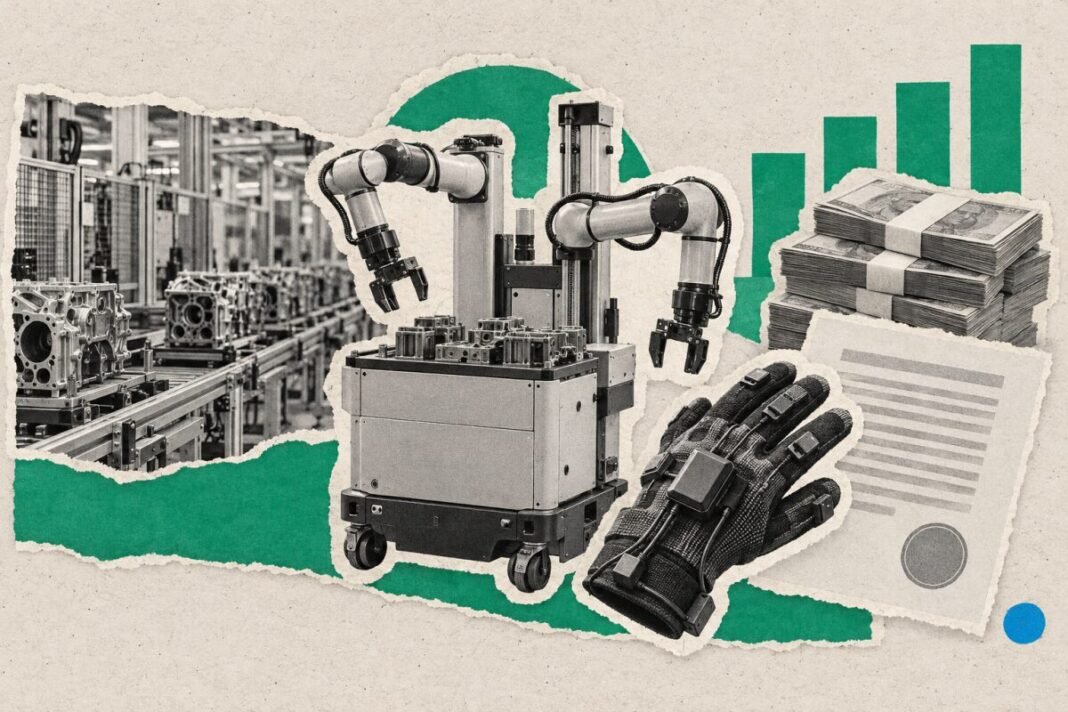
Genesis AI announced on November 17 a Series A of $500 million, approximately 450 million euros, which values it at $3.5 billion. The Franco-American robotics start-up, based in Paris and California, wants to finance the production and deployment of Eno, its two-armed robot mounted on wheels, in factories and warehouses.
Bpifrance, Nvidia and Xavier Niel at the table
The round is led by Khosla Ventures, Premji Invest and Eclipse, and Nvidia is entering the capital, alongside AMD Ventures, Bpifrance, HSG, Samsung Next, Ericsson and Zoom. Eric Schmidt, the former boss of Google, and Xavier Niel are at it again on a personal level: they were already there in 2025, specifies AFP. The company then raised $105 million in seed funding.
Genesis AI was founded in 2024 by Zhou Xian, its general director, and Théophile Gervet, its president, a former researcher at Mistral AI. The two men met during their doctorate at Carnegie Mellon University, says TechCrunch. The company employs around sixty people.
Sensor gloves to learn the gesture
His method starts from the hand. More than a hundred workers around the world wear force-sensing gloves and a front-facing camera as they carry out their tasks. The robot’s hands have the proportions of a human hand and wear the same gloves, so that the data collected is directly transposed. They power the in-house model, GENE, which the Genesis World simulator then puts to the test on millions of scenarios, details The Next Web.
The company does everything itself: data, model, robot. Eno, revealed in June, has neither head nor legs. Genesis AI says it prioritizes “human capabilities rather than appearance.”
Thirty to forty robots built
The company has made 30 to 40 examples of Eno and is conducting pilots with a few customers it is not naming. A test is underway with South Korean LG CNS in manufacturing and logistics. Wider deployment is planned for 2027.
At the place of production, the stories diverge. TechCrunch and The Next Web report that a subcontractor has been selected to launch mass manufacturing next year in the United States, while AFP indicates that production is currently taking place in China and that Genesis AI plans to repatriate it to Europe from 2027. Zhou Xian himself places the difficulty on the hardware side. The robotic hands currently only last a few weeks of regular work before being replaced.
Factory robotics attracts capital
The announcement comes on the day that equipment manufacturer Novares publishes the first results of a humanoid robot on one of its lines, also with French software. With 605 million dollars raised in sixteen months, Genesis AI has the means to go from prototype to series. Now he needs hands that last.
Our articles will be prioritized in Google’s “Featured” section.