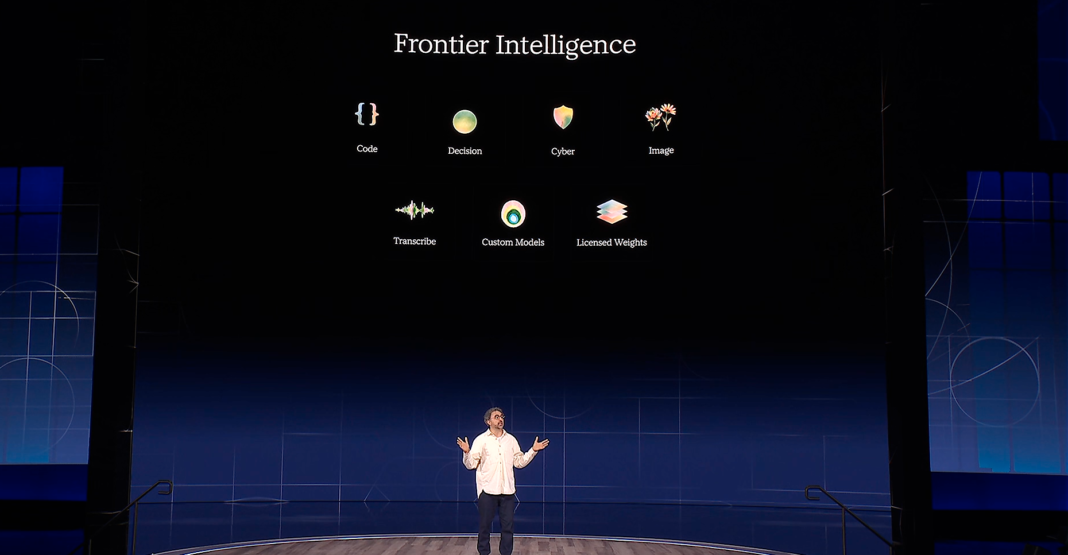
Key points to remember about Microsoft’s new “Licensed Weights” feature
- Microsoft will allow its customers to customize the weights of its new models.
- This approach should appeal to companies in terms of confidentiality, performance and costs.
- Western “open-weight” AI is experiencing increasing growth.
During the keynote speech at its Ignite conference last Tuesday, Microsoft CEO Satya Nadella announced several new models developed by Microsoft AI (MAI), the company’s in-house lab. But new model launches are common these days. What really got the attention here is how Microsoft will enable its customers to access these models.
MAI said it would allow its customers to customize its cutting-edge models with their own data and run them securely on Azure through an initiative called Licensed Weights. This is a selective approach to open-weight AI: more open than proprietary models from OpenAI and Anthropic, but not fully uploadable to Hugging Face like Mistral’s Chonk. Interested businesses will need to go through their Microsoft account managers to get started.
“You control who can access it. Your data and your adaptations remain entirely yours. And we will work with you through Frontier Company to provide you with the custom template and integrate it with your own products and agents,” said Mustafa Suleyman, CEO of MAI, during his keynote speech.
This approach should appeal to companies looking for affordable AI that allows them to maintain control of their intellectual property. Microsoft has clarified that it will only use information from its customers to train its models with their consent.
“No one wants to invest their IQ in someone else’s model,” Suleyman said, echoing an argument that Palantir CEO Alex Karp has made repeatedly.
An “open-weight” AI for businesses?
The dominant, albeit simplistic, narrative in AI has long been that expensive, proprietary models deliver cutting-edge performance but are not customizable, while less expensive, open models are customizable but less efficient.
Microsoft’s AI models don’t yet necessarily rival those of OpenAI and Anthropic. But the company enjoys historic influence with countless businesses. By offering a customizable AI option, it could restore balance among big tech companies.
Western laboratories, notably Thinking Machines and Mistral, are launching more competitive open weight models. But Anthropic and OpenAI still hold the overwhelming majority of the enterprise AI market. Although Licensed Weights is not a family of open weight models, this initiative somewhat diversifies the debate between open and closed models and helps differentiate Microsoft’s offering from those of OpenAI and Anthropic. It’s also a smart choice that fits with Microsoft’s goal of balancing price and performance, if businesses find it compelling enough.
“On average, across four widely used benchmarks targeting everyday enterprise coding tasks found in GitHub Copilot, MAI Code 2 gives you 98% of the performance of GPT 6.1 Sol for only 40% of the cost, and compared to Opus 5.5, that cost is only 5% of that,” Suleyman said of the new coding model the company announced at the Ignite conference.
The company also unveiled its new image editing model, MAI Image 2.7, on Tuesday, which now leads the category on Artificial Analysis while outperforming Nano Banana Pro and several GPT image models in terms of price and quality. With Licensed Weights, Microsoft has positioned itself for organizations seeking a trusted combination of ROI tools, customization, security controls, and features.
https://www.zdnet.fr/wp-content/uploads/zdnet/2026/11/screenshot-2026-11-17-at-2.46.59-pm.png https://www.zdnet.fr/actualites/la-nouvelle-travailnalite-licensed-weights-de-microsoft-permet-aux-entreprises-de-personnaliser-leurs-modeles-dia-a-laide-de-leurs-propres-donnees-508209.htm?utm_source=rss_feed&utm_medium=link&utm_campaign=unknown