Android App Essentials, Ph. Jack Wallen/ZDNET.
Key takeaways from the Android Essentials app
- Essentials is a dream come true for advanced Android users.
- This application offers a multitude of customization options and settings.
- The app is free, but must be installed manually.
Most Android users are familiar with the Settings menu, which presents them with all the features Google thinks they need. There is also the Developer Options feature, which can be enabled to allow even more possibilities for users.
If that’s not enough, there’s now Essentials, a toolkit for power users that includes over 30 tweaks and tweaks for features like button remapping, app freezing, Google Maps battery saving modes, sound and vibration, wallpaper, widgets, customizing status bar icons, edge lighting, flashlight blinking, notification management, always-on display Display”), and much more.
The only requirement for most Essentials features is Android 8 or newer. A few advanced features require shell providers such as Shizuku (an open source Android tool that allows third-party apps to use system-level APIs) or even root access, but the majority of features that most users will want to enable require no additional requirements beyond the minimum requirements.
Get Essentials
Essentials is not available on the Google Play Store. You must therefore install it manually from the APK available on its official GitHub repository. Keep in mind that Google has changed the manual installation procedure for apps.
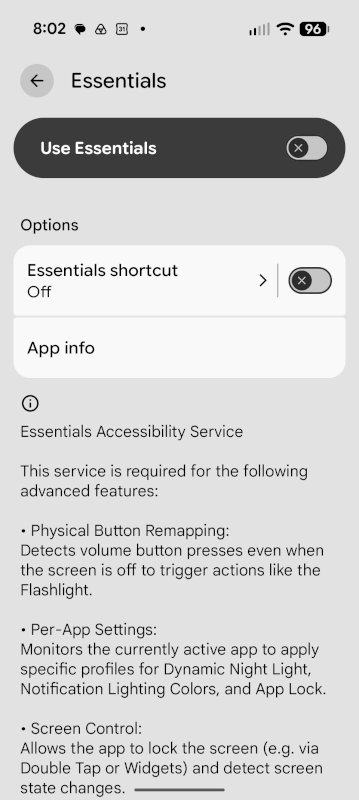
Make sure you understand the new manual installation procedure before continuing. You will also need to change some permissions, depending on the functionality you want to use. For example, to change lock screen shortcuts, you need to enable this option in Accessibility Services.
Likewise, you need to enable restricted settings, which is done via Settings > Applications > See all apps > Essentials. On this page, tap the three vertically aligned dots at the top right corner of the screen, and then tap Allow restricted settings.
If this feature is not enabled, Essentials will be restricted by Android’s permissions system.
Using Essentials
Essentials is quite simple to use. You open the app, find the feature you want to enable, and then enable it. You’ll find, however, that you need to grant a lot of permissions to Essentials. It seems like every time I want to enable or customize a feature, I have to grant a new permission. I know it may seem tedious, but considering the extra opportunities you gain, it’s worth it.
Let me introduce you to a feature from Essentials that you would like to see brought to Android. This is “App Lock”, which allows you to require authentication for certain applications. This is a very convenient option, especially if someone gets their hands on your phone while it’s unlocked and tries to open some apps that you prefer to keep private (like your banking app). To use this feature, you must grant Essentials permission to access accessibility features. You will be prompted when you enable this feature.

Screenshot by Jack Wallen/ZDNET
The “Application Lock” feature can be found in Security and Privacy. Once in this menu, tap the On/Off slider to enable App lock : You will then be prompted to grant Essentials the necessary permissions in the Accessibility settings. Once the feature is enabled, tap on it: you will be prompted to authenticate using fingerprint, facial recognition, or password/PIN (depending on what you have configured).

Screenshot by Jack Wallen/ZDNET
Locked apps
On the next page, tap Select locked apps and you will then be prompted to select the applications that require authentication to open.
For example, I want to ensure that Authy (my favorite two-factor authentication app), my banking app, and Messages require authentication before opening.
To do this, I tap the On/Off slider on those apps until they are in the On position. The next time I try to open one of these apps, I’ll have to authenticate through the fingerprint sensor.

Screenshot by Jack Wallen/ZDNET
Notifications and alerts
Another handy feature can be found in the section Notifications and alertswhere you can enable notification light, flashlight blink, notification sleep, and system notification sleep.
You can turn on notification lighting, then select which apps it applies to. I turned on notification lighting for messages and phone, so I never miss a message or call, even if my device is on silent. You can also activate the flashlight flashes: so no matter whether your phone’s screen is facing up or down, you will be notified of your messages.

Screenshot by Jack Wallen/ZDNET
This is basically how Essentials works. Remember two things:
- You will be overwhelmed by an avalanche of authorization requests
- And some of these permissions are only possible if you have root access or Shizuku and ADB (Android Debug Bridge) privileges without you having to fully root your device). Also note that Shizuku requires you to enable wireless debugging to start the service. Once Shizuku is installed (from the Play Store), you’ll find detailed (and lengthy) instructions on how to do it.
If you want significantly more control over your Android device, I highly recommend adding Essentials, as most of these options aren’t available in any other tool.
Source: “ZDNet.com”
Android App Essentials, Ph. Jack Wallen/ZDNET.
Key takeaways from the Android Essentials app
- Essentials is a dream come true for advanced Android users.
- This application offers a multitude of customization options and settings.
- The app is free, but must be installed manually.
Most Android users are familiar with the Settings menu, which presents them with all the features Google thinks they need. There is also the Developer Options feature, which can be enabled to allow even more possibilities for users.
If that’s not enough, there’s now Essentials, a toolkit for power users that includes over 30 tweaks and tweaks for features like button remapping, app freezing, Google Maps battery saving modes, sound and vibration, wallpaper, widgets, customizing status bar icons, edge lighting, flashlight blinking, notification management, always-on display Display”), and much more.
The only requirement for most Essentials features is Android 8 or newer. A few advanced features require shell providers such as Shizuku (an open source Android tool that allows third-party apps to use system-level APIs) or even root access, but the majority of features that most users will want to enable require no additional requirements beyond the minimum requirements.
Get Essentials
Essentials is not available on the Google Play Store. You must therefore install it manually from the APK available on its official GitHub repository. Keep in mind that Google has changed the manual installation procedure for apps.
Make sure you understand the new manual installation procedure before continuing. You will also need to change some permissions, depending on the functionality you want to use. For example, to change lock screen shortcuts, you need to enable this option in Accessibility Services.
Likewise, you need to enable restricted settings, which is done via Settings > Applications > See all apps > Essentials. On this page, tap the three vertically aligned dots at the top right corner of the screen, and then tap Allow restricted settings.
If this feature is not enabled, Essentials will be restricted by Android’s permissions system.
Using Essentials
Essentials is quite simple to use. You open the app, find the feature you want to enable, and then enable it. You’ll find, however, that you need to grant a lot of permissions to Essentials. It seems like every time I want to enable or customize a feature, I have to grant a new permission. I know it may seem tedious, but considering the extra opportunities you gain, it’s worth it.
Let me introduce you to a feature from Essentials that you would like to see brought to Android. This is “App Lock”, which allows you to require authentication for certain applications. This is a very convenient option, especially if someone gets their hands on your phone while it’s unlocked and tries to open some apps that you prefer to keep private (like your banking app). To use this feature, you must grant Essentials permission to access accessibility features. You will be prompted when you enable this feature.
Screenshot by Jack Wallen/ZDNET
The “Application Lock” feature can be found in Security and Privacy. Once in this menu, tap the On/Off slider to enable App lock : You will then be prompted to grant Essentials the necessary permissions in the Accessibility settings. Once the feature is enabled, tap on it: you will be prompted to authenticate using fingerprint, facial recognition, or password/PIN (depending on what you have configured).
Screenshot by Jack Wallen/ZDNET
Locked apps
On the next page, tap Select locked apps and you will then be prompted to select the applications that require authentication to open.
For example, I want to ensure that Authy (my favorite two-factor authentication app), my banking app, and Messages require authentication before opening.
To do this, I tap the On/Off slider on those apps until they are in the On position. The next time I try to open one of these apps, I’ll have to authenticate through the fingerprint sensor.
Screenshot by Jack Wallen/ZDNET
Notifications and alerts
Another handy feature can be found in the section Notifications and alertswhere you can enable notification light, flashlight blink, notification sleep, and system notification sleep.
You can turn on notification lighting, then select which apps it applies to. I turned on notification lighting for messages and phone, so I never miss a message or call, even if my device is on silent. You can also activate the flashlight flashes: so no matter whether your phone’s screen is facing up or down, you will be notified of your messages.
Screenshot by Jack Wallen/ZDNET
This is basically how Essentials works. Remember two things:
- You will be overwhelmed by an avalanche of authorization requests
- And some of these permissions are only possible if you have root access or Shizuku and ADB (Android Debug Bridge) privileges without you having to fully root your device). Also note that Shizuku requires you to enable wireless debugging to start the service. Once Shizuku is installed (from the Play Store), you’ll find detailed (and lengthy) instructions on how to do it.
If you want significantly more control over your Android device, I highly recommend adding Essentials, as most of these options aren’t available in any other tool.
Source: “ZDNet.com”
https://www.zdnet.fr/wp-content/uploads/zdnet/2026/11/essentials-appli-android-pratique.jpg https://www.zdnet.fr/pratique/android-pratique-lappli-essentials-vous-donne-acces-a-plus-de-30-entreprises-supplementaires-508358.htm?utm_source=rss_feed&utm_medium=link&utm_campaign=unknown