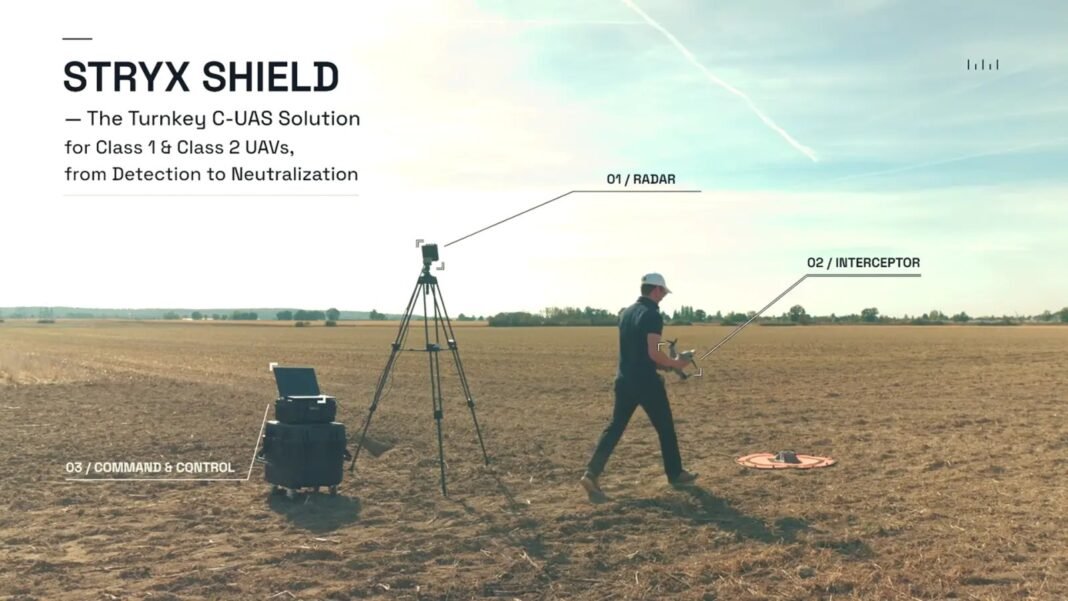
What is Stryx AI? A French start-up, founded in 2025 by Armand Thiberge, the creator of Brevo, which designs drones responsible for intercepting others. It has just raised 7.7 million euros to produce them in France. His argument is to make intercepting almost as cheap as targeting. But the price of its interceptor remains unknown.
An FPV drone, controlled remotely using an on-board camera, costs a few hundred euros. A few thousand as soon as there is a little more sophistication. These unmanned aircraft are in any case cheap and they cost much less money than many of the interceptors that are able to shoot them down.
For an army, pulverizing one with a missile is indeed much more expensive than the target itself. The French Navy has even installed a rocket launcher on its ships to no longer waste its precious missiles. And more generally, staffs are working on much more economical alternatives to counter these threats.
It is in this context that Stryx AI, a young French start-up, places itself. It offers interceptor drones which collide with enemy drones in mid-flight.
Who is behind Stryx AI?
Founded in 2025 and based in Brétigny-sur-Orge (Essonne), the company announced this Thursday, November 19, its first fundraising, of 7.7 million euros. The round is led by its founder and CEO, Armand Thiberge (Brevo, ex-Sendinblue, which became a unicorn in December 2025), with Impala, Jacques Veyrat’s holding company. Michaël de Lagarde and Benjamin Benharrosh, co-founders of drone manufacturer Delair, also invested.
All the investors are French, which fits with the “sovereign” discourse of the company. For Armand Thiberge, quoted by Maddyness, each time “ attack has become cheaper than defense, the world has fallen into chaos. »

Black Friday: Proton Pass Plus at -60%
Until November 30, Proton Pass Plus is €1.99 per month for 12 months, or 60% off! Unlimited email address aliases to take advantage of promotional codes without filling your mailbox, unique password per site, encrypted safe. In short, a stress-free Black Friday!
This sovereign positioning has a concrete translation: Stryx AI presents its system as “ITAR-free”. It therefore does not contain components subject to ITAR, the American regulations on arms exports, which allows Washington to block the resale of equipment incorporating American parts.
For a European customer, this avoids having to depend on a green light from the United States to use or resell it.
The structure has around twenty employees, with Pierre-Louis Blossier in technology and Henri Jouhaud in operations. Arcep, the telecoms regulator, authorized it to use radio frequencies on September 26, 2025, to experiment with its radar.
How does she plan to sell? Two options are available to it: offer its complete system to equip a site, or only provide its interceptor to an industrialist already responsible for protection, who would then maintain the relationship with the end customer.
How does the Stryx AI system work?
According to its website, the system includes:
- Stryx Watcha lightweight radar that spots and tracks drones;
- Stryx C2the software that displays threats and controls shots;
- Stryx Impactthe interceptor drone guided by AI, which pursues its target alone after takeoff;
- Stryx Launchthe station that keeps several interceptors ready to go.

Stryx Impact destroys its target by hitting it in mid-air. According to the company, the system must protect both a fixed position and a moving vehicle.
A human operator keeps the decision to initiate fire. The system first targets FPV drones, including fiber optic ones, which do not emit any radio signals and escape jamming. Stryx AI also says it can target heavier machines, such as the Shahed, this Iranian-designed attack drone used en masse by Russia, which Ukraine now shoots down with robotic machine guns.
Where does Stryx AI stand compared to its competitors?
Everything is currently based on prototypes, tested in the Defense Innovation Agency’s Épervier program. The start-up claims to have succeeded in interceptions in September, during the XLAD exercise. She also says she signed a first order with the French authorities, without giving either the amount or the customer.
It also arrives after others: the armies selected the Blaze from Latvian Origin Robotics in June, then ordered 50 Gobi Zephyr interceptors from Harmattan AI in September. Above all, Stryx AI has communicated neither the price of its interceptor nor the cost of a protected site, even though its entire argument depends on it.
The fundraising must first finance a manufacturing line in France, planned for the beginning of 2027. Stryx AI then wants to sell to armies and sensitive sites (ports, airports, energy sites), and increase to 50 employees by the end of 2027. The start-up is aiming for the first deliveries during 2027.
All the tech news at a glance
Add Numerama to your home screen and stay connected to the future!