Here is an article written in the style of ZDNet, focused on the technical and strategic analysis of the distinction between these two devices.
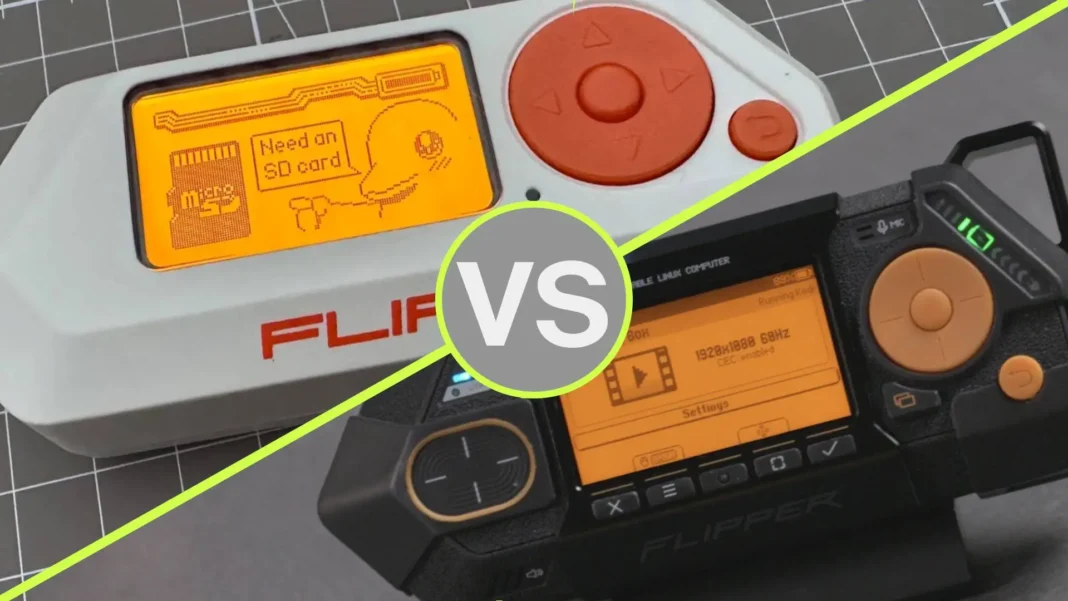
Flipper Zero versus Flipper One: why the new model is not an update
The Flipper Zero has become an icon of geek culture and cybersecurity. The announcement of a successor, the Flipper One, therefore aroused immense enthusiasm. However, the firm insists on a crucial point: it is not a V2. ZDNet takes stock of the fundamental differences between these two devices.
With its translucent case, its virtual dolphin and its 90s toy look, the Pinball Zero has won over enthusiasts of pentesting (intrusion tests) as well as those curious about technology. A true “Swiss army knife” for radio waves, RFID, infrared and GPIO, the small orange box has ridden a wave of global popularity, fueled by TikTok and security fairs.
Then, the rumor of Flipper One has swelled, presented too quickly by the community as “Flipper Zero 2”. A strategic error that the creators quickly rectified. No, the Flipper One is not an update. It’s a totally different product, aimed at a different audience.
Here’s why we need to stop seeing the One as a direct replacement for the Zero.
1. Two opposing material philosophies
The Flipper Zero was designed according to the principle of simplicity and autonomy.
- Pinball Zero runs on a microcontroller (ARM Cortex architecture). No heavy operating system, no Linux. This gives it instant start-up, minimal energy consumption (several days of autonomy) and foolproof robustness.
- The Pinball Oneon the other hand, radically changes dimension. It integrates a SoC (System on a Chip) capable of running a system Full Linux. For what ? To run real security programs, native Python code, and manage advanced Wi-Fi and Bluetooth cards autonomously, without the need for third-party hardware or an additional Wi-Fi module (like the Zero devboard).
2. The case of Wi-Fi: the trigger
On the Flipper Zero, Wi-Fi (although essential for modern network audits) is conspicuous by its native absence. To get it, users need to connect an external module (ESP32) to the GPIO ports. It’s bulky, unattractive and fragile.
The Flipper One natively integrates much more robust Wi-Fi and Bluetooth capabilities thanks to its Linux architecture. It is this software and hardware complexity that brings it closer to a pentesting mini-computer (in the vein of a miniature Raspberry Pi) rather than a simple pocket multifunction tool.
3. General public use vs professional use (Penetration Testing)
This is arguably the most important distinction.
- Flipper Zero is a tool for exploration and learning. Although it can be used to audit systems, it is above all designed to understand everyday radio frequencies (gate remote controls, RFID badges, NFC). Its playful aspect makes it accessible to a wide audience.
- The Flipper One is designed for professionals. Due to its complexity, its Linux nature and its increased computing power, it is intended for cybersecurity experts and pentesters. It requires much more advanced technical skills to really benefit from it.
4. Availability and production: an obstacle course
Let us also recall an industrial detail: the Flipper One has experienced chaotic development. Faced with component shortages, overly ambitious design choices and ultimately geopolitical disruptions, the team had to review its priorities, going so far as to suspend or fundamentally rethink the Flipper One project, even as the Flipper Zero continued to sell hundreds of thousands of copies.
ZDNet’s verdict
The Flipper Zero and the Flipper One do not box in the same category.
Thinking that Flipper One will “obsolete” Flipper Zero is a mistake. The Flipper Zero will remain the reference tool for rapid tampering, learning and light nomadism thanks to its record autonomy. Flipper One (when fully available and released) will be aimed at technicians looking for a pocket-sized Linux workstation capable of real network attacks and extensive Wi-Fi auditing.
In short: they are not rivals, they are complements. If you already own a Pinball Zero, keep it safe: it won’t be replaced anytime soon.
Here is a rewritten, fluid, modern and optimized version of your content, while retaining the original spirit of the article, the basic HTML tags and the journalistic tone.
After missing the Flipper Zero Kickstarter campaign in 2020, I was finally able to get my hands on mine in 2023. Since then, this device has continued to exceed my expectations. It's the ultimate gadget for materializing the invisible: sub-GHz radio waves, NFC, 125 kHz RFID, infrared or even iButton. What the Flipper ecosystem calls “layer 0”.
Just when I thought I had figured out the Zero's capabilities, I dove into the world of alternative firmware, which opened up whole new horizons of functionality.
Over the years, this scene has been structured around an incredibly active community of developers, constantly creating innovative applications.
A whole new paradigm
By May 2026, more than a million Flipper Zeros had found buyers. When the company made the Flipper One official, it wanted to clarify things: it is in no way a replacement, but a radically different tool. Comparing the two is a bit like comparing a hammer to a screwdriver. What are the real distinctions?
The Flipper One is a real Linux computer (built around a Flipper OS derived from Debian and powered by a standard Linux kernel), designed for everything related to IP networks: Wi-Fi, Ethernet and – via M.2 expansion modules – 5G as well as satellite.
If you feel like it, you can transform the One into a router, a VPN gateway or a bridge between wired and wireless networks. This is called “layer 1”.
Why you should go for the Flipper Zero if…

My Pinball Zero. Adrian Kingsley-Hughes/ZDNET
1. You are new to the field
The Zero is one of those rare technologies that will amaze you from the moment you get started. It's a fascinating pocket-sized concentrate for exploring access control protocols (sub-GHz, NFC, RFID, infrared, iButton).
I have often lent it to younger people: in just a few minutes, they understood the principle and carried out their first manipulations while learning.
Everything is integrated, and the dolphin mascot (which took me a while to understand!) is there to guide you step by step.
2. You are looking for a mature ecosystem
You could easily spend six months exploring the Lab — the official app store — before even eyeing third-party firmware.
Thanks to the colossal success of Zero (more than a million copies), the developer community is extremely dynamic. When you take the plunge, I advise you to try Unleashed.
It retains the familiarity of the original software while unlocking powerful options: extension of sub-GHz frequencies without geographical restrictions, advanced NFC tools, and even some games to relax.
3. You want a device that is available immediately
You can order a Zero today for around $170 and start exploring your surroundings before the end of the week.
Please note, I am not discouraging anyone from pre-ordering the One on Kickstarter at the preferential price of around €400 (knowing that it will rise to €550 at the public price), but keep in mind that deliveries will not begin before July 2027 at the earliest.
Why you should choose Flipper One if…

The optional modules of Flipper One. Pinball
1. You want a real pocket Linux PC
The One plays in another court. Unlike the Zero and its FreeRTOS firmware, the One is a full-fledged computer running Flipper OS (Debian, standard Linux kernel).
Result: USB, HDMI, Ethernet ports, and scalability worthy of a PC thanks to its M.2 port for SSD and radio modules.
Plug in a monitor and keyboard, and you have a complete Linux workstation.
2. You want to explore “layer 1” networks
Where the Zero is aimed at proximity connections without IP, the One is designed for global network infrastructure (Wi-Fi, Ethernet, 5G, LoRa, satellite via M.2).
It becomes a tailor-made network tool: router, VPN gateway or network bridge.
Its full-fledged computer architecture also gives it formidable Wi-Fi performance, sometimes surpassing certain laptops. In short, anything a PC can do, the One can.
3. You are looking for a durable device
Flipper's ambition with the One is clear: “to design a long-lasting ARM computer, fully integrated upstream”. To do this, the team pushes its drivers directly into the main Linux kernel rather than locking itself into a proprietary kernel. Software support should therefore be long-term. However, the project still requires a little running-in, and the company is relying on the community to finalize everything.
Some experts, however, have reservations about the total absence of binary blobs or proprietary drivers (especially for Wi-Fi or the cellular part), but time will tell.
Here is a complete technical comparison to help you decide.
Flipper Zero vs Flipper One : Technical sheet
Characteristic
Pinball Zero
Flipper One
Nature of the device
Radio & access control multifunction tool
Network-oriented Linux pocket computer
Price
~€169
Kickstarter: ~€399 (Estimated public price: €550)
Module packs: from €439 to €759
Funding
$4.8M / +37k contributors (2020)
~$14M / ~24k current contributors
(Campaign ends Dec. 17, 2026)
Availability
In stock / Immediate shipping
Scheduled for July 20
Previous article Next article


Popular Articles