Here is an article based on the news mentioned, written in ZDNET journalistic style.
Open source security: GitHub and Microsoft come to the aid of six critical projects
As part of their ongoing commitment to software supply chain security, GitHub and Microsoft teams recently collaborated to identify and fix vulnerabilities in six major open source projects. A prevention intervention that reminds us of the fragility inherent in the basic building blocks of the modern web.
By the ZDNET editorial team Published on [Date du jour]
The open source ecosystem is the cornerstone of modern software development. But it is also, by nature, a house of cards. Aware of this systemic vulnerability, the duo formed by Microsoft and its subsidiary GitHub has just demonstrated once again its role as a “benevolent policeman” of the web. The two giants announced that they have provided security patches to six major open source projects, potentially preventing major incidents for thousands of companies.
A proactive approach against silent threats
Unlike high-profile attacks that target actively exploited zero-day vulnerabilities, the intervention carried out here is proactive research. Thanks to automated security audits and the expertise of Microsoft and GitHub researchers (notably via the GitHub Security Lab), vulnerabilities were detected before they were malicious.
The affected projects, whose exact names have not all been disclosed to give end users time to update their systems, affect critical areas: packet management, data processing and widely adopted network utilities.
“ Open source security is not just the concern of volunteer maintainers who donate their time, it is the responsibility of the entire technology industry, especially the wealthiest players », Cybersecurity experts often point out. It is precisely this philosophy that pushed Microsoft and GitHub to intervene upstream.
The Software Supply Chain Challenge
In recent years, attacks targeting the open source supply chain have exploded. Techniques like dependency confusion (dependency confusion) or poisoning of popular libraries show that hackers have understood that the weakest link in a large company is often hidden in an obscure third-party component downloaded thousands of times a day.
By directly providing pull requests (merge requests) containing the fixes to the maintainers of the six projects, Microsoft and GitHub applied the principle of coordinated disclosure. Patches address vulnerabilities that, if exploited, could have led to remote code execution (RCE) or data compromise.
Towards accountability for tech giants
This joint action illustrates an underlying trend: digital giants, who massively consume open source for their own products (Azure, Windows, GitHub Enterprise), reinvest part of their immense profits in securing this ecosystem.
However, open source maintainers often remain underfunded and overwhelmed. If the one-off help from Microsoft and GitHub is welcomed by the community, it also highlights a structural problem: the global open source ecosystem relies too heavily on the goodwill of a few isolated developers and on the occasional charity of multinationals.
In summary: If you use open source components in your applications, this episode is another red flag. It is urgent to map your dependencies (via SBOM type tools – Software Bill of Materials) and ensure that your libraries are systematically kept up to date.
(Note: This article is a journalistic adaptation based on GitHub Security Lab and Microsoft’s regular initiatives to secure the open source ecosystem).
Here is a clean, modern rewrite of the HTML content in French, maintaining the structure, tone, and formatting of the original article while improving readability and code cleanliness.
GitHub and Microsoft: AI must provide fixes, not simple bug reports
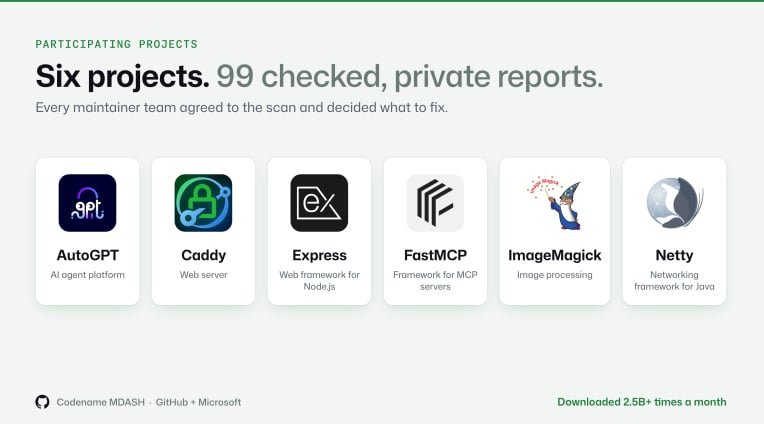
Software maintenance doesn't need more AI-generated bug reports, it needs real fixes. This is the observation made by GitHub, which announces that as part of the pilot project Codename MDASHthe company and Microsoft transformed thousands of raw AI-produced results into 99 private, verified reports. These include proposed fixes for six widely used open source projects. Result: those responsible for these projects have already corrected more than half of the reported problems.
“Focus on high-impact bugs”
GitHub reminds that many free software maintainers “are already overwhelmed with AI-generated security reports, including duplicates as well as reports that do not, in fact, correspond to vulnerabilities. A simple raw scan is of no help to them. Anyone who wants to apply a new AI model to a project should first consult with their managers and suggest fixes, rather than just reporting problems. (…) »
AI should not increase the workload of development teams. This is why GitHub and Microsoft, in close collaboration with maintainers, conducted a pilot project to answer a key question: can artificial intelligence help deploy patches, rather than simply multiply alerts?
Based on multi-model Microsoft agents, the device “is designed to detect and fix security vulnerabilities in major open source software, strengthening the foundations on which much of the world's computer code is built”.
Each project is analyzed using the MAI Cyber model. Duplicates are then eliminated, and the validity of the alerts is manually verified by seven researchers from the Microsoft Forge Lab. “The focus was on high-impact bugs; maintainers never had to review the raw scan results. » They receive reports directly through GitHub's private vulnerability reporting service, along with ready-to-use suggestions.
A sample of six projects launched this system, all from beneficiaries of the open source security fund launched by GitHub at the end of 2024:
- AutoGPTan AI agent platform.
- Caddya web server.
- Expressa web framework for Node.js.
- FastMCPa framework for creating MCP servers.
- ImageMagickimage processing software.
- Nettya network framework for Java.
“Not yet transposable on a large scale”
From this experiment, GitHub draws three main lessons:
- Patching takes precedence over discovery: “It’s fixing that maintainers spend their time on. Thus, each report reaches them already verified, accompanied by a proposal that they only have to examine, adapt and integrate. »
- The value of human analysis: “MDASH, combined with researcher review, provided teams with high-quality results with actionable solutions. »
- Scaling up limits: seven researchers still had to spend about two days manually checking the results, proving that “this type of approach cannot yet be transposed on a large scale. »
Also read
- Free and open source express: apocalypse of vulnerability, European companies, exit from Gafam, boycott of Omarchy — October 31, 2026
- Google suspends its bug-hunting program in open source software — October 5, 2026
- GitHub to support 125 open source projects with $1.25 million — November 24, 2024
- Google and OpenSSF introduce tool for analyzing malicious open source repositories — April 30, 2022