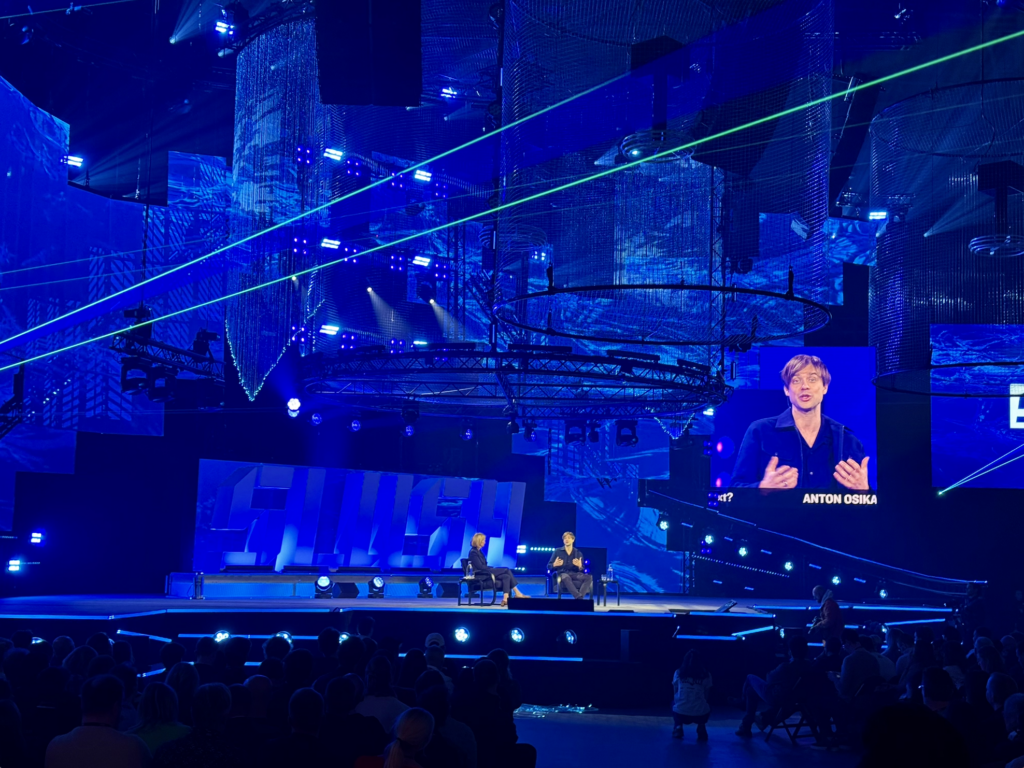
Here is an article written on the subject of Slush, highlighting the remarkable proportion of investors among the participants.
1 in 4 participants is an investor: Slush, the European El Dorado for startups to raise funds
Every year, as winter approaches, Helsinki transforms into the tech capital of the world. While Finland experiences freezing temperatures and particularly short days, the Messukeskus Congress Center is bursting with incandescent energy. Slushit is the unmissable event for the European tech ecosystem.
But behind the futuristic scenography, the dim lights and the electro music which characterize this unique event, hides a mathematical reality which makes all startup founders dream: one in four participants is an investor.
A golden ratio for fundraising
In the world of trade shows, the conversion rate between contacts made and real opportunities is often low. At Slush, the situation is completely different. With an attendance of almost 13,000 participants, the event brings together approximately 4,000 investors (VC funds, business angels, institutional investors) for 5,000 entrepreneurs.
This exceptional ratio (1 investor for 4 participants) makes Slush one of the densest venture capital events in the world. For a startup looking to complete a financing round (Pre-Seed, Seed or Series A), the density of opportunities is unrivaled. Unlike traditional fairs where you have to jostle to meet a decision-maker, at Slush, the investor is omnipresent: in the queues, on the networking sofas, and of course, on the stages.
The next level’s “Matchmaking”
What differentiates Slush from other major technological events like the Web Summit or CES is its obsession with effective meetings. The organization has developed a connection application (matchmaking) extremely efficient, coupled with a precise physical device: the “Founder-to-Investor” (F2I).
Thousands of pre-scheduled 15-minute meetings take place at a breakneck pace. For a young entrepreneur, it is the equivalent of several weeks of prospecting condensed into 48 hours. International funds, particularly American and Asian, are making the trip specifically to source European gems, attracted by the rigor and quality of local tech.
Beyond the cold, the warmth of deals
Originally created in 2008 by Finnish students at a time when the local ecosystem was struggling to exist, Slush has retained its “non-profit” DNA and underground culture. Run largely by volunteers, the event cultivates a refreshing paradox: a relaxed, almost rock’n’roll atmosphere, combined with financial transactions worth tens of millions of euros.
In a macroeconomic context marked by the “VC winter” (the slowdown in venture capital investments observed in recent quarters), Slush is resisting and confirms its status as a barometer of European tech.
Why Slush remains an obligatory step
For French-speaking founders, often technically excellent but sometimes shy on the international scene, Slush offers an ideal launching pad. The message sent by this tide of investors is clear: Europe is full of capital, but the latter are looking for daring projects, capable of scalping internationally.
In short, with 25% of its audience ready to sign checks, Slush is not just a conference where people come to listen to trends. It is an open-air market, a real El Dorado where, as long as you have prepared your pitch and its product, every handshake can transform the future of a startup.
Here is a rewritten, modern and fluid version of your article, while keeping the HTML code clean and marked up:
Slush 2026: The big meeting of European tech in Helsinki
In a gloomy European economic climate, completing a fundraising effort is often an obstacle course. Between the reluctance of investment funds and a concentration of capital on mega-rounds (13 operations worth more than a billion dollars expected in Europe in 2026), the picture remains mixed despite an overall rebound. According to Atomico's annual report, European startups are expected to raise $81 billion in 2026, a spectacular increase of 62% compared to the previous year ($50 billion).
However, if the overall amounts increase, the volume of transactions decreases. The number of pre-series A transactions fell by 30% in Europe between 2021 and 2025, while series A and B recorded a decline of 19% over the same period. In this tense context, entrepreneurs must seize every opportunity to convince investors. And in this regard, the Slush conference, organized every end of the year in Helsinki, stands out as the unmissable event.
6,000 startups and 3,000 investors: a unique ratio
Beyond its status as a major European tech meeting, the Finnish summit is the scene of intensive networking between founders and investors. More than 50,000 targeted meetings punctuated these two days of the 2026 edition, not counting the informal connections made during the approximately 600 side events that make Helsinki vibrate at this time of year.
Of the 12,756 registered participants, 6,358 startups from more than 70 countries made the trip to capture the attention of 3,248 investors. Result: an exclusive ratio of two entrepreneurs to one investor, difficult to match elsewhere in the world. Among the profiles present, there were 1,746 VC funds, 555 CVC (corporate funds) and 144 business angels, all levers capable of propelling a young company towards new markets or accelerating its product roadmap.
“Very strong networking skills”
Every year, the French ecosystem responds. For this 2026 edition, Business France led a delegation of 31 startups, including Allergen Alert, a finalist for Fundtruck 2025. Historical players in the event, like Leonard (the accelerator of the Vinci group), were also there to support gems from the construction, mobility, energy and real estate sectors.
Julien Villalongue, general manager of Leonard, and Kevin Cardona, deputy director of entrepreneurial innovation, led a delegation of around forty people. “At Slush, the concentration of founders and investors is extremely high. It’s an ideal springboard for business, supported by impressive networking capabilities. Add to that a quality program and a galaxy of side-events, and you get a memorable level of FOMO (fear of missing out)! »enthuses Julien Villalongue.
Up&Charge targets a Series A of 10 million euros
In its suitcases, the accelerator notably brought nuggets from its SEED program. Among them, Up&Charge, specializing in wireless induction charging for electric vehicles – which hopes to complete a 10 million euro Series A round soon – as well as Neuronaix, which is developing an AI allowing industrial robots to learn by demonstration.
The international side was also in the spotlight with Kapture, an Australian startup founded by Raj Bagri (ranked among the 100 best innovators in Australia in 2025 and 2026). Its carbon capture solution installs directly on diesel generators. Coming from Melbourne, Chilean entrepreneur Andrés Mitnik (based in Spain) presented Strong by Form, cutting-edge technology inspired by the structure of trees to design lighter, decarbonized wooden construction materials.
Slush, the springboard for success stories like Lovable
Participating in Slush can radically transform the trajectory of a business. A study carried out by the organizers comparing 2,108 startups attending the event between 2022 and 2024 to nearly 230,000 similar structures is clear: Slush alumni are 3.5 times more likely to raise funds, and are 7 times more likely to be supported by the top 0.1% of VC funds. Their fundraising also turns out to be twice as large, for companies with an average of two years of existence and 300,000 euros raised. “This demonstrates a strong correlation, even if it is not a direct causal link”tempers the Slush team.
It is precisely at Slush that Anton Osika chose to officially launch Lovable in 2024. Specializing in “vibe coding”, the Swedish startup has become one of the most meteoric growths in European tech history, posting more than $500 million in annual recurring revenue (ARR) as of last June.
Back on stage this year, the entrepreneur expressed his gratitude: “I owe so much to this scene”he said during an exchange with Jessica Livingston, partner at Y Combinator. Buoyed by successive funding rounds – including a $400 million raise this summer which brought its valuation to $13.3 billion – the Swedish nugget continues to attract talent: Aino Bergius, former general manager of Slush, now manages its activities in the Nordic countries.
“Slush 100”: the queen competition for startups
Many companies dream of following in Lovable’s footsteps through the prestigious “Slush 100” competition. This year, around twenty finalists had the opportunity to pitch to a jury of renowned investors.
Ultimately, it was the American startup Goldfish which won the prize, ahead of the British Sqwish Labs and the Luxembourgish TerraSpark in the final. Founded by Swedes Joel Edholm and Kaspian Jakobsson in San Francisco, Goldfish designs a memory based on artificial intelligence acting as a cognitive extension of the user on their computer.
The victory comes with a check for 500,000 euros non-dilutive, giving the founders complete freedom to experiment and accelerate their vision. Goldfish thus succeeds Diffraqtion (quantum cameras for space and defense) and, in a historical nod, to the French nugget CybelAngel, which won over the Helsinki jury ten years ago.
Slush's ambition