Will artificial intelligence eliminate jobs in France? Employers don’t think so, at least not in the short term. For his first studypresented on November 17, 2026L’France Travail Observatory questioned more than 16,000 establishments on how AI will transform their jobs from here five years. Their gaze is measured: the AI first modifies the taskslong before the professions. “For the vast majority of companies, what is at stake first is not the disappearance of work, it is its transformation,” summarizes Thibaut GuilluyDirector General of France Travail.
An investigation of unprecedented scale
The study is based on a complementary part of the annual survey Labor requirements 2026, conducted by telephone among a representative sample of more than 19,000 private and public establishments, excluding the state civil service, in mainland France and in the five overseas departments. The section devoted to AI covers more than 16,000 establishments of at least one employee, questioned about their vision in one, two, three and five years.
AI already present in four out of ten companies
According to France Travail, 38% of employers are already using artificial intelligence or are testing it. The most common tool is theGenerative AIthe one who researches, summarizes and writes text: 85% of employers who use AI are using it, especially to create content, save time and automate repetitive tasks.
Usage varies greatly depending on the size of the company: a third establishments with fewer than 5 employees use AI, compared to 71% those with 200 employees or more. It is also more common in large cities: for the same profession and sector, the probability of use there is 30% higher than that of rural communities, according to Hello Workplace.
What employers plan
When asked about their main job over a five-year horizon, employers respond as follows:
| Expected effect of AI within five years | Share of employers |
|---|---|
| Little or no effect | 59% |
| Save time on certain tasks | 35% |
| Carrying out numerous tasks, competing with humans | 6% |
“Very few companies think that AI will replace humans,” underlines Marc Bouscasse, head of studies and foresight at France Travail, quoted by Hello Workplace. Concretely, writing a report, summarizing a document or preparing a first draft of a quote: the AI takes care of part of the work, and the professional keeps the verification, the decision and the relationship with clients or users.
Four job families
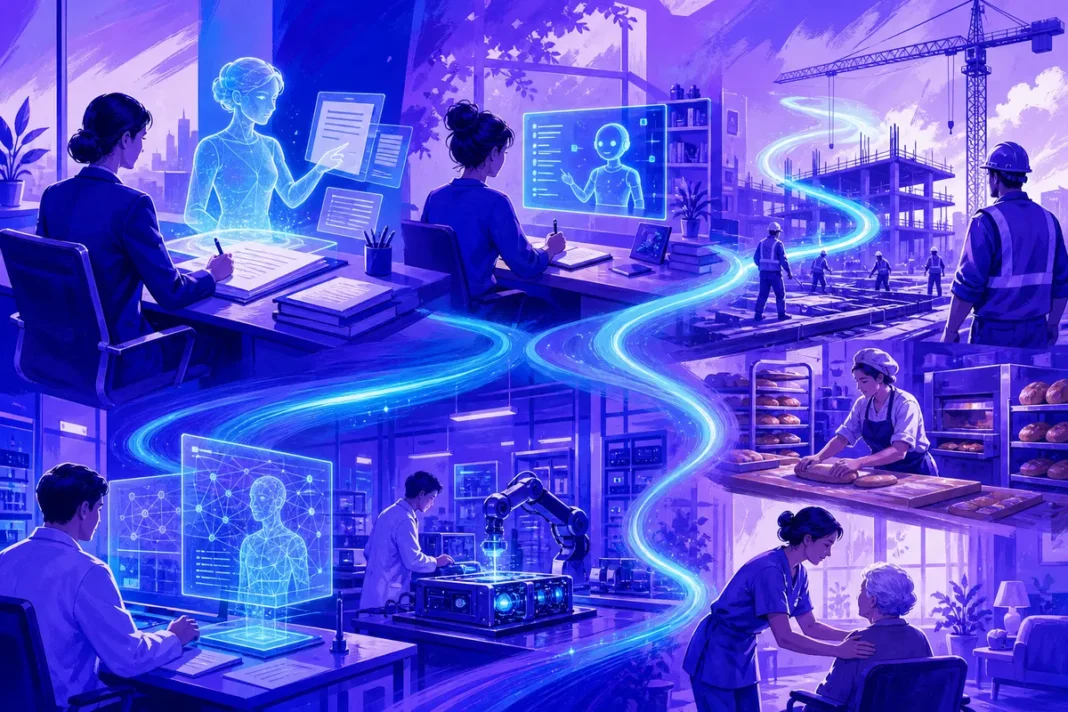
The study distinguishes four situations depending on the share of tasks that AI can take care of.
Weakened professions
AI can carry out many of the usual tasks there. These are professions that deal with a lot of written or encrypted information: administrative secretaries, bookkeepers, legal assistantseditors. For example, 19% employers of accounting employees and 20% of those of IT technicians think that AI will carry out many tasks in these professions, compared to 6% for all professions combined. For France Travail, weakened does not mean doomed: these professions are evolving towards more control, advice and relationships.
Augmented professions
It is the largest family. AI becomes a co-pilot which saves time, the human retaining the decision: lawyers, human resources managers, radiologists, teachers, project managers. Employers expect significant time savings in law (74%), education (55%) or commerce (40%).
Between these exposed professions and those which are little affected, some find themselves in an intermediate situation: nurses, caregivers, security guards, cashiers, salespeople or handling workers. AI can help them, for example to analyze data or make a forecast, without replacing their physical and relational tasks.
Professions that develop AI
New professions are emerging to design and manage these technologies: data scientists, AI engineers, AI ethicists. However, these profiles remain in the minority in the needs expressed: among employers who use AI, 19% cite programming or machine learning as skills to develop.
Jobs that are little affected
Where the gesture, the terrain and the human relationship take precedence, the effect remains limited. A large majority of employers foresee little or no effect of AI in services to individuals (85%), the building and public works (80%), thecraftsmanship (77%) andhotel and catering industry (76%). Childminders, home helpers, hairdressers, cooks and construction workers are concerned, professions which are often recruiting.
These results qualify other, more worrying signals. The Banque de France observed that hiring of young people on permanent contracts fell by 28% in professions exposed to generative AI. The two findings do not contradict each other: employers can recruit fewer beginners for certain tasks without considering replacing their main profession. Only 16% of employers surveyed by France Travail cite the reduction in recruitment difficulties among the benefits of AI.
A subject that concerns all territories
The departments most affected are those in large cities, such as Île-de-France, Rhône, Loire-Atlantique or Haute-Garonne, where office and service professions are more numerous. But according to France Travail, even in the least affected departments, a little morea third of salaried jobs are expected to be affected by AI within five years.
Skills that matter
27% of employers are already seeing, or will see within three years, the skills of their main profession evolving with AI. Among those using AI:
- 70% expect their employees to know how to use generative AI;
- 65% expect good handling of the tools deployed by the company;
- 61% want them to know When to use it, and when not to;
- 60% cite knowledge of legal rules, from the GDPR to the European regulation on AI;
- alone 19% expect programming skills.
On the recruitment side, AI remains discreet: only 14% of employers use it at some point in the process, especially to write job offers (28% of these uses). The analysis of CVs or interviews remains rare.
Prepare rather than fear
The study shows a gradual shift rather than a sudden upheaval. For employees, the message is clear: knowing how to use AI wisely becomes an asset, including for being recruited, without it being necessary to become an IT expert. For companies, the challenge is to train their teams, anticipate the evolution of the most exposed positions and promote the human skills that AI does not replace: discernment, relationships and decision-making. It remains to be seen whether the cautious vision of employers will resist the acceleration of progress in AI, which the France Travail Observatory promises to follow in its next studies.