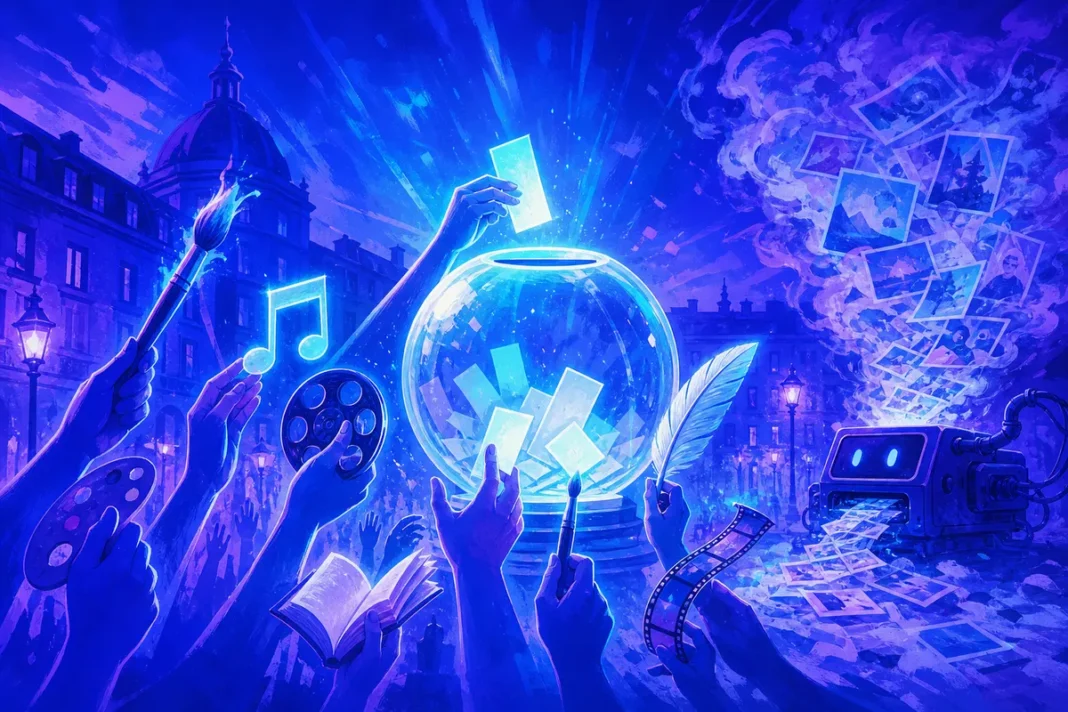
How to recognize a human work? How can we protect the rights of authors in the face of artificial intelligence that learns from their creations? To try to answer it, eleven cultural sector organizations launched the November 23, 2026 a citizen consultation entitled “How to ensure the future of human creation in the era of artificial intelligence?” “. Open to all until January 17, 2027it must make it possible to collect public expectations and fuel debate with public authorities.
Who carries out the consultation
The initiative brings together organizations from the book, music, press, cinema, audiovisual, visual arts, digital creation and performing arts sectors. Among the signatories are, according to franceinfo and Livres Hebdo:
- there Sacemwhich represents authors, composers and music publishers;
- there SACDsociety of dramatic authors and composers;
- there Scamcivil society of multimedia authors;
- THE National Publishing Union and the Permanent Council of Writers;
- there SofiaFrench society of the interests of authors of writing;
- there Procirepsociety of film and television producers;
- L’General News Press Alliance (Apig).
The consultation is implemented by Make.organ independent civic platform, which will analyze the results.
Why now
Organizers describe growing tension between AI and human creation. “Artificial intelligence produces texts, images, music or videos in just a few seconds. If the tools it offers open up new possibilities, they also pose threats to the cycle of human creation,” they write. They emphasize that these tools rely, to learn, on works created by women and men, “most of the time, without their authorization and without remuneration”.
Their press release is based on several figures:
| Observation | Source cited by the organizers |
|---|---|
| More than half of the titles uploaded each day to Deezer in June 2026 were entirely generated by AI | Deezer data |
| 24% of music creators’ income and 21% of audiovisual income threatened by 2028 | Global study for CISAC |
| 39% of British novelists say AI has already reduced their income | University of Cambridge, 2025 |
| Nearly one in three AI responses to current events misquotes its sources or cites none at all | Study of 22 public media, 2025 |
| Nearly 4 in 10 French people, or 23 million people, consult information sites generated by AI every month | Gesture, Médiamétrie, Next, 2026 |
The questions asked
The press release lists the questions that the consultation wants to answer: “How to recognize a human work? How can we protect ourselves from a society of fakes and hyperfakes? How can we guarantee respect for copyright and neighboring rights? Should we fear the eventual disappearance of all human creation? »
These questions concern everyone, the organizers insist, “whether we read, listen, watch or create”. The debate has taken a concrete turn in the world of books, where a controversy around a novel suspected of having been written with the help of AI has, according to franceinfo, raised fears of the start of an “era of generalized suspicion”.
Participation is simple and open to all:
- go to the platform Make.orgon the consultation page “How to ensure the future of human creation in the age of AI?” » ;
- propose an idea in the form of a short sentence;
- vote on the proposals of other participants: agree, disagree or neutral;
- come back regularly: new proposals are added until January 17, 2027.
A legislative debate still blocked
The consultation comes while the legal framework remains under discussion. In France, a bill proposed by Senator Laure Darcos, aimed at establishing a presumption of exploitation cultural content by AI providers, was to be examined in the National Assembly on November 19; according to Livres Hebdo, it was blocked again. Such a text would force AI companies to prove that they did not use a work, rather than leaving the burden on authors to prove that it was used for training.
At the European level, the AI Regulation already requires providers of general-purpose AI models to publish a summary of training data and to respect copyright, including refusals expressed by rights holders. Some giants of the sector have also adopted a common signal of refusal of training, without this being enough to appease the creators.
What everyone can already do
Without waiting for the results of the consultation, readers, listeners and spectators have a few ways to act at their own level:
- check the origin of the content: some platforms now report pieces or images generated by AI, and serious media indicate their sources;
- favor identified sources for information, rather than anonymous sites that mass produce articles;
- directly support creatorsby purchasing their works, by going to concerts, to the cinema or to bookstores;
- be wary of hyperfakes: a spectacular image or video circulating without a source deserves verification before being shared.
The issue of labeling content generated by AI is also at the heart of European standardization work: ETSI has published a standard for AI creators to prevent abuse linked to hyperfaking, in line with the obligations of the European regulation on AI. These technical tools do not resolve the issue of remuneration of authors, but they help the public to distinguish what was created by a human from what was produced by a machine.
A consultation with a view to the presidential election
According to the National Publishing Union, the results of the consultation will be shared in the run-up to the 2027 presidential election. The objective is clear: to make the place of human creation in the face of AI a subject of public debate, and to influence the commitments of the candidates.
It remains to be seen whether the mobilization will be there. Its success will depend on its ability to reach beyond cultural professionals, by mobilizing readers, spectators and listeners, who are primarily concerned with the future of the works they consume. The most supported proposals should outline, in January 2027, society’s expectations on the labeling of content, the remuneration of authors and the place of humans in creation.