Five months of preparation, dozens of commented CSV files, an impeccable pyramid plan on paper… and an explosion at the 22nd kilometer that Gemini didn’t see coming. Claude had anticipated everything. Feedback on my first marathon, and what we should really expect from an artificial coach.
On November 8, I crossed the line of the Nice-Cannes marathon in 4h09 on my watch. “Less than 4 hours” goal missed, but first marathon completed, 20 months after starting running again. I’m proud of it: in March 2025, my first outing was 2.6 km and I thought I was going to die there.
I owe this time largely to artificial intelligence. My failure to go under 4 hours too, and it is this ambivalence that interests me.
Before Gemini: Runna, or one-way coaching
It all started with Runna (read the full article here), the training plan app acquired by Strava. For my first half marathon, I followed it to the letter. Two problems emerged very quickly.
The first is conceptual. Runna works like it does in 2015: the app gives you a session, you do it, period. Impossible to ask him why this session, to discuss calf pain, to know how many gels to take or how to manage a departure in an airlock. At a time when any chatbot can hold a conversation on the physiology of exercise, a coach who does not answer questions seems from another age.
The second is more concrete: I injured myself twice with Runna training. This is a criticism that we often read about the app, the pace and volumes calibrated too high for profiles like mine, sporty but not runner. Result, on March 8, at the Paris Semi, I completed the 21 km in 1h52 while I was aiming for 1h45.
Gemini, the talking coach
That same evening, I opened a conversation with Gemini. I give him my times, my feelings, my sessions. He offers me specific work, explains his choices to me, answers all my questions (this is the first time I’ve heard about gels, carbohydrates, racing food, etc.). Three weeks later, I ran a semi in 1:45:21. Right on target.
The week that followed, I saw a guy on Insta saying that no one takes pride in reading half a book or seeing half a film, but that we’re packing it for a half marathon. It made me laugh and it touched my ego. I had to do a marathon. I registered for Nice-Cannes, symbolic for me since I had done my first 10 km there 20 years ago, and I decided to entrust all the preparation to Gemini, in the same conversation – which I had named, without realizing the irony, “Half-marathon time prediction”.

The device was simple. Gemini has built a 29-week plan, very classic in its structure: a large base of fundamental endurance (at least 80% of the volume under 145 bpm), increasingly long marathon pace blocks, a peak in volume with outings of 24 to 30 km, then three weeks of sharpening (-30%, -50%, -70%). After each session, I sent him the exported CSV of my Coros watch (yes I ended up buying it after testing it), and he commented on it.
And honestly, a lot of it worked really well:
- The progress was real. The load weeks were consistent, I didn’t have any serious injuries, and I went up to 30 km on a long outing (September 18) without any damage.
- The “everything else” was excellent. Nutrition, gut training (accustoming the stomach to 80 g of carbohydrates per hour), choice of gels, timing of the caffeine postponed after the semi, management of minor pains, shoes, sacrificial clothing in the airlock… This is exactly what Runna did not know how to do.
- Stupid questions were answered. 12 days before the race, I wonder if I should do my Covid and flu boosters. Answer: postpone after the race, your body will be overworked by the vaccines during the training period, wear an FFP2 mask in transport. The kind of exchange you have with a human coach at the side of a track.
Gemini’s first flaw: amnesia
The first problem appeared after a few weeks. Gemini forgets.
Not all at once, but in large chunks. We believe that we have entrusted him with relevant things that he remembers, and then suddenly he forgets. On several occasions, he offered me a completely different week plan than the one he had constructed himself. I had to remind him: “No, we had planned this, this and this. » Response: “Ah yes, that’s true, here is the corrected plan. »
This is the known limit of very long conversations: after a certain volume, the model loses information from the beginning. Except that a training plan is precisely a progression. If the coach forgets where we are, he breaks the very logic of training. Same thing on details (I had a psychological breakdown at a time when my rabbit was in the veterinary clinic, he kept reminding me of it then completely forgot it when I tried to make him remember why I was less happy at one point in prep) or the obvious (at one point, he had forgotten all my personal records).
My parade: every two months or so, I asked Gemini for a complete “freeze frame”. What has been done, what remains to be done, paces, key data, my runner profile. If the conversation got out of hand, I would pick up on this assessment. It works, but it’s up to the user to do the memory work. Not really our idea of a coach. An app like Momentum, based on Gemini, fixes this on its own.
Second fault, the real one: the yes man
From the start, Gemini set a target in relation to the half run of 5:00/km: 5:30/km, or 3h52 for the marathon. I only wanted to go under 4 hours, but the entire preparation was built around this pace.
On paper, it wasn’t absurd. The Riegel formula, used by most online calculators, transforms my semi in 1h45:21 into a marathon of around 3h40. My Coros watch predicted 3:44 a week before the race. Aiming for 3:52 therefore looked like a comfortable safety margin.
Except that these predictors have documented bias. In 2016, Andrew Vickers and Emily Vertosick studied more than 2,000 amateur runners: Riegel’s formula works well up to the semi, but clearly underestimates the marathon time, by at least 10 minutes for half of the runners. Their model shows that weekly training volume matters as much as past times. A first marathoner with 20 months of running behind him (me) is not the average runner on a prediction table.
That’s where I had the idea of bringing Claude in, somewhat by chance. Coros offers an MCP connector that allows Claude to directly access my watch data. Out of curiosity, I asked him for an independent assessment. He immediately pointed out what Gemini had never noticed: my cardiac drift.
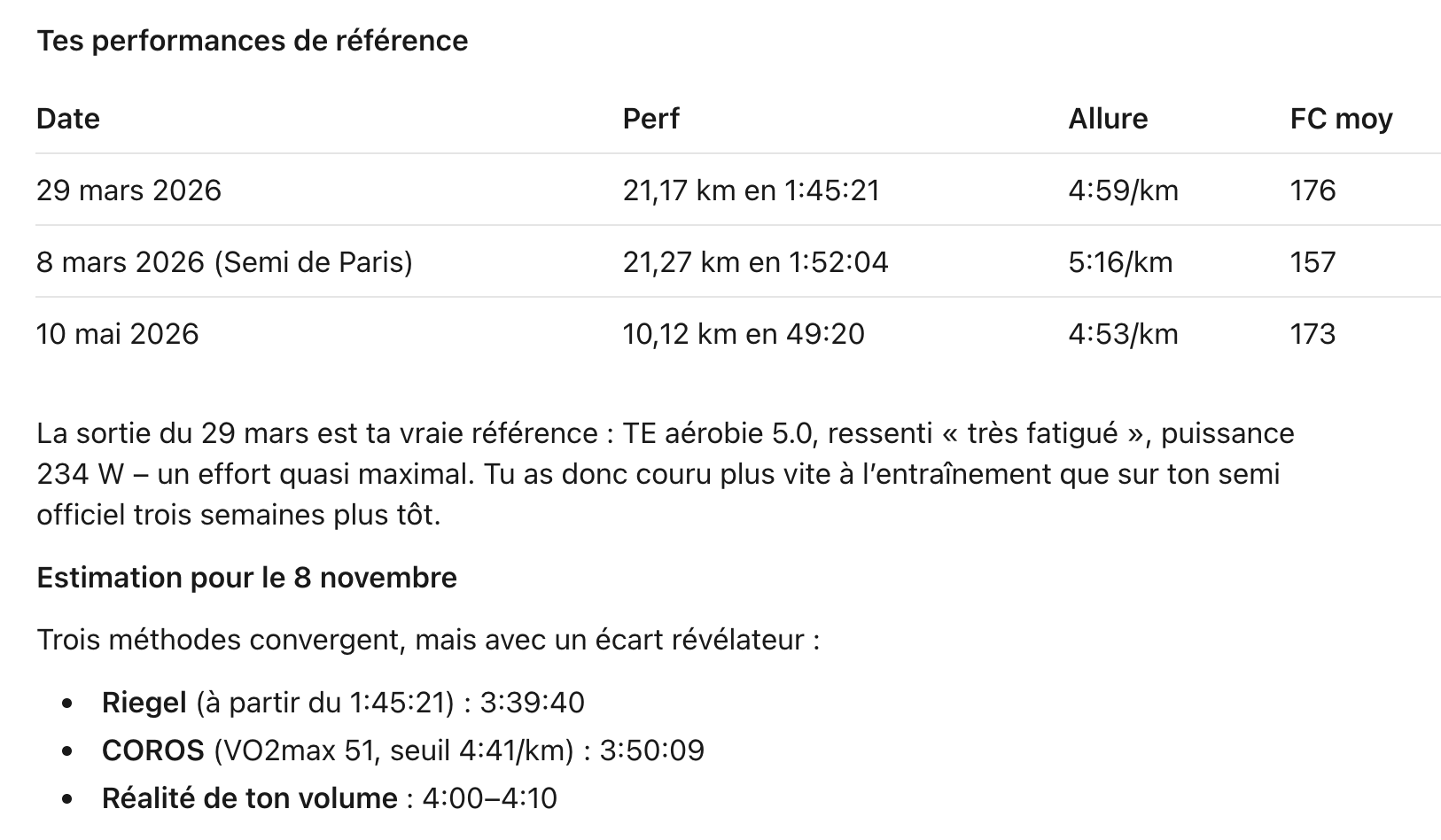
The reasoning was simple. On my long outings, doing 5:30/km cost me around 165-168 bpm, and it climbed at the end of the block. However, a 4-hour marathon is not run at the threshold: you place yourself well below, otherwise you empty your glycogen reserves well before the line. Claude’s conclusion: as it stands, 5:30/km over 42 km won’t hold up.
There remains one question that no one has ever really answered: where is my threshold? Coros displays it at 166 bpm. Except that on March 29, I ran my semi in 1h45 at an average of 176 bpm, between 174 and 180 bpm from the 4th to the 20th kilometer, with a last kilometer at 184. Maintaining ten beats above your threshold for an hour and a half, being an amateur, is not plausible. Claude had concluded that my true threshold was probably higher, somewhere in the 170s, and that Coros had simply never recalculated it correctly.
The reason is almost stupid. The reliable method for obtaining your threshold at Coros is the “Running Fitness Test”: 25 minutes of sustained effort, then 3-minute increments. And the test is invalidated as soon as it is paused. I never did it. The rest of the time, the watch estimates the threshold based on my outings, which are peppered with stops to fill the bottle or wait for a light. Result: in 20 months, I have never had a measured value. My threshold was deduced by calculation. I don’t know him.
It doesn’t change the substance. Whether the threshold is 166 or 175, running at 172 bpm from the 10th kilometer of a four-hour marathon is running at almost the intensity of a semi for twice as long. But it reminds us of something obvious that neither Gemini nor I had asked: before building five months of training on cardiac zones, we must measure them.
I sent the analysis back to Gemini. And there, the response was complete assurance: it will be cooler, you will be sharper, you will lose 15 bpm, no problem. Gemini even found numbers to prove it: at 10k at 5:30/km on October 4, I was at 168 bpm; on November 5, on a block at 5:29/km, at only 151 bpm. “Record economy,” he replied, triumphantly.
Except that these two figures are not comparable. The first is 10 km at marathon pace after a 12 km warm-up, on a 28 km outing. The second is 1.5 km over a 5 km session, as fresh as a roach. Comparing the two is not measuring the effect of sharpening: it is comparing a long end of release to a warm-up. Gemini selected the data that confirmed his plan and discarded those that contradicted it.
So who was right?
On November 8, the race went almost exactly as Claude had described. This is what my watch says:
| Section | Average pace | Average HR | Elevation + |
|---|---|---|---|
| km 0 to 10 | 5:32/km | 162 bpm | 12m |
| km 10 to 22 | 5:31/km | 172 bpm | 19m |
| km 22 to 28 | 5:51/km | 177 bpm (max 183) | 48m |
| km 28 to 33 | 6:01/km | 176 bpm | 16m |
| km 33 to 42.5 | 6:36/km | 172 bpm | 26m |
The detail you need to see: from the 6th kilometerat 5:31/km my heart was at 168 bpm, and it settled above 170 from 10th onwards. Within a few beats, the intensity of my semi in March, with more than 30 km ahead of me. No bump, no fatigue yet, just the cold reality of my level at this pace.
I stuck to the flight plan until the semi, which passed in around 1h56. Then came the climb to Cap d’Antibes, the real climax of the race, between the 22nd and 28th kilometer. Let me be clear: I exploded. My stride went from 1.05 m at the start to 86-88 cm at the end. The second semi took me about 2h13, at over 6:30/km over the last ten kilometers.

Small tasty detail: in his post-race assessment, Gemini explained my nausea at the finish as “mesenteric ischemia”. In medicine, this term refers to a serious vascular emergency, not an upset stomach after 42 km. The real phenomenon (the reduction in irrigation of the digestive system during a long effort) is known and commonplace among marathon runners. But dressing it up with a medical diagnosis is the same fault as throughout the prep: a scientific veneer placed on a lack of rigor. Well done Google.
What to expect from an AI coach
Let me be clear: I’m not trashing Gemini. He took me from 1h52 to 1h45 on a semi in three weeks, took me to the start of a marathon without injury and supported me on everything that planning apps ignore. For someone who ran 2.6 km twenty months ago, finishing a first marathon in 4h09 is nothing to be ashamed of and I burst into tears as I crossed the finish line, a mixture of exultation, pride and relaxation which proved that the time had little importance.
But a coach is not a plan. It’s someone who reads data that we don’t know how to read, who says what we don’t want to hear, and who adjusts. On this very point, Gemini failed in the worst way: he saw the data, he received the objection, and he chose to reassure me. A human coach who would have told me “at 5:30, you explode at the 25th, we aim for 5:45 and you go under 4 hours” would undoubtedly have helped me achieve my goal.
Claude is not infallible, however, and he is clearly less cheerleader. But he did what you expect of a coach: compare my numbers to what you know about a first marathon, and tell me no.
I would have three lessons for anyone who would like to be coached by an AI:
- Give it direct access to the data. CSVs are great, but don’t screenshot your Strava outputs or anything manual, it’s tedious and gets lost in context (or just plain misinterpreted). A connector to the watch changes everything, like Coros with its MCP.
- Hold the memory of the plan yourself. An up-to-date follow-up document, which you put back together when the conversation goes astray. You can create a Coach project and have it extract this data automatically every month.
- Explicitly ask for the contradiction. “What in my data could defeat this goal? » This is THE question that no complacent AI spontaneously asks.
For my next races, after Runna and Gemini, I will try to follow the advice of good old Claude. He’s not super nice, but at least he’s lucid.
All the tech news at a glance
Add Numerama to your home screen and stay connected to the future!