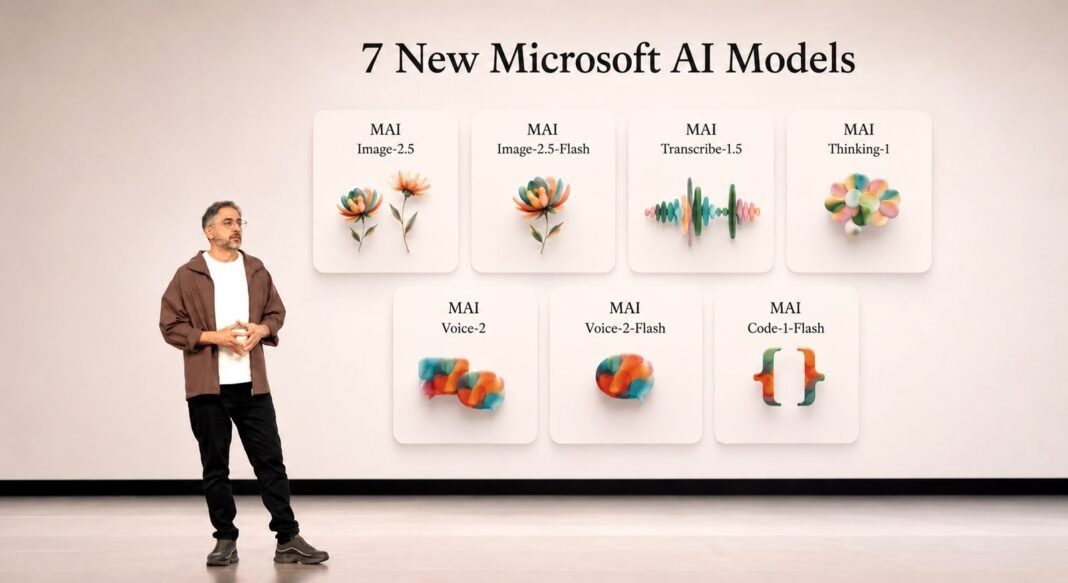
- → At Build 2026, Microsoft revealed MAI, a family of 7 AI models developed in-house : reasoning, code, image, voice and transcription.
- → Central argument: ” zero distillationThe transfer of knowledge from a large model to a smaller one, to save cost and speed. »models trained from scratch, without reusing those from OpenAI or others.
- → The real objective: reduce dependence on OpenAI and lower costs for developers.
- → First deployments: MAI-Code-1-Flash in GitHub Copilotthe rest in preview on Azure AI Foundry.
For years, Microsoft’s artificial intelligence was OpenAI. Copilot, Bing, Azure: everything was based on the models of its partner, in which the Redmond giant has invested tens of billions. On June 2, 2026, at its Build conference, Microsoft sent an unambiguous signal: it now wants to stand on its own two feet.
The company revealed MAY (for Microsoft AI), a family of seven in-house models covering most uses. A technical announcement in appearance, but which marks a major strategic shift in the most powerful couple in tech.
7 models revealed at once
0 · distillation, driven from zero
June 2, 2026 · at Build
Azure + Copilot deployment
01, The range
Seven models in one go
Rather than a single flagship model, Microsoft preferred to release a complete range, designed to cover the needs of a company without having to draw from several suppliers.
| Model | Role |
|---|---|
| MAY-Thinking-1 | Reasoning, the flagship model |
| MAY-Code-1-Flash | Code and agents, integrated with GitHub Copilot |
| MAY-Image-2.5 (and Flash) | Generating and editing images |
| MAY-Voice-2 (and Flash) | Speech synthesis, voice agents |
| MAY-Transcribe-1.5 | Transcription, 43 languages |
The ambition is clear: to offer a complete stack, from reasoning to voice, entirely controlled by Microsoft. According to the company, these models compete with the best on the market in their respective niches, for a significantly lower cost, figures to be confirmed by independent tests.
02, The argument
“Zero distillation”, the argument that counts
Microsoft strongly emphasizes one point: its models are trained from scratch, on licensed data, without “distilling” the outputs of a competing model. Distillation, training a small model by imitating a large one, is a common practice, but it is addictive and raises questions of ownership.
By claiming “zero distillation”, Microsoft sends a message to its business customers: these models are its own, traceable, and usable without fear of hidden dependence on a third party. It’s an argument of confidence as much as technique.
03, The real story
The real subject: emancipating yourself from OpenAI
This range does not happen by chance. On April 27, 2026, Microsoft and OpenAI renegotiated their agreement, lifting the exclusivity that linked Redmond to its partner. Microsoft is now free to build and offer its own models. And he doesn’t hold back.
At the helm, Mustafa Suleyman, co-founder of DeepMind then of Inflection, recruited in 2024 to lead Microsoft AI. He set up a team dedicated to the construction of in-house models, with a clear objective: autonomy.
It’s all about long-term autonomy for Microsoft and its partners. These are models that can be trusted.
Satya Nadella, the CEO of Microsoft, summed up the issue differently: the days when a company was content to “consume” a cutting-edge model are over, make way for those who “participate” at the frontier by building their own.
04, Availability
Where to try them, and at what price
Microsoft has not released these models in isolation: some are already deployed. MAY-Code-1-Flash arrives in GitHub Copilot, the most used assisted coding tool in the world, which immediately guarantees millions of users. The other models are available in preview on Azure AI FoundryMicrosoft’s AI platform for developers and businesses.
The price argument is at the heart of the system: by running its own models on its own infrastructure, Microsoft saves the sums paid to OpenAI and can reduce prices for developers. Full pricing for MAI-Thinking-1 should be clarified as it is deployed on Azure.
05, The market
What this changes for the market
With MAY, the landscape is reconfigured. OpenAI loses its most strategic exclusive customer, even if the partnership continues. Above all, the battle is moving: it is no longer just a question of having the best model, but of having your own stack, from silicon to software, so as not to depend on anyone.
Microsoft thus joins Google, which has always developed Gemini internally, and reinforces a major trend for 2026: the giants all want to own their AI from end to end. For developers and businesses, this is mostly good news, more choice, more competition, and downward pressure on prices. It remains to be seen whether MAI will keep, in use, the promises of in-house benchmarks.
To go further: GPT-5.5 unveiled at Microsoft Build · OpenAI and Anthropic become consulting firms · The ChatGPT model sheet · Compare AI models