At the Singaporean A*STAR IMRE institute, which designs new materials, an old microwave reactor has no API. It has a touch screen. Its executive director, Professor Loh He says this in the Google Cloud post which opens the model in public preview on October 27, 2026. Then he specifies: “This is the next level that we aspire to reach. »
A public preview on Google Cloud, three months after the API
Google DeepMind presented ER 2 on July 30, 2026. The launch post already said it was “publicly available to developers via the Gemini API, Google AI Studio”, and in private preview on Gemini Enterprise Agent Platform, Google Cloud’s AI platform. Since October 27, any client company can call it on this platform, in Model Garden, under the identifier gemini-robotics-er-2-previewtry it in Agent Studio, and then deploy it with Google Cloud rights management and security controls. The model remains a preview. Its predecessor, ER 1.6, is listed as discontinued on August 31, 2026 in the Gemini API documentation.
He plans and checks, another model executes the gestures
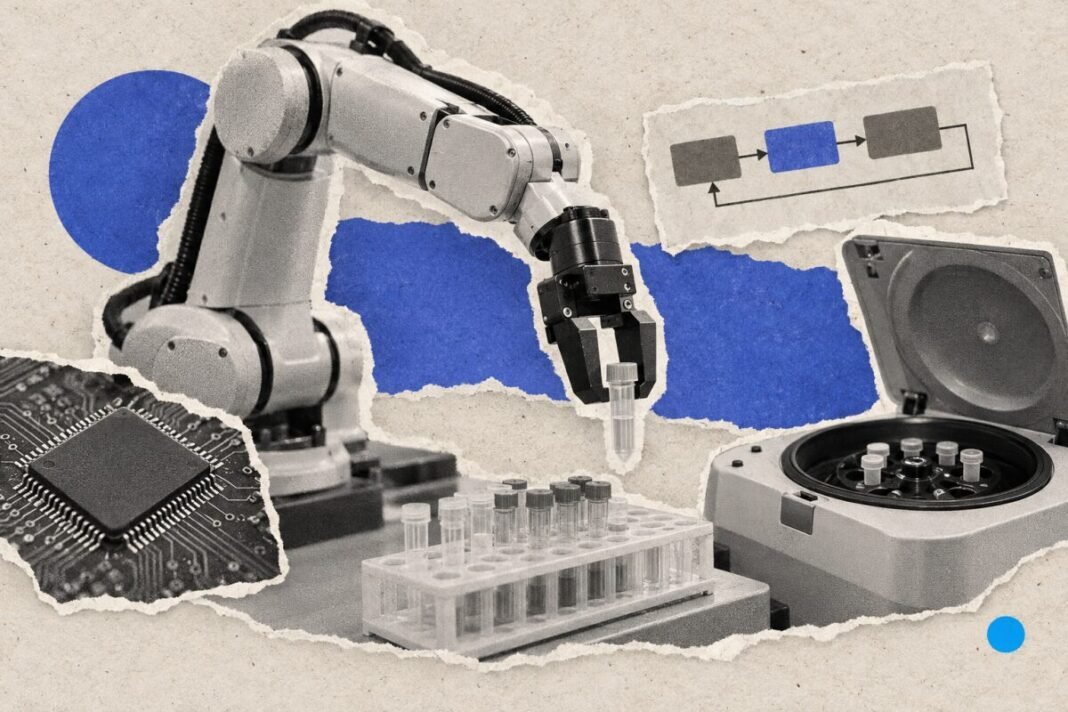
Google describes it as “a high-level brain for robots,” which “then hands off motor execution to any lower-level vision-language-action (VLA) models.” The developer declares as tools the commands he has, a VLA, a navigation API or his own functions. ER 2 receives the video, sound or text, cuts the task, calls these tools, then watches the video to judge whether the step was successful and restarts it without restarting the entire process. The model, built on Gemini 3.5 Flash according to its technical sheet, only produces text. In July, DeepMind had it pilot the navigation and arm APIs of Boston Dynamics’ Spot robot to fetch objects on demand.
The model that controls the motors, Gemini Robotics 2, is reserved for early access partners, according to DeepMind’s July 30 post. A factory that wants to try ER 2 must therefore provide its own commands: the APIs from the manufacturer of its robots, or an action model trained elsewhere.
In-house figures, with no named competitor
Google claims 91.3% accuracy in identifying, in a video, the image where a critical event occurs, such as the moment to stop pouring a liquid, with an average deviation of 0.96 seconds. The model reportedly runs at “4 times the speed” of “many categories of larger models”, which are not named. On the classification of the progress of a task, the July post announces 57.4% correct answers. This is the ability on which restarting a failed step depends. On this test, for which Google publishes neither the protocol nor the competing scores, 42.6% of the answers remain false.
Safety remains the responsibility of the operator
The Gemini API robotics documentation is explicit: “It is your responsibility to maintain a safe environment around the robot.” The datasheet excludes safety-critical applications, such as healthcare or transportation, anywhere a failure could result in death, injury or property damage. DeepMind’s security report, dated July 29, 2026, measures that the best models tested detect in an image the crossing of a boundary of one meter around a person with an accuracy of approximately 79 to 93%. In the agentic version of the test, the models which reduce the proportion of missed stops to around 10 to 15% when a person is nearby stop the robot for no reason 15 to 25% of the time. None approach zero on either count. The report concludes that it is “currently preferable” to use these models with “low-level deterministic security guardrails.”
Industrial inspection, the only use described, was built on ER 1.6
The only robotic use described in operation in these announcements comes from Boston Dynamics. On April 8, 2026, AIVI-Learning, its visual inspection module for Spot, upgraded to Gemini Robotics ER 1.6 for registered customers: reading gauges and displays, liquid indicator levels, conveyor damage, puddles and debris, pallet counting. Sharing data with Boston Dynamics is mandatory. In the October 27 post, Marco da Silva, who heads the Spot business, believes that ER 2 brings “even more value” to these customers: “Video changes what an inspection can be. » No timetable for switching to ER 2 has been published. DeepReach, of which Chris Liu is a co-founder, uses ER 2 to sort recordings of gestures from qualified professionals intended to train physical AI models.
One dollar per million input tokens, net of credits, until the end of 2026
Google Cloud offers to prepare the simulation tests in MuJoCo-Warp or NVIDIA Isaac Sim, then to offload the mapping and trajectory calculation on site with Google Distributed Cloud. The Genie 4 world model, presented by DeepMind on the same October 27 as an aid to “develop training environments for robots and agents”, is currently only open to trusted testers.
The first test is done in Agent Studio, with your own images or videos. The Google Cloud price list displays for ER 2 a promotional price of 1 dollar per million tokens for input, text, image, video or sound, and 5 dollars for output, including reasoning, until December 31, 2026. This is not an invoice discount: Google pays back 50% of the net expenditure in credits, without specifying on the page when these credits are paid or how long they remain valid. On January 1, 2027, the promotion ends and the grid displays 2 dollars for entry and 10 for exit.
Quotes translated from English by ActuIA.
Our articles will be prioritized in Google’s “Featured” section.