Here is an article written in the style of ZDNet, based on current technological issues in data centers and artificial intelligence.
AI data centers: why (and how) the industry is preparing its big switch to 800 VDC
Faced with the explosion in power consumption of servers dedicated to artificial intelligence, traditional infrastructures are reaching their physical limits. To avoid overheating and energy loss, cloud giants and OEMs are turning to high-voltage direct current (800 VDC). Deciphering a silent revolution.
The data center industry is experiencing a paradoxical moment. As language models (LLM) and GPU clusters continue to grow in power, the electrical infrastructures that power them are reaching the end of a historic cycle. With server racks now happily exceeding 40 kW — and quickly heading toward 100 kW and more — the venerable alternating current (AC) network is showing signs of running out of steam.
To deal with this energy surge, a consensus is emerging among engineers: the solution lies in 800 VDC (Volt Direct Current)or the use of high voltage direct current.
Why the current system is collapsing under the weight of AI
Historically, powering data centers has been an energy obstacle course. High voltage alternating current from the public grid is stepped down, converted to direct current for battery backups (inverters/UPS), then transformed back to AC for distribution in the racks, before being converted again to DC (12V or 48V) by the server power supplies (PSUs) for the chips.
Each energy conversion generates heat and results in losses, estimated between 5% and 15% depending on the age of the installations. On the scale of a data center campus consuming as much electricity as an average city, these losses amount to millions of dollars and wasted megawatts.
In addition, transporting massive power at low voltage (like the long-dominant 12V) requires cables of disproportionate thickness, which end up blocking the air flow necessary for cooling servers.
800 VDC: the physical and industrial response
By switching to a bus 800 volts direct currentthe industry applies a simple physical principle: the higher the voltage, the lower the intensity (amperage) for the same power transported. Lower currents mean much thinner cables, less resistance, and therefore a drastic reduction in thermal losses.
The advantages of 800 VDC are multiple:
- Increased energy efficiency: By removing several conversion stages, the overall efficiency of the electrical chain improves by 3 to 5 points.
- Space saving: Thinner cables free up valuable cubic millimeters in racks, improving airflow (or the efficiency of liquid cooling systems).
- Harmonization with adjacent technologies: The automotive sector (notably high-performance electric vehicles) and solar panel systems already use 800V architectures. Data centers thus benefit from a mature supply chain for components (capacitors, switches, converters).
How the industry is changing
The transition to 800 VDC will not happen overnight. It is a titanic project that involves the entire value chain, from semiconductor suppliers to hyperscaler operators (Google, Microsoft, AWS, Meta).
- At the component level: The use of wide bandgap semiconductors, such as Silicon Carbide (SiC) and the Gallium Nitride (GaN)is essential. They alone are capable of switching voltages of 800V with formidable efficiency and without overheating.
- In terms of standards: Industrial consortia and standardization organizations (such as OCP – Open Computing Project) are working hard to define the security and interoperability standards for 800 VDC. Working with high direct voltage presents increased risks of persistent electric arcs, requiring ultra-fast and intelligent circuit breakers.
- In terms of the architecture of the rooms: The new “AI-ready” data centers are designed from the outset to integrate this continuous distribution, often coupled with immersion or cold plate cooling systems (direct-to-chip).
Towards a new essential standard
The switch to 800 VDC illustrates the extent to which artificial intelligence is reshuffling the cards in computer engineering. It is no longer just a question of code, algorithms or GPU engraving finesse, but of pure physics.
As the power needs of AI continue to grow exponentially, 800 VDC appears less of a technology option and more of a condition of survival for a sector under pressure, both financially and environmentally. The first massive deployments of this architecture are expected from 2025-2026, marking the end of the all-alternative era in the data cathedrals of tomorrow.
Here is a rewritten, optimized, fluid and professional version of your HTML content, while rigorously preserving the original structure, tags, image links and encrypted data.
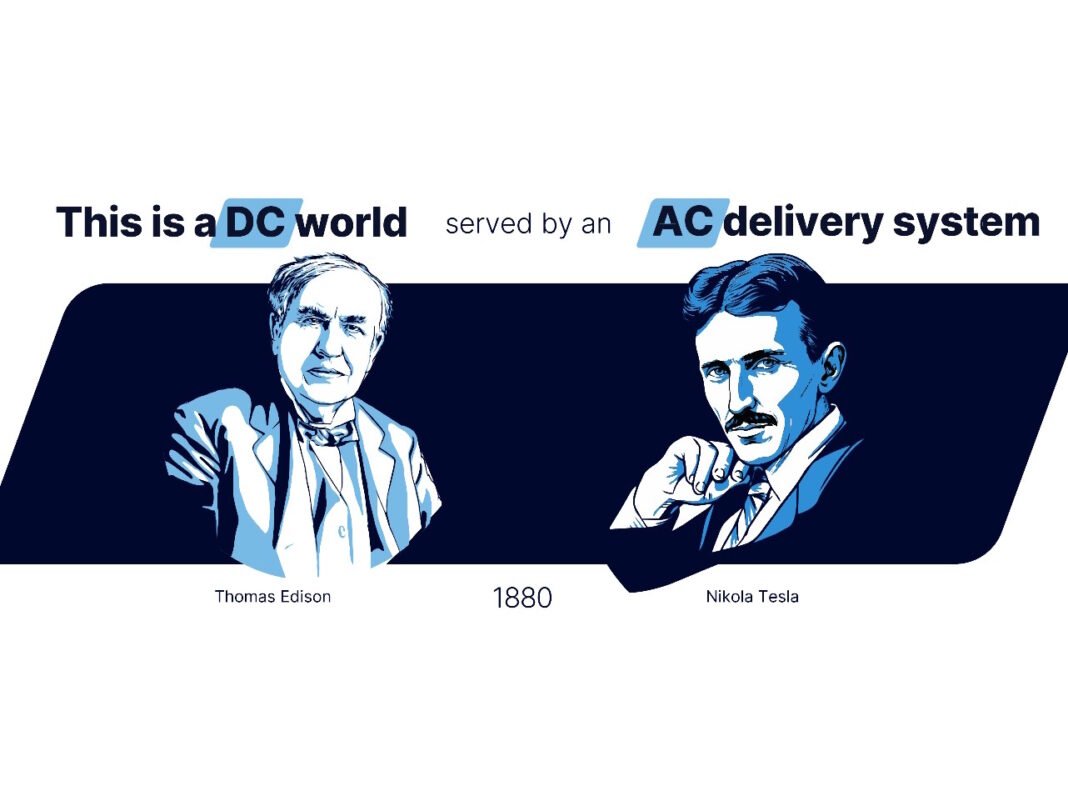
For more than a century, the electrical distribution of infrastructures has accommodated itself to a compromise inherited from the end of the 19th century: transmitting energy over long distances using alternating current (AC), even though electronic chips operate exclusively on direct current (DC).
“We are operating in a DC world powered by an AC distribution system,” summarizes Meir Adest, vice president of technology at SolarEdge.
Until now, this cohabitation worked smoothly in data centers, with “powers of 15 to 25 kW per bay,” recalls Séverine Hanauer, account manager at Vertiv.
However, the meteoric rise of generative AI is changing the situation. The latest generation server racks (such as Nvidia Blackwell and the future Vera Rubin platform) now reach 100 kW, even 250 kW, with the ambition of eventually reaching one megawatt per rack.
At this level of density, the main challenge for data center operators is no longer just access to silicon: “The bottleneck has shifted from GPUs to megawatts,” says Meir Adest. A situation which requires a complete rethinking of architectures and electrical supply, especially since the use of alternating current generates major energy losses that the industry is actively seeking to eliminate.
The end of waste: 12% energy lost in the “first kilometer”
In a classic alternating current power supply chain, the electricity carried from the public network undergoes a cascade of successive transformations before reaching the components. SolarEdge details these successive losses:
- Step-down to 480 V AC via transformer (-1 to -2.5%),
- Low voltage distribution (-1%),
- AC/DC/AC inverter (UPS) guaranteeing continuity of service (-5 to -8%),
- Distribution by AC PDU socket strips (-1 to -2%),
- In-bay power supplies (PSU) converting 480 V AC to 54 V DC (-2 to -4%).
 © SolarEdge
In total, approximately 12% of overall power is wasted during these conversions. With the International Energy Agency (IEA) forecasting a 50% increase in power consumption in data centers dedicated to AI in 2025 (and a near doubling of overall sector consumption to around 950 TWh by 2030), such inefficiencies are no longer tolerable.
Beyond energy losses, physical constraints also apply. Carrying hundreds of kilowatts under a low voltage of 50 V or 400 V AC would require bus bars (busbars) of several thousand amperes as well as bundles of copper cables so bulky “that they would prove cumbersome to the detriment of servers and high-density optical cabling”, specifies Séverine Hanauer.
The preferred solution therefore consists of upgrading data centers to a standard voltage of 800 V DCmaking it possible to drastically reduce copper requirements while simplifying the internal architecture of the bays.
“Efficiency = tokens = revenue”
In AI-dedicated factories, which increasingly dominate the data center market, energy efficiency is the real driver of financial profitability.
According to the projections presented by Meir Adest:
- For an AI computing center 100MW hosting GB200 NVL72 type bays, an efficiency gain of +1% frees 1 MW of additional useful power to power the chips.
- Considering an average cost of $5 per hour of GPU computing and a utilization rate of 90%, this recovered megawatt generates more than 20 million dollars in additional turnover per year.
- Over a standard operating life of 7 years (with a weighted average cost of capital set at 10%), this simple improvement of one efficiency point represents a net present value (NPV) approaching $100 million.
From the “sidecar” to the static transformer (SST)
The transition to 800 VDC will not happen overnight, however. “800 VDC does not abruptly replace existing AC infrastructure; it offers a complementary deployment alternative capable of coexisting with current installations,” underline Google, Microsoft and Nvidia as part of their joint work within the Open Compute Project (OCP).