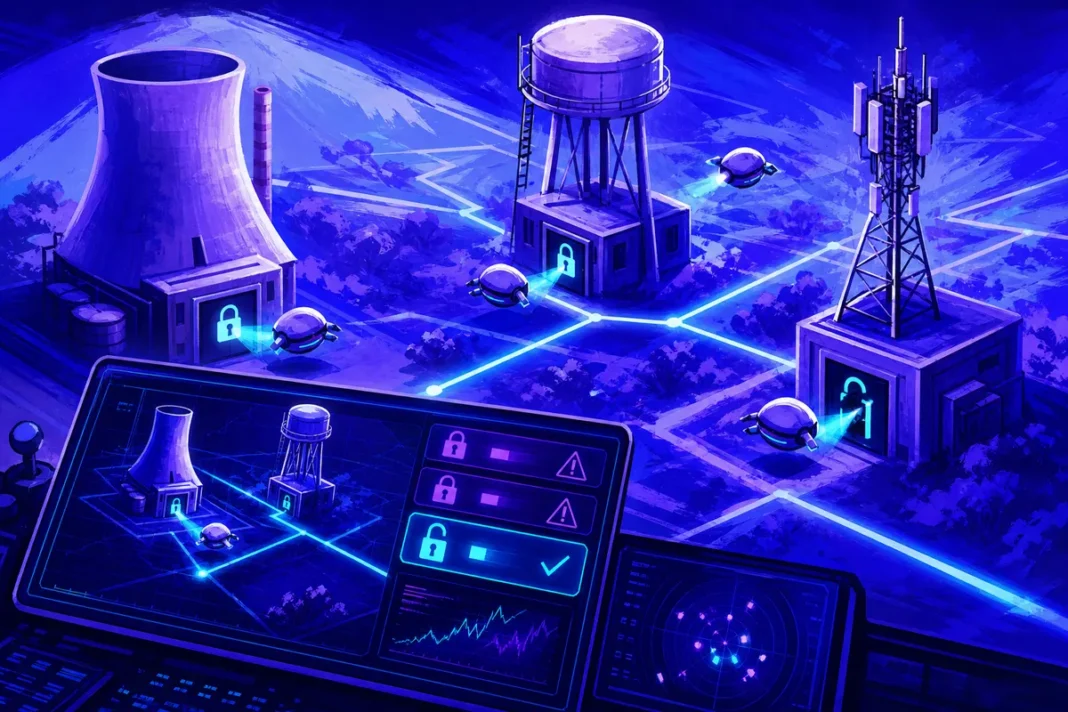
Until now, computer attacks carried out by AI agents have mainly involved laboratory demonstrations. Switzerland has just reached a milestone: the November 24, 2026L’Federal Office for Cybersecurity (OFCS) announced that it has received, for the first time, reports of cyberattacks in which such agents have been used against companies and operators ofcritical infrastructure. In all cases brought to its attention, the targeted systems were compromised.
What the federal office announces
The OFCS indicates having received these reports “in recent days”, without giving a precise date or figure in its publication. The victims are companies and operators of critical infrastructures falling under of at least two sectorswhich the office does not name. No organization is identified, and the Swiss press indicates that SMEs are among the targets.
The most striking point comes from a sentence from the office: in all the cyberattacks reported to it, the use of AI agents made it possible to successfully compromise the victim’s computer systems.
Details then came from the Swiss press, based on statements from the director of the OFCS, Florian Schützon German-speaking radio and television SRF. They must be taken with caution: the figures reported differ from one media to another.
| Element | What is reported |
|---|---|
| Official publication | November 24, 2026, without number |
| Number of cases | Five confirmed cases, according to Le Matin and InCyber |
| Critical infrastructure | Three cases according to Le Matin, two or three according to InCyber |
| Successful attacks | All according to the OFCS, four according to Le Matin, two according to InCyber |
| Authors | Unknown at this stage |
These differences are undoubtedly explained by successive reformulations of the same oral source. The official text remains the point of reference, and it does not mention any figures.
What is an offensive AI agent?
The office uses the expression “Agentic Offensive Frameworks”. Behind this term hides software that does not just execute a list of instructions: it autonomously searches for vulnerabilitieschooses the appropriate attack tools, evaluates the results obtained, then plans and executes the next steps.
This is the major difference with traditional attack tools. A classic automated script always applies the same sequence and fails as soon as it encounters an unforeseen obstacle. An agent can react to a defense by trying another known method, without human intervention, and continue until it finds a way through or exhausts its options.
The OFCS cites two agents visible on the Internet, ARTEX And CyberStrikeAIwithout claiming that they were used in the reported attacks. He specifies that the number of agents of this type visible on the Internet has almost doubled since October 2026without giving a starting value, which prevents us from measuring the real extent of the phenomenon but indicates its trend.
Who are the attackers?
This is the main unknown. Neither the office nor the Swiss media put forward any attribution: we do not know whether these are criminal groups, state actors or simple opportunists who have recovered a publicly available tool. The OFCS also does not give details of the operating mode, nor the consequences suffered by the victims, indicating that no major disturbance was noted.
This discretion is usual: publishing too many technical details amounts to informing other attackers, and naming the victims would expose them more. On the other hand, it complicates the independent assessment of what really happened.
Very classic entrance doors
The most useful detail for businesses concerns the means used. According to the office, these agents operate default or easy-to-guess passwordsas well as known flaws in software or systems connected to the Internet.
In other words, the novelty is not in the intrusion technique, but in its speed and in his ladder. Agents often need only a fraction of the time a human attack would require, and they can work continuously. Negligences that went unnoticed because no attacker had focused on a small business become exploitable once the search for targets costs almost nothing.
Classic automated attack and agent-driven attack
Traditional automated tools
- A sequence of actions fixed in advance
- A blockage as soon as an unforeseen obstacle arises
- Human intervention necessary to change method
- Targeting limited by the attackers’ available time
What an autonomous agent changes
- A search for vulnerabilities carried out without supervision
- The choice of tools and evaluation of results by the machine
- A change of method in the face of a defense encountered
- A continuous search for targets, including on small structures
This observation is consistent with work carried out elsewhere: AI agents discovered an unknown flaw in eleven minutes during an Amazon exercise, and the European Commission confirmed in November that it had suffered a cyberattack carried out with AI tools. The difference this time is that a national authority notes real cases on its territory, including against SMEs.
The six measures recommended by the OFCS
The office asks organizations to apply without delay a series of measures. There is nothing spectacular about them, and that is precisely the point: they are the basics of computer security, recalled because they too often remain incomplete.
- Reduce exposed systems on the Internet, and restrict their access by geographic blocking or by list of authorized addresses.
- Install critical security patches systems accessible from the Internet within 24 hours at most.
- Generalize multi-factor authentication or access keys, systematically and without exception, on all internal resources accessible from the Internet, web messaging and remote access included.
- Apply the principle of least privilege: grant the minimum necessary access rights.
- Detect behavioral changes and volume of data, for identities as well as for applications and infrastructures.
- Carry out regular penetration testsinternally or by a specialized service provider.
The office also indicates that it transmits to operators of critical infrastructures technical indicators making it possible to identify attacks carried out with this type of tool, assistance reserved for the moment for these organizations.
What to remember, in France as elsewhere
Switzerland has nothing in particular that would make it a target: its European neighbors use the same software, with the same flaws, and the attackers do not have to travel. The interest of this announcement lies in the fact that it documents, officially and in a national framework, a phenomenon hitherto described mainly by the publishers themselves.
The conclusion of the director of the OFCS is worth remembering: if there is no vulnerability, even an AI agent cannot break into a system. Automating the attack does not create vulnerabilities, it exploits existing ones, faster and on a larger scale. The time available to organizations to correct their known defects is reduced, and it is in this light that the six recommendations take on their full meaning, including for structures that thought they were too small to interest anyone.
For a French SME, the practical translation comes down to three questions: which company services can be reached from the Internet, when were their security updates last installed, and does remote access require anything other than a simple password. The answers to these three questions determine most of the risk described by the Swiss office.
Frequently asked questions
What did the Swiss Federal Office for Cybersecurity announce?
On November 24, 2026, the OFCS reported that it had received for the first time reports of cyberattacks carried out with artificial intelligence agents against Swiss companies and operators of critical infrastructure, in at least two sectors. The office specifies that in all reported cases, the affected systems were compromised.
What is an offensive AI agent?
It is software capable of carrying out a computer attack without continuous human supervision: it searches for vulnerabilities itself, selects the appropriate tools, evaluates the results of its attempts, then decides on the next steps. Unlike a regular script, he can change his method when he encounters a defense, making him more difficult to block.
How do these attacks succeed?
According to the OFCS, they exploit very classic means: default or easy-to-guess passwords, and already known flaws in software or systems accessible from the Internet. The novelty therefore does not lie in the intrusion technique, but in the speed of execution and in the number of targets that can be tested.
What should businesses do to protect themselves?
The OFCS recommends six immediate measures: reduce the number of systems exposed on the Internet, install critical patches within 24 hours, generalize multi-factor authentication or access keys, limit access rights to what is strictly necessary, monitor changes in behavior and data volume, and perform regular penetration tests.
Sources
References consulted for the writing of this article. The addresses are provided for information purposes only and are not links.
- OFCS, cyberattacks involving AI agents: first confirmed cases in Switzerland, November 24, 2026www.bacs.admin.ch/fr/26-ki-agenten-1-fr
- ICTjournal, cyberattacks carried out by AI agents now affect Switzerland, November 25, 2026www.ictjournal.ch/news/2026-11-25/cest-officiel-les-cyberattacks-menees-par-des-agents-ia-touchent-desormais-la
- Le Matin, the first hacks with AI agents hit Switzerland, November 26, 2026www.lematin.ch/story/cyberattacks-les-premiers-piratages-avec-des-agents-ia-frappent-la-suisse-103674188
- InCyber, Switzerland: critical infrastructures targeted by AI agents, November 26, 2026incyber.org/article/suisse-infrastructures-critiques-visees-par-agents-ia
Report an error or inaccuracy in this article