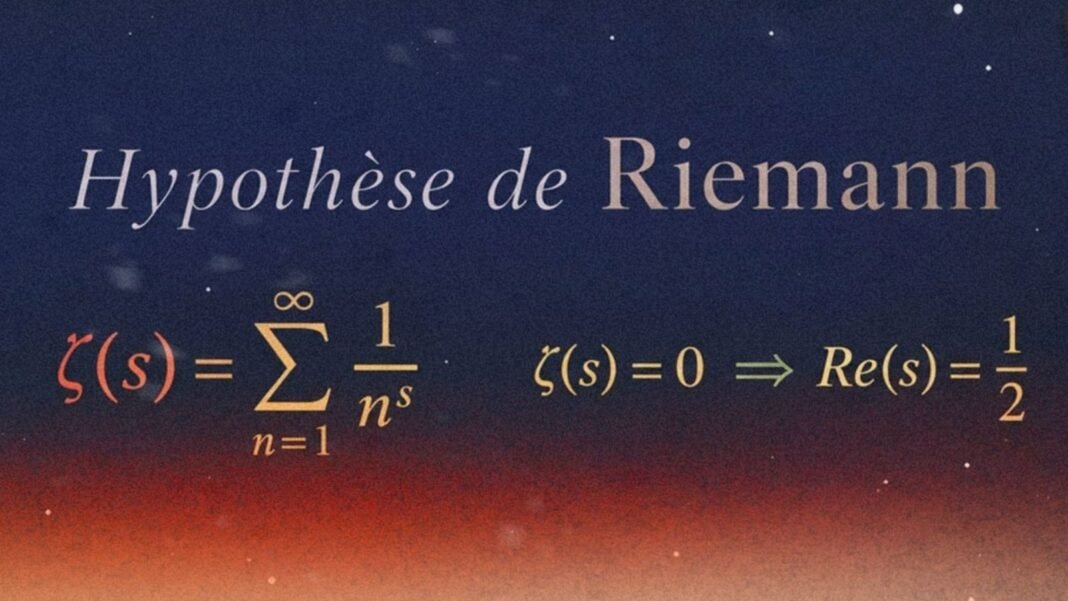
A million-dollar problem, open since 1859, solved with AI? Levent Alpöge, a mathematician employed by Anthropic, claims this Friday, November 20, to have demonstrated the Riemann hypothesis with Claude. As proof, he provides fourteen code archives that no one has yet verified, the day after his employer’s IPO.
“ I believe that, while working with Claude, I discovered proof of the Riemann hypothesis. “. Levent Alpöge, an employed mathematician at Anthropic, wrote these words on the first page of a four-page note posted online this Friday, November 20 on his personal website. If it holds, this proof settles a question that has remained open for 167 years, with the help of his own employer’s AI.
Bernhard Riemann formulated his hypothesis in 1859. It describes how prime numbers are distributed, and much of number theory assumes that it is true, although no one has been able to prove it. It is one of the seven problems of the millennium, each endowed with one million dollars (around 910,000 euros) by the Clay Institute.
Alpöge adds that his method also settles the generalized Riemann hypothesis, which extends the question to an entire family of functions. He especially attributes the decisive stages at the end to Claude. Near the finish line, he writes, the AI “has it far behind ”, before, he added in a more poetic tone, “ fly, dance and sparkle “.

A proof that no one has yet reread
Alpöge has not published any scientific article to present his demonstration. He only posted the code of his proof online, divided into fourteen archives and written in Lean, a language which allows a computer to verify each step of a demonstration.
Anthropic had already used it to have Fermat’s last theorem verified by 1000 AI agents. The researcher explains that he has given up on distributing the version written with Claude, a document of more than 250,000 pages that he himself considers illegible, and promises to later write a readable presentation of his proof. As of yet, this evidence has not been independently verified.
According to Scientific American, it shouldn’t take long for experts to say whether the hypothesis is correctly translated into Lean, and whether the evidence holds up. The calendar also raises eyebrows, since the note falls the day after Anthropic’s entry into the Nasdaq, this Thursday, November 19.
Alpöge admits that a cynical reading of the timing is “obvious”, but he says it is false. He says he wrote to Dario Amodei, the boss of Anthropic, late in the evening of Sunday November 15 to find out if he could announce his result, and mentions a constraint to be respected without specifying it.
Even if the evidence holds up, the reward will have to wait. Clay Institute regulations require publication in a recognized journal, followed by at least a two-year wait and general acceptance by the mathematical community.
All the tech news at a glance
Add Numerama to your home screen and stay connected to the future!