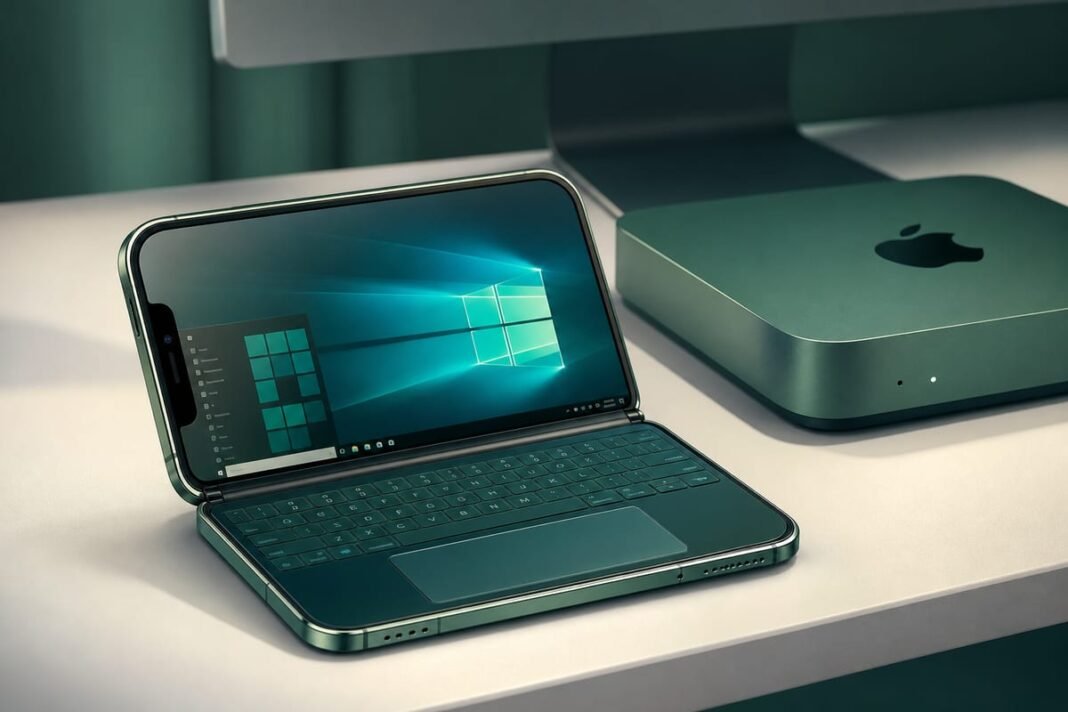
Google AI Studio Head of Product and Design Ammaar Reshi showed off Windows 11 ARM64 running locally on an iPhone Duo without jailbreak, with help from Gemini 4 Carbon. According to him, the agents worked for 2 hours with Swarm. However, this demonstration does not correspond to a ready-to-install application.
Manual installation with a Mac
The procedure requires an Apple Silicon Mac equipped with Xcode and build tools, as well as a debug connection from that computer at launch. You must also provide your own Windows 11 ARM64 image, bring together the EDK2 firmware and the VirtIO network drivers from Red Hat. Added to this is offline preparation in WinPE and a disk image of approximately 12 GB.
The checks only relate to one phone model and no directly installable application package is available. Manual manipulations are necessary. A future version of iOS could make the method unusable.
Another possibility already exists to access Windows from an iPhone: the official Microsoft application. This broadcasts a PC hosted in the cloud, without running the system on the phone.
Two hours of work claimed for agents
WindowsiOS recognizes an earlier open source base. A run of macOS on iPhone was carried out on November 6; Windows was running on the foldable model no later than November 11, 2026.
Varun Mohan, head of the Antigravity team at Google, reacted with astonishment and questioned his colleague about how long the agents had been active. Ammaar Reshi replied that the agents had worked with Swarm for 2 hours. The demonstration took place the day after the official launch of Carbon and this function.
Available in preview since November 10, /swarm operates in Antigravity, Google’s development environment organized around agents. Google presents it as a device capable of distributing a single instruction between several coordinated agents. Carbon, the second Gemini 4 model after Argon, is aimed at extended programming work and cybersecurity.
The evening letterFree · 7 p.m.
Do you code with AI?
Deciphered AI dev tools, agents and new features, every evening in 5 minutes. Free.
Included upon registration: our selection of the best AI guides & comparisons.
Choose your pace
Free · No spam · Unsubscribe in 1 click
WindowsiOS translates instructions on the phone
On video shared on X, Microsoft Edge and Antigravity work in Windows. Ammaar Reshi assures that it is neither Remote Desktop nor a broadcast from the cloud. The phone, sold for $1,999, is Apple’s first foldable and has been on the market for less than a month: half-folded, its upper part is reserved for the Windows desktop, while the lower part serves as a keyboard and touchpad. Opened fully, it displays the system on its interior 7.6 inches.
The public WindowsiOS repository on GitHub had 341 stars and 56 forks when surveyed. The project documentation states that it boots Windows 11 24H2 ARM64, build 26100, on an iPhone Duo running iOS 27 without jailbreak. She specifies that the project does not use Apple’s Hypervisor framework, considered inaccessible to applications in the standard version of iOS.
In its place, WindowsiOS translates ARM64 instructions from the guest system into ARM64 instructions for the host on demand, with software memory management. According to the project, the emulated PC machine combines UEFI firmware, ACPI tables, NVMe disk, USB 3.0 interface and VirtIO network adapter. An Intel HD audio controller has also been developed to allow the installation of Windows drivers without additional installations.
Debugger bypasses memory restrictions
Running Windows on an Apple phone was previously demonstrated in 2024. NTDEV, developer of Tiny11, booted a lite variant of Windows 11 on an iPhone 15 Pro with UTM SE. Apple had accepted this PC emulator on its App Store after initially refusing it.
UTM SE does not have on-the-fly compilation, or JIT: it interprets guest instructions individually, with a significant loss of speed. On iOS 26 and 27, Apple’s Trusted Execution Monitor restricts the use of both modifiable and executable memory areas, which initially blocked emulators’ JIT bypasses.
Community tools, including StikDebug, now use a debugger to obtain pre-clearance of these memory areas. WindowsiOS uses this process in its launch script to speed up startup and system operation.