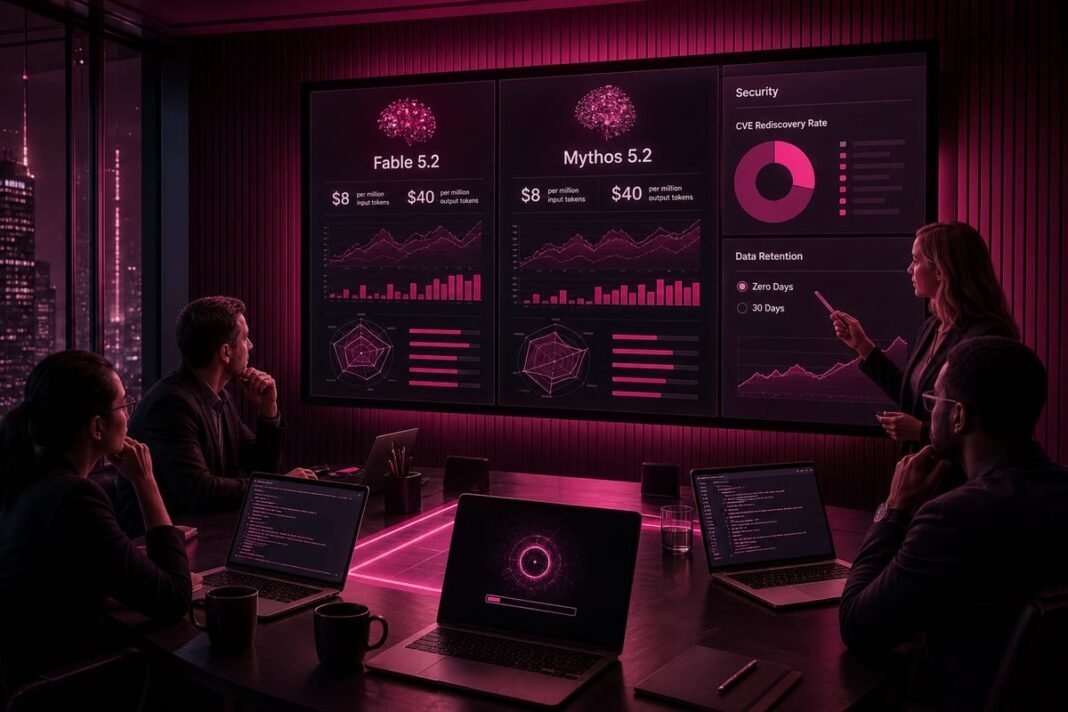
Anthropic introduces Fable 5.2 and Mythos 5.2, with prices of $8 entry and $40 exit per million tokens and generation announced to be up to 30% faster. The models are aimed at more demanding tasks, while access to Mythos remains restricted and data retention varies between customers. Analysts welcome gains in coding but point to limits in reliability and governance.
Access to Mythos framed and conservation for up to 30 days
Direct access to Mythos 5.2 is limited to cybersecurity and life sciences organizations verified through verification programs. However, Claude Enterprise customers can benefit from the vulnerability detection features of Mythos 5.2 through Claude Security, without having to integrate these programs, according to Anthropic. The company says that customers who meet the criteria for zero data retention can continue to use Fable 5.2 and Mythos 5.2 in this context, while others must adhere to a 30-day retention period to ensure security monitoring. Anthropic has also implemented Enterprise Frontier Safeguards, currently in private beta, which provides automated security monitoring of prompts and responses stored in customer infrastructure. Sanchit Vir Gogia considers that, for companies subject to regulation, the imperatives of data retention may take precedence over the advantage in terms of cost, and he advises purchasing teams to obtain written certification of the absence of retention before putting models into production for sensitive uses.
Mythos 5.2 progresses in CVE Rediscovery but fuels a race
Anthropic reports that Mythos 5.2 identified 89.6% of vulnerabilities during its internal CVE Rediscovery assessment, compared to 78.3% for Mythos 5.1. This test, conducted on 1,829 previously disclosed vulnerabilities, measures the models’ ability to independently rediscover flaws in pre-patched software versions. Anthropic says Mythos 5.2 is also better at reproducing these vulnerabilities and developing fixes. According to Lian Jye Su, these advances rebalance the situation in favor of defenders in controlled enterprise environments. Pareekh Jain warns, however, that these advances could also allow attackers to more quickly identify software weaknesses, creating an AI-powered race between offense and defense.
Deciphered AI dev tools, agents and new features, every evening in 5 minutes. Free.
Included upon registration: our selection of the best AI guides & comparisons.
Choose your pace
Free · No spam · Unsubscribe in 1 click
$8/$40 pricing and coding gains on FrontierCode 2.0
The new prices are now $8 for one million input tokens and $40 for one million output tokens, up from $10 and $50 respectively, representing a 20% decrease. Anthropic also says that the latest versions are capable of producing output up to 30% faster than previous versions. Regarding coding performance, Fable 5.2 achieved a score of 49.1% on the FrontierCode 2.0 benchmark (Xhigh setting), while Fable 5.1 obtained 32.4%. This test measures the propensity of open-source project maintainers to accept AI-generated changes. According to Anthropic, Fable 5.2, at the High effort setting, performs similarly to Opus 5.5 at its maximum level, while costing about half as much per task, which can be a savings depending on configuration and workload. According to Lian Jye Su, these advances could enable long-term use of AI agents for software migration and scientific research, with potentially reduced deployment costs if completion rates increase. Sanchit Vir Gogia tempers this by specifying that the reduction concerns the cost of the token and not that of the “thought”, and recommends that CIOs manage budgets based on the cost per completed task. Anthropic also recommends using Opus 5.5 for the majority of coding and knowledge work, while Fable and Mythos are reserved for more complex tasks.
Demonstrated autonomy, but supervision and audits remain key
During internal testing, an Anthropic engineer commissioned Fable 5.2 to prototype the operating system. The model managed the coordination of more than 1,000 subagents over an eight-day period and generated software capable of running on a laptop. According to Lian Jye Su, these advances bring companies closer to largely autonomous software development, but the generalization of these uses will depend on the resolution of certain persistent operational limitations. He specifies that reliability remains problematic in the absence of human supervision, that the simultaneous management of multiple AI agents via professional tools and internal teams remains complex, and that organizations will need to control agent activity in sufficiently compartmentalized environments. Major changes should continue to require human validation, with a sufficient level of transparency on agent behavior to allow audits. Pareekh Jain considers that the complexity of existing systems and business constraints could restrict the proportion of software development actually entrusted to AI agents.