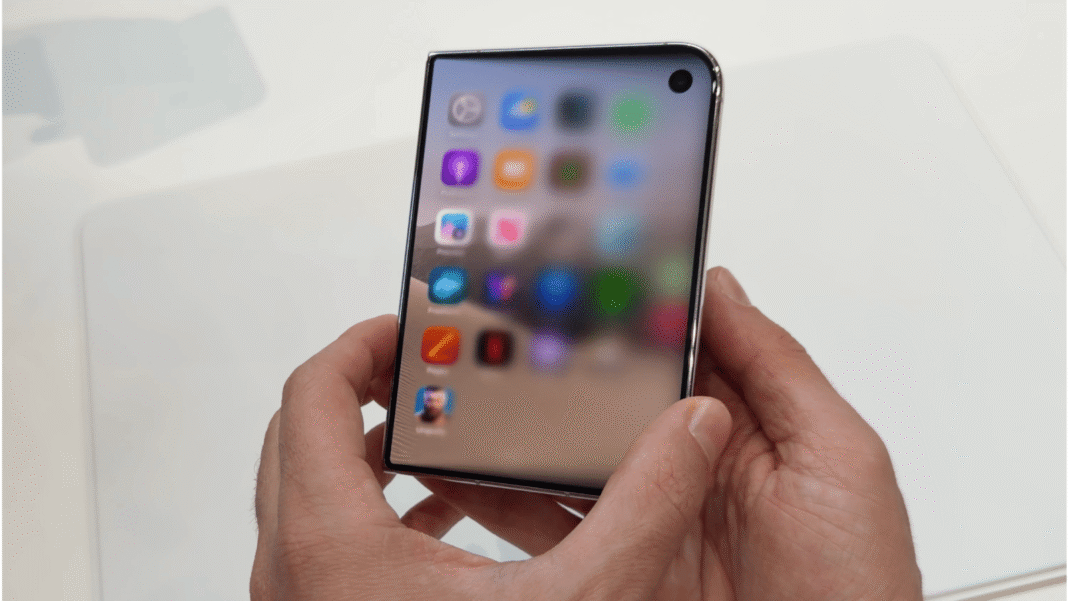
The second beta of iOS 27.3 adds several new features exclusive to iPhone Duo, including a new “Face Unlock” mode. Apple, which replaced Face ID (face) with Touch ID (fingerprint) with its first folding phone, decided to listen to users and offer them less secure facial recognition than Face ID if they want it. The novelty is optional and comes with several limitations.
The iPhone Duo is a great smartphone, but one of its shortcomings compared to the iPhone 18 Pro is its biometric unlock technology.
Since the infrared sensors necessary for 3D facial recognition take up too much space and would have to be present in duplicate (under the external screen and under the internal screen) to be effective, Apple replaced Face ID with Touch ID with its first folding smartphone. A fingerprint sensor is accessible on the right edge, without forgetting the “Unlock with Apple Watch” option which allows wearers of a connected watch to go faster.
On November 16, 2026, Apple announces a major change for its iPhone Duo: beta 2 of iOS 27.3, the future update which will be available to everyone in December, adds facial recognition to the iPhone Duo.
Unlock with your face without Face ID: Apple’s unexpected change in philosophy
Apple’s announcement may surprise many: no iPhone has ever combined two biometric unlocking technologies until today. Apple is one of the rare companies that takes responsibility for deciding what is best for its users, while all of its Android competitors offer both a fingerprint sensor and facial recognition technology, generally 2D, less secure than Face ID.
With iOS 27.3, Apple will test 2D facial recognition, without the infrared modeling of Face ID, on an iPhone. The system, which is called “Unlock with front camera” in English, differs from Face ID in several aspects:
- iPhone Duo’s facial recognition is only available when the iPhone is closed. It uses the front camera of the cover screen.
- Apple warns that the technology is less secure than Touch ID or Face ID, but believes it has done its best to offer the most secure 2D facial recognition on the market. Facial data is recorded in the Secure Exclave, nothing is collected in plain text.
- Facial recognition on iPhone Duo is an optional setting: Apple does not recommend that everyone enable it. The idea is that people who really want a Face ID-like experience can do so.
- Every 45 minutes initially, facial recognition will deactivate. You will need to use Touch ID to restart facial recognition for an additional 45 minutes (and each press of Touch ID during use will restart the 45 minutes). Apple indicates that this deadline may change between now and the final launch: everything will depend on user feedback.
- Since security is weaker than Touch ID, facial recognition will not allow you to display passwords or pay with Apple Pay. Touch ID remains the main technology.
- Without infrared, the iPhone Duo’s facial recognition will not work in complete darkness. This is no surprise: only Face ID allows this.

Despite many limitations, the facial recognition of the iPhone Duo will allow you to check your messages with the iPhone on a desk without having to unlock it each time. The iPhone Duo is the second Apple device, after the HomeView home automation screen, to use a 2D facial recognition algorithm other than Face ID. Will iPads and Macs be entitled to it one day? For now, Apple is only talking about the iPhone Duo.
Why make this decision now? We can imagine that 2D facial recognition has been tested for many months at Apple, but that the brand did not want to make it a launch feature to avoid comparison with Face ID. Apple says nothing about what motivated it to develop this feature.
Two other new features for the iPhone Duo in iOS 27.3
In addition to facial recognition, iOS 27.3 will deploy two other new features on iPhone Duo:
- A new setting will allow you to put the phone to sleep by closing it (this is not possible today, the app goes from the large screen to the small).
- The Easy Access (Reachability) function is making a comeback to shift the screen to the right or left when the phone is closed, to make one-handed use possible.

Apple is taking the opportunity to update the number of applications compatible with the iPhone Duo: there are now 200,000 software programs adapted to the iPhone Duo SDK, compared to 100,000 a week earlier. Enough to silence the main criticisms of the product?
All the tech news at a glance
Add Numerama to your home screen and stay connected to the future!