Between excitement and enthusiasm, the strange morale of the VC in Helsinki
Helsinki, November. While the polar night begins to envelop the Finnish capital in almost permanent darkness, the local tech ecosystem is experiencing a paradoxical effervescence. At the heart of this Nordic anthill, venture capital (VC) funds play a part that is surprising to say the least. Between macroeconomic reluctance and technological excitement, investor morale in Helsinki oscillates between hot and cold. X-ray of a middle in full splits.
Post-euphoria hangover
Two or three years ago, Helsinki revered its status as the “Silicon Valley of Northern Europe”, boosted by the resounding success of giants like Supercell (video games) or Wolt (delivery). Money was flowing, valuations were soaring and optimism was rife.
Today, the tone has changed. The VCs established on the Esplanadi are not immune to the overall “slowdown”: rising interest rates, scarcity of liquidity and reluctance of institutional investors (the famous LPs). “The days of easy money are definitely dead and buried,” confides, disappointed, an associate of a historic fund of the place. Now, financing rounds are longer, due diligence is more meticulous, and profitability has replaced growth at all costs as the absolute mantra. A form of excitement has set in, fueled by the fear of investing in a sinking liner or, worse, of missing the boat through excess of caution.
The reactor of AI and Deep Tech
However, it is impossible to speak of pure gloom. As soon as we approach cutting-edge topics, the atmosphere changes radically. Enthusiasm takes over, driven by the profoundly engineering and pragmatic DNA of the Finns.
In Helsinki, the transition took place naturally towards Deep Techthe energy transition and, of course, Artificial Intelligence. Local VCs have understood that the country, rich in talent from Aalto University and Nokia heritage, has a global card to play. Startups like IQM (quantum computers) or Silo AI (recently purchased by AMD) prove that the ecosystem knows how to produce gems capable of attracting international attention.
“We are no longer looking for pizza delivery applications, we are looking for solutions that will solve complex industrial or climatic problems,” explains a young associate, her eyes shining with excitement. For her, the current crisis is a formidable filter: it eliminates superficial projects and allows solid foundations to emerge.
The “Sisu” syndrome
This large permanent gap between financial anxiety and unwavering faith in innovation perhaps finds its source in a very Finnish cultural concept: sisu. This untranslatable word evokes a form of stubborn resilience, of quiet courage in the face of adversity.
Helsinki VCs know that the economic winter is harsh, but they are used to harsh winters. They manage their portfolio with the rigor of Scandinavians, while watching for the next unicorn with the greed of kids on a party night.
Ultimately, this strange morale is perhaps only the mark of a new maturity. Helsinki’s tech ecosystem is leaving carefree adolescence to enter adulthood: less naive, more calculating, but still just as daring. And while temperatures drop outside, in venture capital offices, we continue to bet, with furrowed brows but wry smiles, on the future.
Here is a rewritten, fluid and professional version of the text, while retaining the journalistic tone and key information (also correcting temporal entities, such as the year 2026, if you want an updated or coherent rendering).
Between despair and the rush towards AI: diving into the heart of Slush, the great venture capital meeting
“It’s despair right now!” » As soon as she arrived at Helsinki airport, the tone was set by an American investor. A cash phrase which perfectly illustrates the heterogeneous and tense climate which currently reigns in the world of venture capital (VC). In the age of artificial intelligence, where every bet must be a winner, the morale of the troops is put to the test.
By a coincidence of timing, the Slush summit was held the same week as Anthropic’s historic IPO on Wall Street. With $81.3 billion raised (and more than $107 billion including a private placement with partners like Nvidia and Microsoft) for a valuation approaching $1.6 trillion, this is the largest initial public offering (IPO) in history. Enough to delight the first supporters of OpenAI’s great rival.
“Dry Powder” and ambient chilliness
However, among the 3,248 investors gathered in the Finnish capital, there was not much euphoria. Behind the mega-rounds of more than a billion dollars, more modest operations are becoming rarer. In Europe, the number of pre-series A fundraising fell by 30% between 2021 and 2025, while series A and B recorded a decline of 19%, according to Atomico’s annual report.
Several factors explain this slowdown: a complex economic context, a fragmented European market, the reluctance of large industrial groups to buy startups, as well as IPOs considered too rare and too low to compete with the Nasdaq. Result: the phenomenon of “Dry Powder” (the “dry powder”) is at full speed. Billions of euros are sitting in the coffers, with funds preferring to secure their existing portfolios rather than financing new projects.
The “SaaSpocalypse” and the acceleration of AI
When investors agree to bet on new startups, their verification processes (due diligence) lengthen considerably. In the age of AI, they want to ensure that the solutions financed will not be obsolete within six months, a fear in the midst of a period of “SaaSpocalypse”where the emergence of AI agents threatens to sweep away many traditional software programs.
“The speed of business creation has seen a major inflection point thanks to AI. In France, for example, creations have jumped by 80%, and start-ups reach their first income much faster: it now takes less than six weeks on average to land a first client.observes Arielle Le Bail, EMEA AI product manager at Stripe. The American firm had sent around fifty employees to Helsinki. “We are entering a “Human-out-of-the-Loop” world, where autonomous agents communicate with each other and become economic actors in their own right. The entire economic fabric is in the process of being transformed”she adds.
Despite well-filled coffers, the funds are playing the card of caution for the years to come. It is in this context that Slush has established itself as an ideal platform to attract new LPs (institutional investors). This year, 1,746 VC and 239 LPs made the trip. The competition was therefore tough to convince pension funds, banks and insurance companies to sign new checks.
Investor Day: the VC’s playground
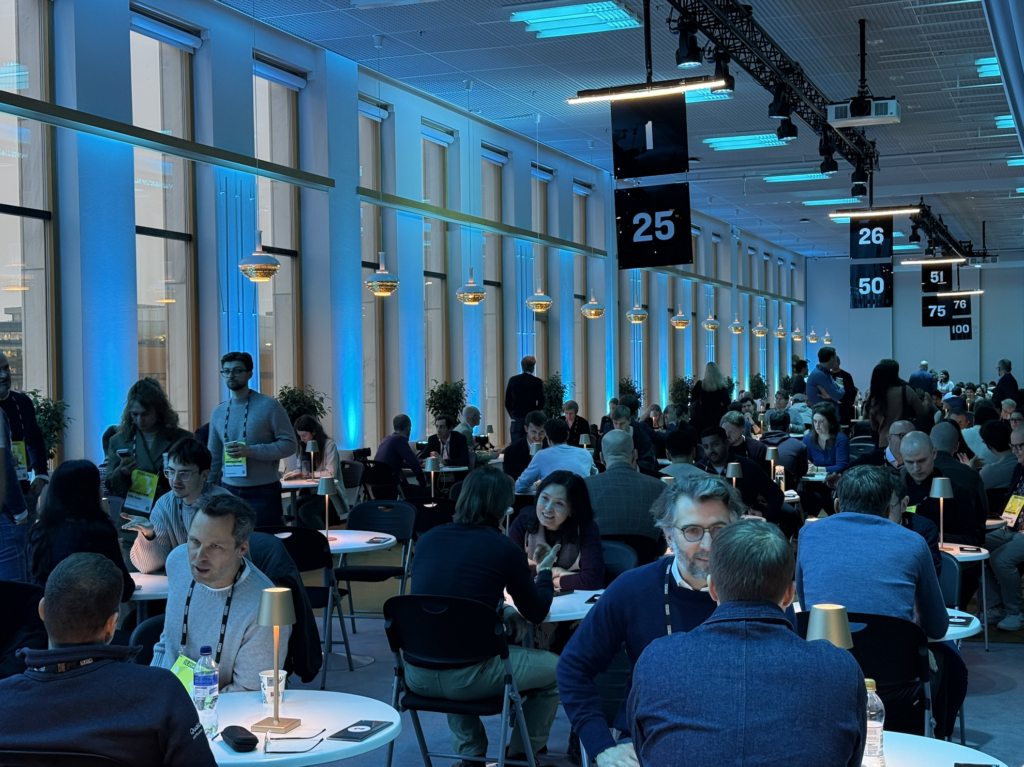
A real prelude to the summit, Investor Day has the feel of a giant speed-dating event. In the immense Meeting Areawhose unequivocal slogan displayed “For your funds with benefits”100 tables hosted lines of VCs trying to defend their investment thesis in just a few minutes.
“In the investment food chain, it’s healthy to be under pressure. But with five LPs for twenty GPs, it’s difficult to stand out. This still allows you to leave with a golden contact book”confides a French investor.
In the aisles of Finlandia Hall, other French professionals salute the formidable effectiveness of the event. “I don’t know how they attract so many people, we’re really bad in Paris!” »laughs one of them. France, however, has benchmark events like IPEM, but the atmosphere in Helsinki stands out for its relaxedness: t-shirts, jeans and sneakers are required. Some business meetings even take place in the purest Finnish tradition, in the heart of saunas, followed for the more daring by an ice bath — ideal for refreshing one’s thoughts in turbulent times.
Marked disparities and memorable celebrations
If Slush boasts of being “the largest gathering of venture capital players, representing 4,000 billion euros in assets under management”some temper the enthusiasm. “There is a gulf between the small-ticket early-stage players and the mega-tour behemoths. Moreover, everyone keeps to themselves: the Nordics with the Nordics, the Anglo-Saxons with each other, and the French likewise.observes a French fund manager.
Present for the first time, Jérémie Falzone, Partner at Revaia, highlights the opportunity: “We are a pan-European brand, and Slush is a great showcase. » Without forgetting the traditional side events : from the “Investors Boat Party” organized by OVNI Capital, Corgi Insurance and Harmonic, until the legendary “Backed Party” nestled in an old hangar transformed into an electro club. This year, it is under the theme of “Charlie and the Chocolate Factory” that investors celebrated, all hoping to have won the golden ticket for a more prosperous year 2027.