After taking legal action against image generators accused of copying its characters, Disney chooses its side for generative AI. THE November 9, 2026at the Adobe MAX conference in Miami Beach, Adobe and The Walt Disney Company announced a multi-year strategic alliance which makes Adobe the Disney’s official partner for AI innovation. At the heart of the agreement: AI models trained specifically on the group’s characters and universes, for internal use.
What the alliance plans
According to Adobe’s press release, the agreement covers several aspects:
| Shutter | What is planned |
|---|---|
| Tools | Early access to Adobe’s latest technologies, including Firefly, Firefly Foundry, Premiere, and Photoshop, with dedicated teams of engineers and researchers |
| Custom models | Generative AI models specific to Disney, trained on its characters, settings and visual styles |
| Parks and cruises | Tools to accelerate the design of future Disney Cruise Line attractions and projects |
| Studios | Adobe joins StudioLAB, the Walt Disney Studios innovation laboratory |
| Sport | Projects with ESPN Edge, the sports channel’s innovation center, around fans and archives |
| Marketing | An increased Adobe presence on Disney media, in the parks and at conferences |
The amount of the agreement was not communicated, nor its precise duration. Both companies indicate that joint projects with StudioLAB and ESPN Edge are already underway.
Firefly Foundry: an AI that only knows the Disney universe
The central element of the alliance is Firefly FoundryAdobe’s offering which allows a company to build private generative AI models, trained on its own content. According to the press release, the models developed for Disney will be personalized from its properties and trained on its “knowledge of the world”: character attributes, environments, visual styles. Stated objective: produce results “commercially safe and ready for production”.
Adobe and Disney insist on an approach “human-centered and artist-guided”. Hannah Elsakr, Adobe’s vice president of new generative AI business, describes a new creative foundation that deploys AI “as an accelerator of artistic vision, creativity and visitor engagement.” On the Disney side, Becca Vodnoy, vice president of alliances, talks about “new ways for our creative teams to explore and develop their ideas”.
Sketches transformed into illustrations for future parks
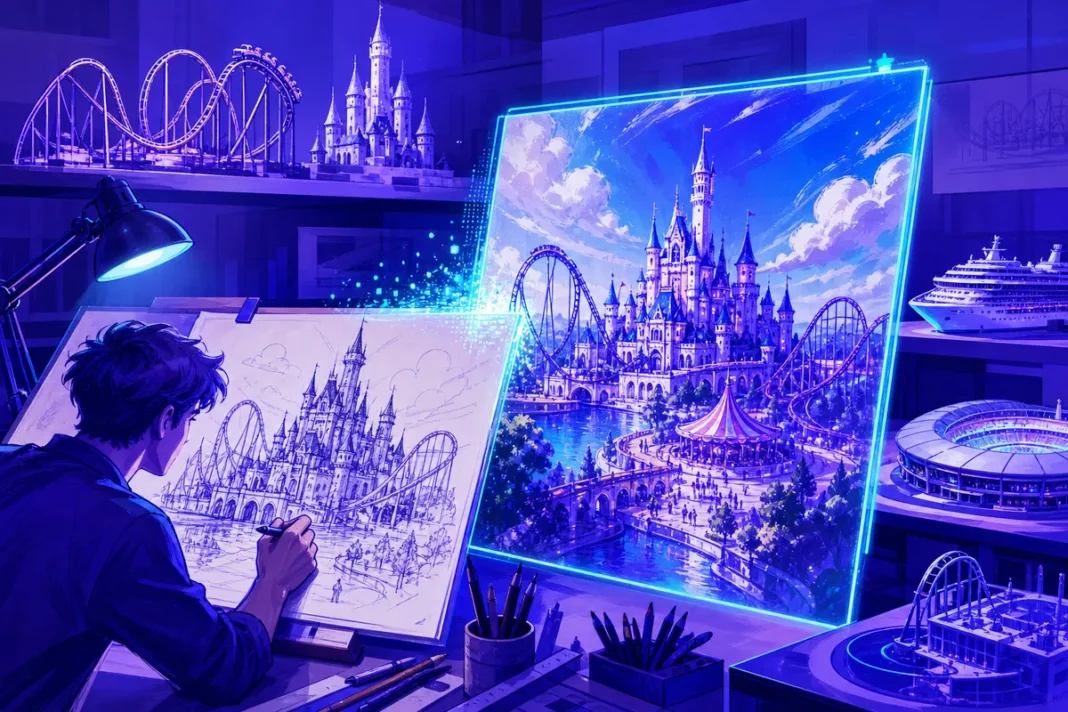
The alliance extends work already underway with Walt Disney Imagineeringthe branch that designs amusement parks. According to the press release, Disney uses Firefly Foundry to bring new ideas into the development of its parks more quickly, with two tools:
- a model that turns hand-drawn sketches into concept illustrations two-dimensional, fully rendered;
- an image model capable of generating visuals faithful to the identity of each franchise.
According to The Next Web, Adobe had already shown tools of this type in June applied to franchises like Frozen and Moana, Disney specifying that the models were based on works licensed or owned by it. The intended use is therefore above all the exploration phase: go faster from the idea to a presentable image, rather than producing the final images of a film.
StudioLAB and ESPN: the other two testing grounds
The alliance goes beyond the parks. Adobe becomes innovation partner of StudioLABthe Walt Disney Studios structure which brings together creative and technical profiles to prototype ideas and transform experiences into tools. According to the press release, Adobe will work with Disney creatives and technologists to explore and expand their internal working methods, without specific projects being detailed.
The second field is ESPN Edgethe innovation center of the group’s sports channel, responsible for testing emerging technologies in the service of sports storytelling. ESPN and Adobe will explore how AI can enhance fan engagement, evolve the way the network delivers content and breathe new life into its archives. For a broadcaster that holds decades of competition images, the challenge is to make this collection easier to exploit, research and showcase.
A turnaround in Disney’s AI strategy?
Disney’s relationship with generative AI is ambivalent. In June 2025, the group teamed up with NBCUniversal to sue Midjourney, accused of reproducing their characters without authorization. Then, by December 2025, it had licensed more than 200 characters to Sora, OpenAI’s video application, a partnership called into question when OpenAI shut down Sora in March 2026, according to The Next Web.
Adobe’s choice is part of this logic: controlling the use of its characters rather than letting them circulate in general public tools. Adobe has built its strategy around models trained on licensed content, such as those in its image bank, a decisive argument for a group whose value is based on its intellectual property.
What this changes for creators and audiences
For the public, nothing immediately visible: these models are internal tools, and the agreement does not provide for opening them to fans. The content imagined thanks to them will only appear through future attractions, studio projects or programs from ESPN, which notably wants to find new ways of revive its archives sports.
For creative professions, the question is more sensitive. The two companies repeat that AI must accelerate the work of artists without replacing them, and protect creators and their works. But the agreement does not specify how the artists whose work fed these models will be associated or remunerated, nor what part of the creation will go to AI. In a sector still marked by the Hollywood strikes of 2023, where AI was among the main subjects of contention, these points will be scrutinized.
Towards private AI for large catalogs
The agreement illustrates a basic trend: holders of large catalogs of intellectual property prefer to build private modelstrained on their works alone, rather than entrusting their characters to open tools. For Adobe, which relies on Firefly tools presented as secure in terms of rights, winning Disney is a strong commercial argument against competing generators. The first concrete results, expected in the parks and ESPN projects, will show whether these tailor-made AIs keep their promise of accelerating creation without impoverishing it.