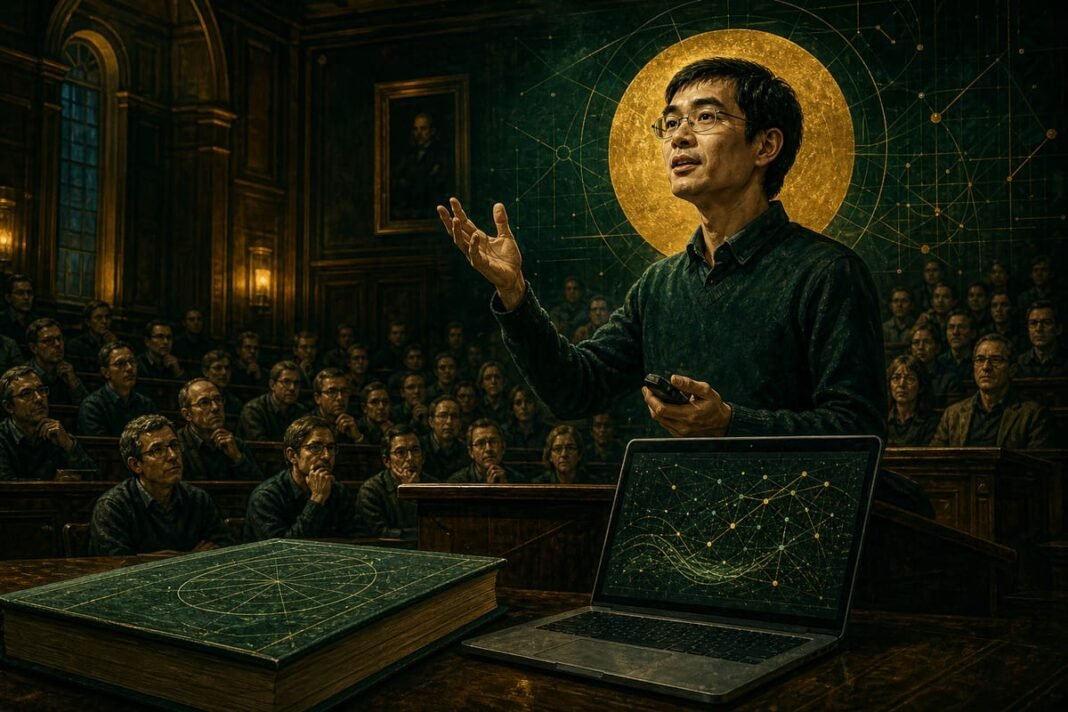
Terence Tao, professor of mathematics at UCLA, pleaded last week at Harvard for a rapid transformation of scientific incentives and journals in the face of AI. Under the name “math 2.0”, he proposes in particular to no longer measure the credibility of researchers by their publications alone, but by their ability to explain their results.
Anthropic researcher claims Riemann resolution
On Friday, a mathematician employed by Anthropic claimed to have solved with Claude the Riemann hypothesis, reputed to be the most famous mathematical question still open. Mathematicians have deemed this claimed resolution very important. Steven Strogatz, a professor at Cornell, has described this problem as the “white whale” of mathematics.
Last month, in the Numberphile podcast, Tao nevertheless estimated that humans associated with AI models would not obtain “progress” on this hypothesis before 2050. His speech at Harvard, in front of a room full of mathematicians, preceded the Anthropic researcher’s claim.
Tao challenges the weight of scientific publications
For Tao, publishing in a journal, long considered a prestigious achievement, is rapidly losing its value. He describes submissions overrun with research produced with AI, often sent, he says, by mathematicians whose competence is diminishing and who don’t understand their own work.
The evening letterFree · 7 p.m.
Are you following the race for AI models?
Each output (GPT, Claude, Gemini, Mistral, etc.) decrypted the same evening, in 5 minutes. Free.
Included upon registration: our selection of the best AI guides & comparisons.
Choose your pace
Free · No spam · Unsubscribe in 1 click
Journals must therefore, in his eyes, review their criteria or risk becoming less important. In addition to counting articles published in the most reputable titles, which he considers insufficient, Tao wishes to substitute a requirement for understanding: researchers should only acquire credibility if they know how to explain their research to human evaluators.
Tao favors explaining AI results
The transition from “math 1.0” to “math 2.0” supposes, for the UCLA professor, to stop placing problem solving at the center of research. He claims that AI now processes certain complex conjectures more efficiently than humans and considers the blind pursuit of this optimization harmful in the long term. Maintaining the old values would not, according to him, allow mathematicians to remain relevant.
Tao recommends instead favoring tasks in which he considers humans already competent: interpreting the solutions generated by AI and deriving new mathematical questions from them. It is also from this perspective that he calls for a rapid change in research incentives.
However, he does not recommend that young researchers interrupt their doctorate for an AI startup and says he is optimistic about the future of his discipline. Among the avenues he cites is Caltech’s mathathon: organized by students, this event has participants work with AI to look for other ways to solve old problems.