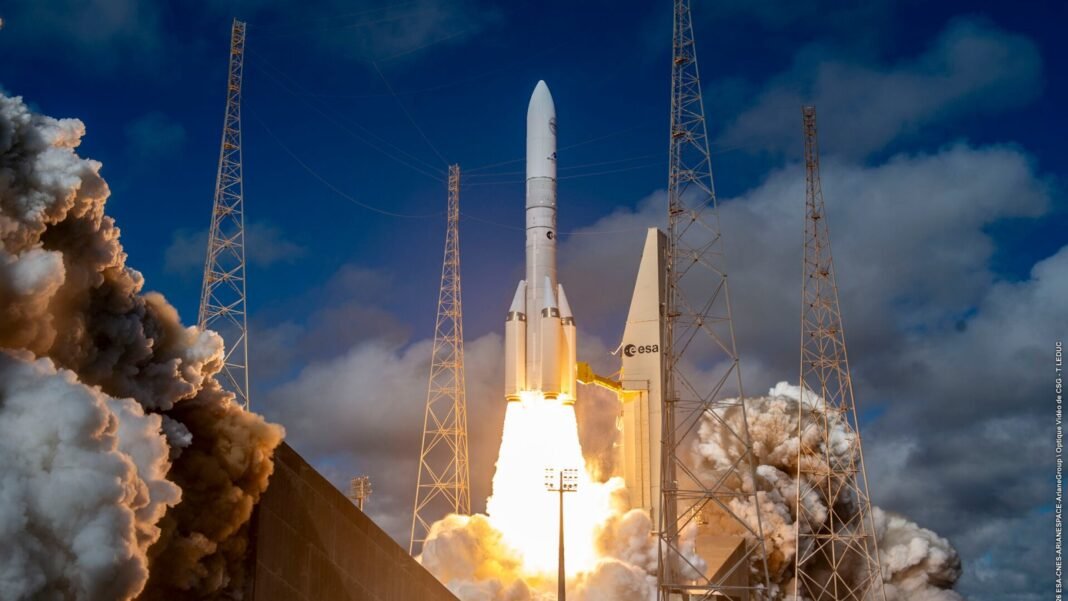
Ariane 6 must carry 36 Amazon Leo satellites for its 10th flight, on Monday November 23 at the earliest. The shot comes eight days after the loss of 40 satellites from the same constellation on an American Vulcan rocket, and it will be followed live.
On Monday, November 23 at the earliest, Ariane 6 is scheduled to take off from Kourou, Guyana, with 36 Amazon Leo satellites under its fairing. This will be the tenth flight of the European launcher, three months after August 27, when Ariane 6 aimed for the geostationary transfer orbit for the first time (successfully), the destination which made up the entire commercial career of Ariane 5. Return to low orbit, therefore, for this shot to be followed live on YouTube.
Ariane 6 is flying this time in its most powerful version, with four boosters, called Ariane 64. This is the fourth flight of this configuration, and the second with the new P160C thrusters, launched in June. The 36 satellites must be released into low orbit, at around 465 km altitude, where Amazon teams will take control of them from their operations center in Redmond, United States.
After the release, the first contacts and the proper functioning checks, the satellites will rise under their own power to their working altitude, 630 km, before being put into service for customers, specifies Amazon.
The 10th flight of Ariane 6 in summary
- What ? The 10th takeoff of Ariane 6 (mission VA271, called LE-04, for Leo Europe 4, by Amazon) and the fourth mission of Ariane 6 for the Amazon Leo constellation this year;
- When ? Monday, November 23, 2026 at the earliest, with a shooting window opening at 12:09 p.m. (Paris time);
- Or ? From the Guiana Space Center, for a drop into low orbit, at approximately 465 km altitude;
- What will we see? The takeoff of the Ariane 64 version with four boosters, its ascent and the release of the 36 Amazon Leo satellites.
Where to watch the Ariane 6 launch live?
Arianespace will provide a video broadcast of this event, broadcast live on the CNES YouTube channel, as indicated on the agency’s page dedicated to the mission. The start time of the live will depend on the shooting window, which Arianespace has not yet communicated. Those who are in Guyana can watch the takeoff: the Guyana Space Center website provides practical information.
What is the VA271 mission for Amazon?
For this tenth flight, Arianespace releases the configuration heavy of its rocket, called Ariane 64, equipped with four P160C powder boosters. This will be the 363rd launch in Arianespace’s history, and its fifth in 2026.
Underneath the fairing are 36 Amazon Leo satellites, Amazon’s low-orbit satellite internet network. It must provide fast internet access to customers that existing networks do not reach.
These satellites will join a constellation which already includes nearly 400, launched in 14 missions. According to Amazon, it is the third largest constellation in orbit. The first generation should ultimately bring together 3,232 satellites. Arianespace has already placed 100 during its first three flights for Amazon (32 in February, 32 in April, 36 in June). If successful, its counter will increase to 136, or approximately one in three Amazon Leo satellites.
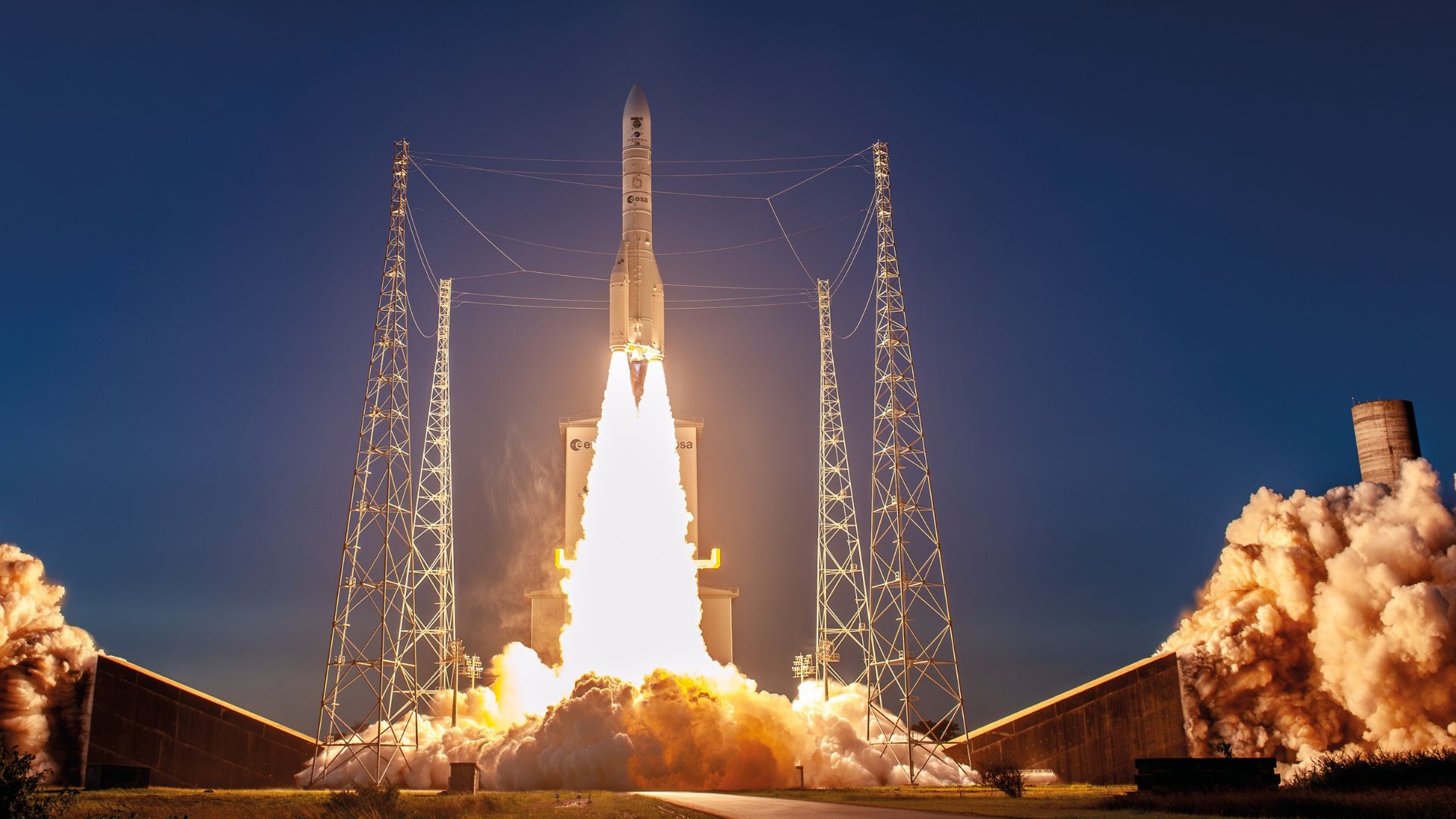
The previous launch for Amazon, on June 17 (mission VA269), marked the debut of the P160C thrusters. Their additional power made it possible to accommodate 36 satellites under the fairing instead of 32, with the result being a mass record for the Ariane family. VA271 takes exactly this configuration.
This shot has taken on particular weight in recent days. On November 15, a Vulcan rocket from the American ULA lost the 40 Amazon Leo satellites it was carrying, following an anomaly that occurred ten minutes after takeoff. ULA, which has never lost a mission since its creation in 2006, has not yet communicated the cause. However, Amazon has purchased 38 launches from ULA, and Vulcan must ultimately put nearly half of the first generation of the constellation into orbit. During the investigation, Amazon still displays the Ariane 6 takeoff as November 23 on its mission tracking page. The European launcher successfully completed its first three flights for Amazon’s Leo constellation, after also serving the medium orbit for the Galileo satellites.
For Arianespace, VA271 must also show that Ariane 6 can keep up with megaconstellations, “ including future European constellations », writes the operator in its press release of October 14. Amazon has reserved 24 launches for it in total, including six more on Ariane 64 announced in September 2026. Ariane 6 also inherits a reputation to defend: Ariane 5 has flown with almost perfect reliability in 27 years. Each successful shot reinforces the rocket in its role against SpaceX: guaranteeing Europe’s autonomous access to space.
When does the Ariane 6 rocket take off?
Takeoff is scheduled for Monday, November 23, 2026 at the earliest. Arianespace still has to set the firing window as the mission approaches. It will take approximately two hours and four minutes between takeoff and separation of the last satellite, time for the upper stage to distribute all the cargo. This is a little longer than during VA269 in June (1 hour 51 minutes), and more than three times the duration of the flight of the MTG-I2 weather satellite at the end of August (36 minutes).

All the tech news at a glance
Add Numerama to your home screen and stay connected to the future!