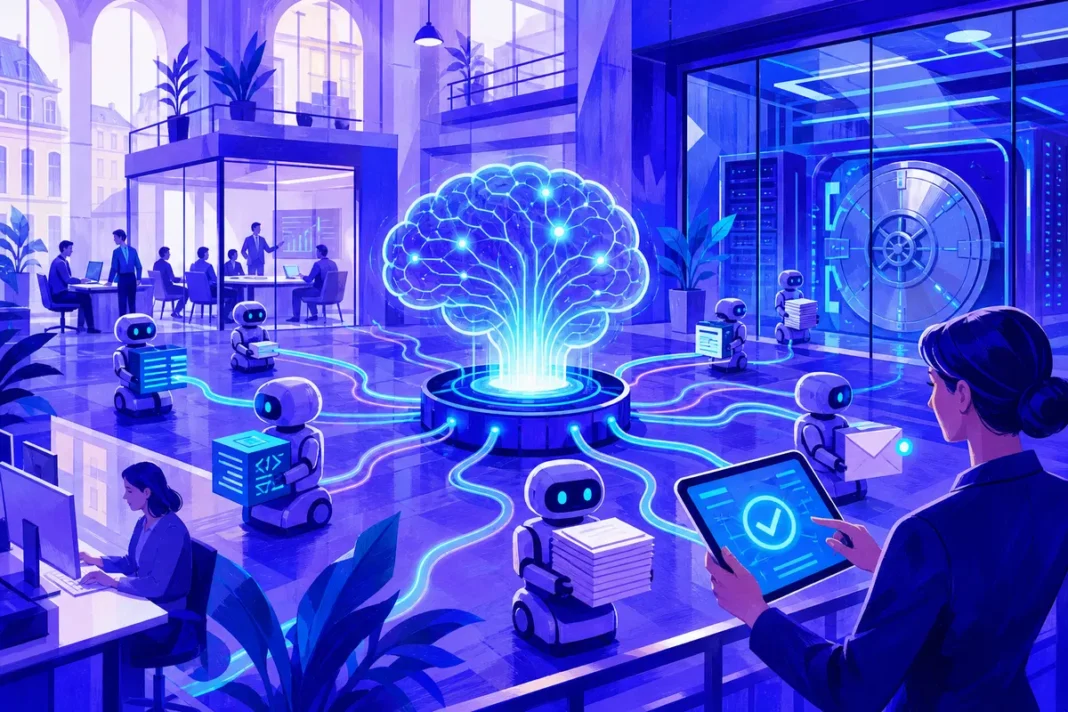
Having a good AI model is not enough: it must also be linked to a company’s tools, data and processes. This is Mistral AI’s bet with Mistral Studioof which the French start-up unveiled a new version on November 5, 2026. A week after publishing the weights of its Mistral Large 4 model, nicknamed “The Chonk”, the company summarizes its strategy in one formula: “The Chonk brings the brain, Studio puts it to work. »
A platform to move from model to real work
Mistral Studio is Mistral AI’s platform for businesses. It allows models to be put into service through agentsof the workflows and appsconnected to the organization’s data and systems. What’s new is its deployment method: according to Mistral AI, Studio can run in the cloud, in the company’s private cloud, on its own servers or in a combination of these environments.
Three complementary bricks
The offer is structured around three elements:
| Brick | What it allows, according to Mistral AI |
|---|---|
| Managed Agents | Deliver complex, multi-step tasks to agents with skills, isolated environments to execute code, and sub-agents |
| Workflows | Describe a process combining fixed rules, agent reasoning and human decisions, with recovery in the event of an interruption |
| Applications | Host internal tools with authentication and access control, reusing agents, workflows and documentary research |
For the managed agentsMistral AI takes care of the execution infrastructure, building on that which already runs millions of weekly sessions of Mistral Vibe, its programming tool. Developers set the limits of what the agent can do: accessible tools, data and actions.
THE workflowslaunched in public preview in April 2026, gains triggers linked to events in the company’s systems and a visual representation of their logic. They can be generated from a simple description in Mistral Vibe, with searchable code. THE apps are deployed in a single command, at their own address or in Mistral Vibe.
Keep control of the agents
The question of control is at the heart of the offer, while the possible excesses of agents are causing increasing concern. According to Mistral AI, companies can:
- choose the models used;
- regulate access data and tools;
- decide which actions require human validation;
- follow each step from execution, calls to the model to the use of tools and validations, thanks to traces in the OpenTelemetry open standard;
- test changes instructions, models or tools on their own data sets before they are put into service.
A new MCP server, a protocol that allows assistants to communicate with external tools, also allows developers to build with Mistral Vibe or another programming agent, test locally and deploy in a Studio environment in one command.
Sovereignty as an argument
Mistral AI highlights the possibility of keep AI under control. The company says models like the platform can be deployed in the company’s cloud, its private cloud, or on its servers, so that sensitive data and the processes built around it remain within its scope. An argument that weighs on banks, administrations or manufacturers subject to confidentiality requirements.
This approach differs from the agent offers of major American players, most often offered from their own cloud. It joins the strategy initiated with the publication of the Mistral Large 4 weights, which allows organizations to run the model at home.
Large groups already users
Mistral AI cites several companies that use Studio in production: the Spanish bank ABANCA, Accenture, Alten, BNP Paribas, Capgeminithe shipowner CMA CGM And Tata Consultancy Services.
Su Yang, head of artificial intelligence and IT innovation at BNP Paribas, says the bank runs Mistral Studio “on its own infrastructure”. Julien Smadja, vice president of AI at CMA CGM, says processes are ready for production “in weeks rather than months.” Fernando Alvarez, Capgemini’s chief strategy officer, points to the ability to decide exactly which systems agents can access.
Other testimonies illustrate the diversity of uses. At Alten, Gualtiero Bazzana, executive committee member and head of AI, says the group will build agents and workflows for its clients’ engineering and research teams. ABANCA runs Studio in its own cloud, with models served by Mistral AI. Tata Consultancy Services emphasizes sovereignty, governance and deployment flexibility.
Mistral AI also describes its own internal uses: an incident investigation agent that would save hundreds of hours per month, or a workflow for sorting product requests that would save around 35 hours per week. These figures come from the company.
Who in the company is affected?
The platform is primarily aimed at technical teamswhich build and deploy the agents, but its uses concern the entire organization. A customer service department can entrust the sorting of requests to a workflow, a legal team use a search application in its documents, an IT department automate the analysis of incidents. Human validation rules make it possible to keep an identified manager for each sensitive decision.
For information systems departments, the issue is also governance: knowing which agents are running, with what access, and being able to trace each of their actions. Mistral AI adds to this version agents observation and evaluation tools, as well as company-specific context management.
What remains to be clarified
The announcement does not detail or pricesnor the exact status of each function, preview or general availability, nor precise timetable by deployment mode. Interested companies should refer to Mistral AI documentation or its sales teams. The announcement also does not specify which models are recommended for each use, beyond Mistral Large 4.
A strategic issue for European AI
With Studio, Mistral AI seeks to capture value beyond the models themselves, in an enterprise agent market where OpenAI, Anthropic, Google and Microsoft compete. Its difference is based on control of deployment and data, a strong argument for European organizations concerned with digital sovereignty. It remains to convince beyond the large accounts already involved, and to demonstrate that these agents keep their promises on a large scale, in environments as varied as those of banks, industrialists or administrations.