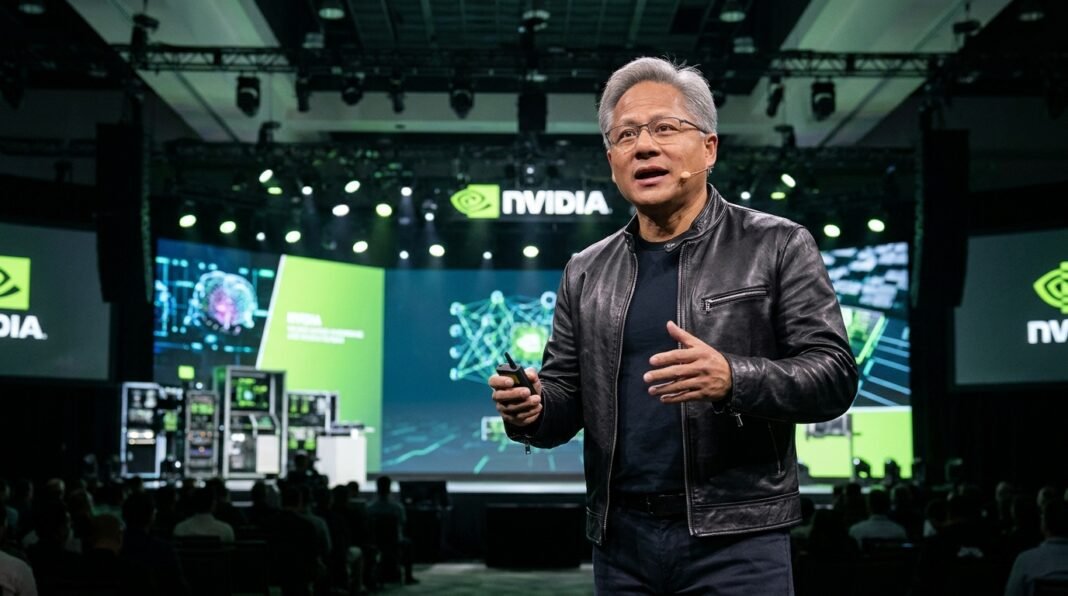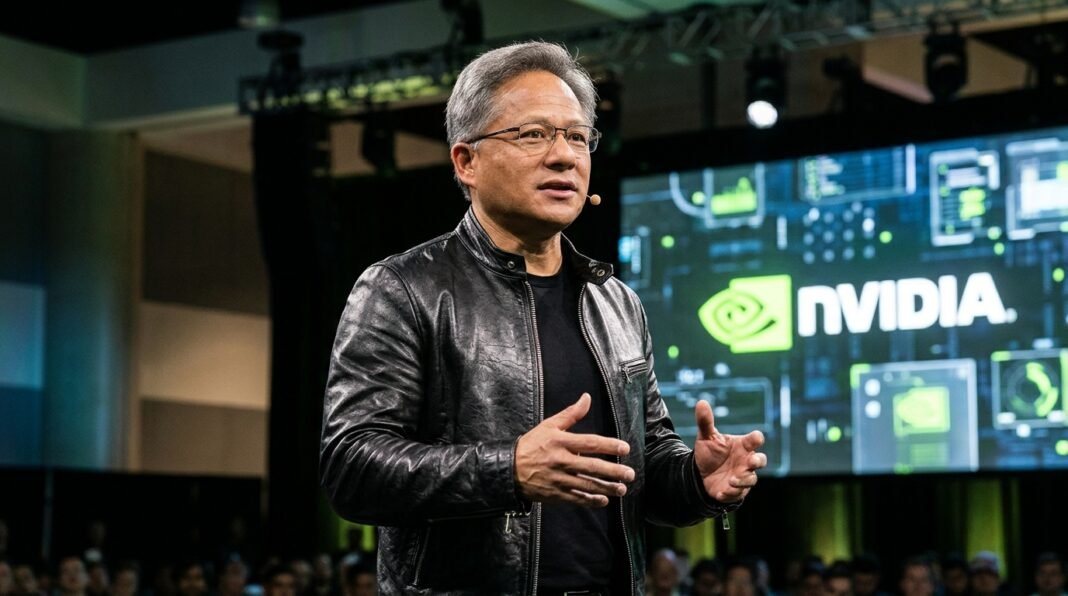
From washing dishes at a local Denny’s restaurant to guiding a multi-trillion-dollar tech titan, Jen-Hsun “Jensen” Huang has redefined modern computing. Consequently, exploring this Nvidia Ceo Jensen Huang Biography reveals a story driven by relentless risk-taking, technological foresight, and unwavering determination. Today, his leadership powers everything from high-end video games to supercomputers driving generative artificial intelligence.
However, his trajectory to becoming one of the most influential executives in Silicon Valley was far from straightforward. In addition to navigating immense market competition, Huang made audacious financial bets that repeatedly transformed the global semiconductor landscape. Therefore, understanding his journey offers unmatched insights into how hardware innovation continues to shape our technological future.
Key Takeaways: The Jensen Huang Legacy
- Early Roots: Emigrated from Taiwan to the United States as a child, learning resilience through tough early environments.
- Co-Founding Nvidia: Established Nvidia in 1993 alongside Chris Malachowsky and Curtis Priem inside a Denny’s diner.
- Inventing the GPU: Introduced the GeForce 256 in 1999, effectively defining the modern Graphics Processing Unit.
- The CUDA Revolution: Invested heavily in CUDA in 2006, laying the essential software foundation for today’s AI boom.
- Distinct Leadership: Built a flat corporate structure built on first-principles thinking, continuous adaptation, and long-term vision.
Early Life and Education: From Taiwan to Oregon
Jen-Hsun Huang was born on February 17, 1963, in Tainan, Taiwan. During his early childhood, his family moved to Thailand to seek new economic opportunities. However, rising political instability in Southeast Asia soon prompted his parents to send Jensen and his brother to live with relatives in the United States.
Consequently, the young Huang brothers ended up in Tacoma, Washington, before being enrolled in the Oneida Baptist Institute in Kentucky. Because of a misunderstanding, his family believed the boarding school was a prestigious prep academy. Instead, it was a reformatory school where Huang was assigned to clean the campus bathrooms while navigating a harsh social environment.
Despite these challenges, Huang adapted quickly and developed a fierce work ethic. Furthermore, his passion for table tennis surfaced during this period, ultimately leading him to place third in the U.S. Junior Table Tennis Championship at age fifteen. Shortly thereafter, his parents reunited with the family in Beaverton, Oregon, where Huang attended Aloha High School.
Academic Pursuits and Engineering Foundations
After graduating high school early at age sixteen, Huang enrolled at Oregon State University to pursue electrical engineering. During his time on campus, he met his future wife, Lori Mills, who was his engineering lab partner. He earned his Bachelor of Science degree in Electrical Engineering in 1984.
Following graduation, Huang moved straight into the fast-growing technology sector of Silicon Valley. Meanwhile, he continued his advanced academic training while working full-time. As a result, he earned his Master of Science in Electrical Engineering from Stanford University in 1992, sharpening his technical expertise right as personal computing entered a massive growth phase.
The Birth of Nvidia: How a Denny’s Booth Changed Computing
Prior to establishing Nvidia, Huang gained valuable hands-on experience in chip design. He worked initially as a microchip designer at Advanced Micro Devices (AMD) and later as a director at LSI Logic. Nevertheless, he recognized that specialized 3D graphics hardware represented the next massive frontier in computing.
In early 1993, Huang met regularly with two skilled engineers, Chris Malachowsky and Curtis Priem. Interestingly, these strategic brainstorming sessions took place over coffee and hash browns at a Denny’s restaurant in San Jose. Together, they realized that video games were both computationally demanding and commercially viable enough to fund massive microprocessor developments.
With just $40,000 in capital, the trio founded Nvidia in 1993, appointing thirty-year-old Jensen Huang as its Chief Executive Officer. However, their initial chip designs, such as the NV1, struggled to gain widespread commercial adoption. Therefore, the company faced potential bankruptcy within its first few years of operation.
The Breakthrough and Inventing the GPU
Facing imminent financial failure, Huang made a critical strategic decision to pivot toward Microsoft’s emerging Direct3D standard. Consequently, Nvidia launched the RIVA 128 graphics processor in 1997, which became an instant commercial success. This breakthrough saved the young company and generated the revenue needed for future research.
In 1999, Nvidia went public on the NASDAQ exchange. That same year, the company released the GeForce 256, marketed explicitly as the world’s first true Graphics Processing Unit (GPU). By offloading complex mathematical calculations from the central processor (CPU), Huang fundamentally changed how computers rendered high-definition 3D imagery.
The CUDA Gamble and the Shift to Artificial Intelligence
While competitors focused exclusively on video game graphics, Huang looked far beyond the gaming industry. In 2006, he initiated a secret, high-risk project known as CUDA (Compute Unified Device Architecture). This software platform allowed programmers to use GPUs for general-purpose parallel computing tasks.
However, developing CUDA required immense capital expenditure and severely impacted Nvidia’s short-term profitability. Wall Street analysts routinely criticized Huang’s strategy, causing Nvidia’s stock price to plummet. In addition, the company spent billions of dollars deploying CUDA support across every chip line without a clear immediate payback.
Nevertheless, Huang refused to yield to short-term market pressures. He firmly believed that massive parallel processing would eventually unlock breakthrough applications in scientific simulation, medical imaging, and data analysis. Ultimately, his long-term vision proved astonishingly accurate.
Timeline of Breakthrough Moments
- 1993: Co-founding Nvidia at age 30 inside a San Jose diner.
- 1999: Launching the GeForce 256 and pioneering the modern GPU industry.
- 2006: Introducing CUDA, enabling general-purpose computational power on graphics cards.
- 2012: Powering AlexNet, sparking the global revolution in deep learning.
- 2023-2024: Scaling Nvidia into one of the most valuable corporations in world history.
Powering the Deep Learning Explosion
The turning point for modern artificial intelligence occurred in 2012 when researchers led by Alex Krizhevsky used Nvidia GPUs to train AlexNet, a neural network that shattered image recognition records. Suddenly, the global AI research community realized that Nvidia’s hardware was uniquely equipped to process deep learning algorithms.
Consequently, Huang immediately pivoted Nvidia’s entire corporate strategy around artificial intelligence. He redirected billions of dollars toward designing specialized AI chips, such as the A100 and H100 Tensor Core GPUs. Therefore, when generative AI platforms like ChatGPT emerged worldwide, Nvidia held a near-monopoly on the hardware needed to train these massive models.
Nvidia CEO Jensen Huang Biography: Leadership Style and Tech Legacy
Analyzing this Nvidia Ceo Jensen Huang Biography highlights an executive management philosophy unlike almost any other in Silicon Valley. Huang famously maintains a flat organizational structure, with over forty executive directors reporting directly to him. This design minimizes bureaucratic friction and allows the company to execute pivots rapidly.
Furthermore, Huang practices first-principles thinking, constantly urging his engineering teams to solve hard problems that conventional logic deems impossible. He encourages a culture that views failure as a necessary byproduct of innovation. As a result, Nvidia employees are taught to embrace high-risk projects with long investment horizons.
Beyond his managerial approach, Huang is globally recognized for his iconic personal brand. He almost exclusively wears a tailored black leather jacket at public appearances, symbolising agility, focus, and a non-traditional corporate culture. Under his continuous guidance, Nvidia transitioned from an obscure graphics niche maker to a foundational pillar of global computing infrastructure.
Financial Impact and Modern Global Influence
As artificial intelligence became the dominant technological force of the 2020s, Nvidia’s financial performance exploded. In mid-2023, Nvidia joined the elite group of companies achieving a one-trillion-dollar market capitalization. Shortly thereafter, the company’s valuation skyrocketed past two trillion and even three trillion dollars, briefly making it the world’s most valuable public company.
Consequently, Huang’s personal net worth scaled dramatically into tens of billions of dollars. Yet, despite his immense wealth, he remains deeply involved in day-to-day operations and architectural strategy. In addition, his philanthropic efforts have funneled hundreds of millions of dollars toward higher education, including major donations to Stanford University and Oregon State University for advanced scientific research centers.
Frequently Asked Questions
Where was Jensen Huang born and raised?
Jensen Huang was born in Tainan, Taiwan, in 1963. He spent part of his childhood in Thailand before moving to the United States, where he grew up in Kentucky and Oregon.
What degree does Nvidia CEO Jensen Huang hold?
Jensen Huang holds a Bachelor of Science in Electrical Engineering from Oregon State University (1984) and a Master of Science in Electrical Engineering from Stanford University (1992).
How did Jensen Huang start Nvidia?
Huang co-founded Nvidia in 1993 with Chris Malachowsky and Curtis Priem. The idea was initially conceptualized during meetings at a local Denny’s diner in San Jose, California, targeting 3D graphics for gaming.
Why does Jensen Huang always wear a black leather jacket?
Huang wears his iconic leather jacket as a simple signature uniform. It reduces daily decision fatigue while projecting a sleek, modern, and distinct brand identity for Nvidia.
What was Jensen Huang’s biggest strategic gamble at Nvidia?
His biggest strategic gamble was investing billions of dollars into CUDA software starting in 2006. This decision transformed standard graphics chips into general-purpose engines that ultimately enabled modern artificial intelligence.
Stay Ahead of the AI Revolution
Discover how hardware innovations, semiconductor breakthroughs, and visionary executives are reshaping the digital economy. Subscribe to our deep-dive technology newsletter today!