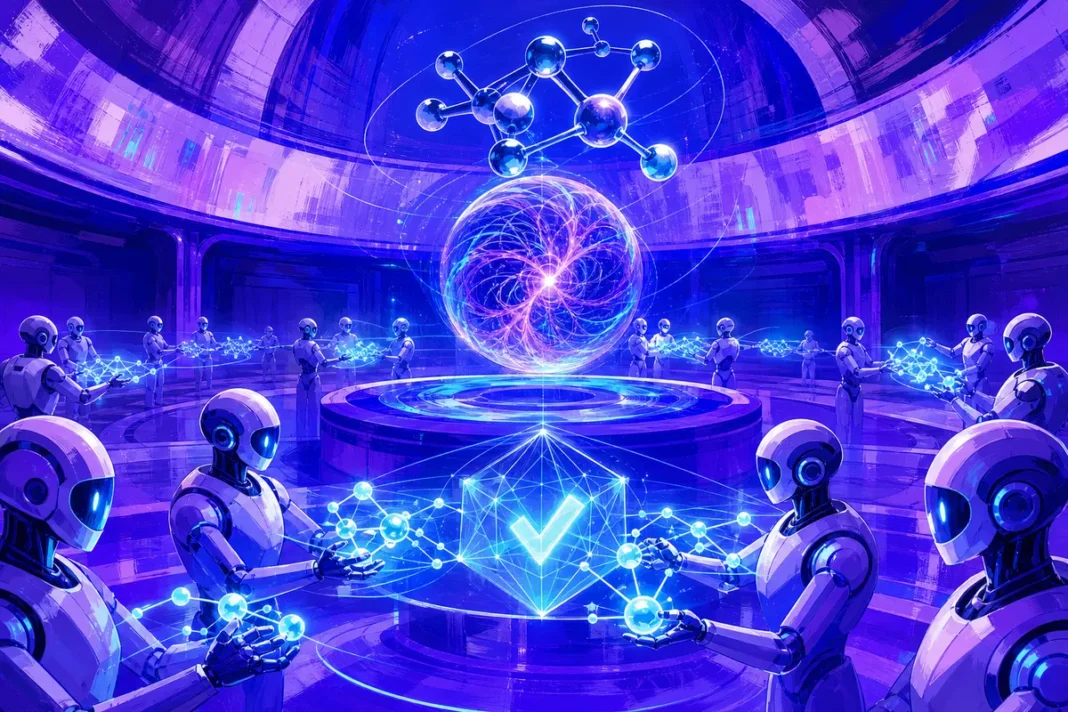
Quantum computers capable of solving real scientific problems do not yet exist, but the programs they will run are already being written. THE November 23, 2026Google DeepMind and the Google Quantum AI team presented a method that entrusts this writing to Gemini 4 AI agent teamswith a particularity: each proposed improvement must be mathematically proven before being retained. Result, algorithms up to 11.8 times less expensive for a calculation linked to nuclear fusion, and gains in chemistry and pharmacology.
Why write algorithms for machines that don’t exist?
A quantum computer does not manipulate classical bits, but qubitscapable of exploiting quantum physics phenomena for certain calculations beyond the reach of current machines: finely simulating molecules or materials, for example. The problem is that these qubits are extremely fragile. To obtain reliable results, qubits are needed corrected errors (called “logical”), each made up of numerous physical qubits. As a benchmark, the Willow chip presented by Google at the end of 2024 has 105 physical qubits.
Researchers therefore prepare the algorithms for future machines in advance, and seek to make them as economical as possible. Each qubit or each operation gained brings closer the day when a calculation becomes feasible. But there is a major difficulty: we cannot test these programs. They are too heavy to be simulated by a classical computer and too large for current quantum processors. As the authors summarize, in the absence of being able to execute them, it is necessary to prove mathematically that they work.
Teams of agents meeting in conference
For each problem, the researchers assigned the search for improvements to several independent agent teamsbased on the Gemini 4 models. Humans set the direction: they choose problems, write their formal description, and supervise the work.
The organization mimics that of a scientific community. A verified idea joins a shared notebook where other agents can take it back. And every four hours, agents from each team meet during a virtual “conference” to exchange their leads. A way of combining approaches, without allowing unproven assertions to circulate.
Lean, the referee who doesn’t let anything pass
The guardrail is called Leana proof assistant: software that verifies, step by step, that a mathematical proof is correct. Google DeepMind already uses it for its reasoning systems, as shown by AlphaProof Code, which proved the security of Signal’s encryption.
Here, the researchers built a library of quantum programs in Lean. For each problem, a specification sets what the program must calculate. The agents propose their algorithms, and Lean verifies two things: that the program gives the correct resultand that he respects the announced cost. This cost is a measure that combines the number of qubits required and the number of operations. An idea that does not pass verification does not enter the common notebook.
Fusion, chemistry, drugs: the announced gains
The agent teams tackled five problems, three focused on science and two on building blocks of quantum computing.
| Issue | What it allows | Gain announced |
|---|---|---|
| Fusion by inertial confinement | Calculate an important property for this type of fusion | Cost divided by 11.8; from 5,650 to 4,338 qubits corrected |
| Photochemistry | Simulate a light-sensitive molecule | Cost divided by approximately 8 |
| Cytochrome P450 | Estimating the energy of a key drug metabolism enzyme | Cost divided by 2.5; from 481 to 333 qubits |
| Grover’s Search | Accelerate database searching for precise implementation | Up to 2.57 times more efficient |
| Arcsine Calculation | Arithmetic operation used in many algorithms | Gain of a factor of 290 |
The most telling result concerns the nuclear fusion: the circuit studied helps to calculate an important property for fusion by inertial confinement, a technique which consists of very strongly compressing, often with lasers, a tiny ball of fuel. Its cost is divided by almost 12, and the memory required drops by around 23%. For the cytochrome P450a family of liver enzymes that transform a large part of drugs, the number of qubits falls by around 30%.
The spectacular gain of a factor of 290 relates to a calculation routine (the arcsine, trigonometric function): a technical brick reusable in other algorithms, not a scientific application in itself. Same logic for Grover’s algorithm, proposed in 1996 by researcher Lov Grover: it makes it possible to find an element in an unsorted list with much fewer tries than a classic computer, and serves as the basis for many other programs. Improving these foundations potentially benefits the entire building.
Results to be read with caution
These figures must be placed in context. First, they do not say that these calculations are now possible. The authors recognize this: running these algorithms in scientific simulations would require even more resources than the first error-corrected quantum computers are likely to provide. Further progress will be required, both on the software and hardware sides.
Then, the gains are measured against published benchmark solutions and according to a cost metric chosen by the researchers, not by timing on a real machine, which does not exist. Finally, the study is a preprint deposited on the arXiv platform under the title “Discovering formally verified quantum programs with AI”, signed by 25 Google researchers. It has not yet been peer-reviewed in a scientific journal.
Towards research where AI proposes and the proof decides
Beyond the figures, the interest of this work lies in the method. AI agents are increasingly used to explore research avenues, but their errors remain difficult to spot. By imposing formal verification at every step, Google DeepMind shows a path where AI can search long and hard, without humans having to double-check everything by hand. According to the authors, this evidence-controlled research condenses work that once required years of manual design, and leaves researchers to choose problems and interpret results.
For quantum computing, the message is twofold. On the one hand, each reduction in the number of qubits brings closer the time when a machine will be useful for chemistry, energy or health. On the other hand, this work reminds us that this moment remains distant: the best algorithms in the world will not replace computers that have yet to be built.