This is an article written in the style of ZDNET, focusing on cybersecurity, privacy and new technologies.
Signal blocks screenshots: messaging goes on the offensive to protect your data from AI
Faced with the insatiable appetite of artificial intelligence models for textual data, Signal is rolling out a radical new feature. The secure messaging application now prohibits screenshots on certain conversations, one more safeguard to guarantee the inviolability of your exchanges.
By the ZDNET editorial team Published on [Date du jour]
The era of generative artificial intelligence poses an unprecedented challenge to privacy advocates. As tech giants train their LLMs (large language models) on everything that makes up the web, the question of the confidentiality of private messages becomes crucial. Signal, often considered the gold standard for encrypted messaging, has just taken it a step further.
The foundation announced the deployment of a major update aimed at purely blocking screenshots. A strong decision, designed to prevent your intimate or professional conversations from being taken over, without your knowledge, by AI tools.
The mirage of end-to-end encryption
Until now, end-to-end encryption (E2EE) was Signal’s ultimate shield: it ensured that only the sender and recipient could read a message. Neither ISPs, nor governments, nor even Signal could intercept content in transit.
However, this system suffered from an inherent flaw, located at the “ends”: the user’s device itself. Nothing prevented an unscrupulous interlocutor – or malicious spyware – from taking a screenshot of a discussion. These images, once stored, can easily be sucked in, analyzed and injected into training databases for AI, or used by transcription and contextual analysis tools.
How does screenshot blocking work?
Already tested in different forms (such as the disappearance of messages or the prohibition of capture on Android for ephemeral messages), the protection is broadening and strengthening.
Depending on the mobile versions of the application (iOS and Android), Signal activates restrictions at the operating system level:
- On Android: The app prevents capture entirely, returning a black image if the user attempts to capture their screen.
- On iOS: Although Apple’s constraints are sometimes stricter, Signal toughens the tone by alerting the user or blocking the display depending on the context of the conversation.
This measure is particularly aimed at discussion groups and sensitive conversations. It aims to neutralize an insidious threat: the growing integration of AI assistants into operating systems (such as Apple Intelligence or Microsoft Copilot), which constantly scan the content displayed on the screen to “help” the user, effectively appropriating data that was not intended for them.
Signal vs. Industry: a radical positioning
This new feature illustrates Signal’s uncompromising philosophy in the face of a technology industry obsessed with data collection. While Meta (WhatsApp, Messenger) integrates conversational AI directly into the heart of its applications – opening the door to potential exploitation of metadata and uses – Signal is making the opposite bet: closing the floodgates.
For CISOs (Chief Information Systems Security Officers), investigative journalists and digital rights activists, this update is excellent news. It reduces the human attack surface, often the weak link in the security chain.
Does security have limits?
However, cybersecurity experts point out: no software measure is foolproof. If Signal blocks screenshots integrated into the system, nothing technically prevents a determined user from photographing their smartphone screen with a second camera.
Nonetheless, by raising the technical difficulty and dissuading automated mass aspiration by third-party software, Signal sends a strong signal. Messaging reminds us that confidentiality is not only a question of transport of data, but also of absolute control over its display.
One thing is certain: in the cold war between privacy and artificial intelligence, Signal has just drawn one of its most dissuasive shields.
Here is a rewritten, fluid and modern version of your content, optimized for the web while retaining all the key information.
Signal strengthens its security against AI agents and blocks screenshots
Signal locks its screenshots to counter AI agents
Key points to remember:
- Signal is tightening its security measures by restricting screenshots on its applications.
- This decision follows the emergence of AI assistants integrated directly into operating systems.
- These artificial intelligence tools threaten the confidentiality of exchanges, a fundamental pillar of Signal's mission.
Faced with growing threats to privacy in the age of artificial intelligence, the encrypted messaging app Signal has decided to impose drastic new restrictions on screenshots.
In a blog post published Friday, Signal President Meredith Whittaker announced that the platform will now block photoshooting in its upcoming iOS 27 release, as well as “when AI assistants will attempt to capture on-screen data on Android”.
Ms. Whittaker points to “agentic” features developed by Google and Apple — such as Gemini Intelligence or the function Onscreen Awareness of Siri —, believing that they openly violate the confidentiality standards of third-party publishers.
Microsoft's previous Recall AI
These new AI tools work constantly in the background, analyzing everything displayed on the screen to contextualize user queries.
“Your sensitive data is thus captured, stored and made accessible to any local database or remote server operated by an AI agent of the operating system”alarms Meredith Whittaker. She adds: “Once the information is sucked in, Signal loses all control, putting the privacy of all participants in a conversation at risk. »
This is not a first for the application: last year, Signal had already blocked screenshots in Windows 11 to counter the controversy aroused by the function Recall AI from Microsoft.
More agents, more risks
This decision illustrates the direct repercussions of the tech giants' AI strategy. As artificial intelligence moves from the status of external services (like chatbots from OpenAI or Anthropic) to the very heart of operating systems, independent applications must fight to preserve their security.
Ironic paradox: just last week, Google DeepMind researchers used AI agents to formally audit Signal's code, proving by9p, mathematically, that the application's encryption works perfectly. A security guarantee that loses all meaning if a simple visual assistant can suck up messages directly from the screen.
Competition is also accelerating in this area, with the supposed development of the agent Galaxy Claw at Samsung, and a rival to ChatGPT and Claude concocted by Apple.
Protection still incomplete (especially on macOS)
Ms Whittaker admits, however, that this anti-capture parade is not infallible. AI agents have other entry points, “such as retrieving content already present on the device via the file system”.
As such, a recent investigation by Reuters with support from Signal and the AI Now Institute found that the agent Muse of Meta hijacked initial permissions to dig into applications and data without explicit user consent.
Additionally, Signal has acknowledged that its current protections do not yet work on macOS.
“This is a major problem: application developers do not have robust tools to counter AI intrusions at the system level”deplores the president of Signal. “Even when we manage to block access to our data, Apple, Google, Microsoft and others provide no easy way to do so without degrading the overall user experience. »
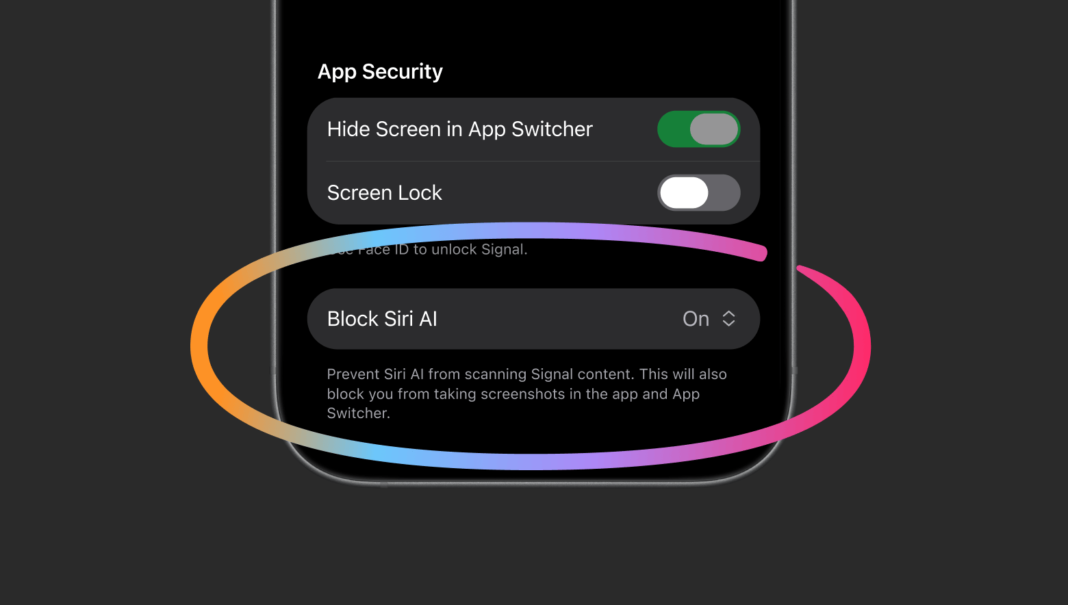
How to disable this restriction?
If you prefer flexibility and want to continue taking screenshots, it is technically possible to deactivate this option in the application settings. A manipulation strongly discouraged by Signal.
“You would thus expose your content and that of your correspondents to these AI agents, nullifying our confidentiality guarantees”concludes Meredith Whittaker.