Why aren’t your ad results directly linked to your sales?
Let’s take a concrete example: a customer sees an ad on Instagram, but does not click on it or make a purchase. Two days later, she searches for the product on Google, clicks on a Google Ads ad and completes her purchase. This same sale can then be recorded by both platforms:
- Meta can take credit for the sale because the customer was exposed to an Instagram ad before her purchase, based on the attribution settings you set.
- Google Ads may also take credit for the sale because the customer clicked on a Google ad before making her purchase.
Result: a single real sale can be counted by two advertising platforms, thus distorting the performance indicators (ROAS and CPA), which no longer necessarily reflect the real contribution of the campaigns.
To go further, let’s take another example: you have a very high ROAS on Google Ads. The problem is that these campaigns can target prospects who already know you. You also have advertising campaigns on Meta which allow you to acquire new customers and renew your audience base. If you rely solely on ROAS, you risk only keeping Google Ads campaigns when both can be useful to your media mix.
This example shows the limits of reading advertising performance based solely on the conversions attributed to each platform. To better understand the true value of your campaigns and their impact on your sales, it is essential to distinguish three complementary notions: attribution, contribution and incrementality.
Attribution, contribution, incrementality: what are the differences?
So, what is the difference between these three concepts?
- Attribution helps determine which touchpoints are attributed a conversion (first click, last click, etc.).
- The contribution allows you to see how your campaigns participate in the funnel (initiation, participation, closure).
- Incrementality allows you to estimate whether your customers would have purchased without your ads (i.e. how much additional sales your ads generated).
In fact, it is possible that your ads contribute to the customer journey, but do not generate additional sales.
What methods should you use to measure the effectiveness of your advertisements?
Some companies still rely on the last click to measure the sales generated by their advertising campaigns. The problem is that the first clicks, which initiate the conversion journey (or funnel, that is to say the different stages which lead a consumer to the purchase), do not necessarily generate immediate sales, but play an essential role in triggering a journey which can subsequently lead to a conversion. Other advertisers use data-driven attribution models, which are complex to understand.
Here are three commonly used methods:
- The MTA : factual and granular analysis of touchpoints to understand the immediate user journey.
- Marketing Mix Modeling (MMM) : an analysis of two years of data to identify saturation curves. It reveals the real investment margin: how much can you invest before the return decreases?
- The Lift : an analysis that isolates the specific impact of awareness and consideration campaigns to validate their real contribution to final turnover.
Each solution provides specific insight. Their complementarity makes it possible to obtain a more complete and relevant vision.
The main risk of overinvesting in the bottom of the funnel is operating in a closed circuit, by not renewing the prospecting audience and only communicating with its loyal base. Some advertising campaigns can cannibalize each other. This is particularly the case for retargeting, affiliation or even certain Performance Max campaigns, which can reach people already close to the act of purchase. To avoid overly soliciting these audiences, you must analyze the contribution of your advertising campaigns and identify those which attract new prospects.
How can prescriptive AI help?
For marketers, it is necessary to collect all the data related to the different advertising platforms, which is time-consuming. Meanwhile, advertising budgets continue to be spent. This is why AI can be very useful.
Indeed, there is descriptive AI, which tells you what happened, predictive AI, which estimates what could happen, and prescriptive AI, which recommends what to do.
Prescriptive AI can, for example, identify a campaign that is spending too much compared to its objective and suggest that you transfer part of the advertising budget to another campaign. It can also identify a problem of over-requesting an audience or even a measurement problem, if the data from an advertising platform is not aligned with the company’s sales.
Prescriptive AI can save you time and make your decisions easier, but be careful, it doesn’t make them for you.
To analyze the contribution of advertising campaigns, advertisers can use solutions liketrackad.aia French advertising measurement platform which crosses the data of the different advertising networks with those of the advertiser.
How does Ask NOA make advertising performance analysis easier?
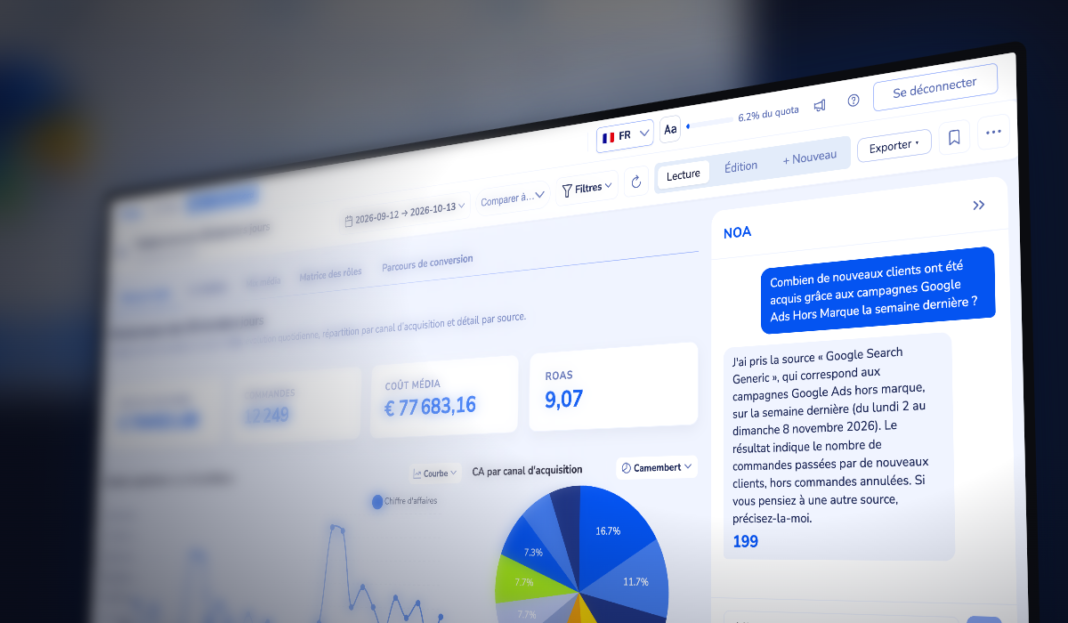
NOA is TrackAd’s prescriptive AI. It analyzes advertising campaigns according to their objectives. Indeed, the analysis of an advertising campaign aimed at reaching new prospects will not be the same as that of a retargeting campaign, for example.
In addition, prescriptive AI detects anomalies in advertising campaigns and suggests areas for improvement. As Guillaume Le Roy, CEO of TrackAd, explains: “NOA does not just provide metrics. It provides actionable and prioritized recommendations. »
Thanks toAsk NOAthe new feature of the TrackAd platform, advertisers can ask the AI questions in natural language to obtain insights about their advertising campaigns. For example, you can ask: “How many new customers were acquired through Off-Brand Google Ads campaigns last week?” »
Finally, TrackAd offers a connection via the MCP (Model Context Protocol), which allows you to query the platform’s data from a compatible external AI assistant, such as Claude.
Why is it important to share analyzes between marketing teams, finance management and agencies?
This subject will be discussed in particular during the next TrackAd and JVWeb webinar, on November 19, 2026, in the format Live. Sylvain Miquel from JVWeb, Antoine Le Magueresse from the Atlas For Men brand and Maximilien Jacquet from TrackAd will explain how advertisers, agencies and measurement solutions can work together to answer the questions of incrementality and the contribution of different levers.