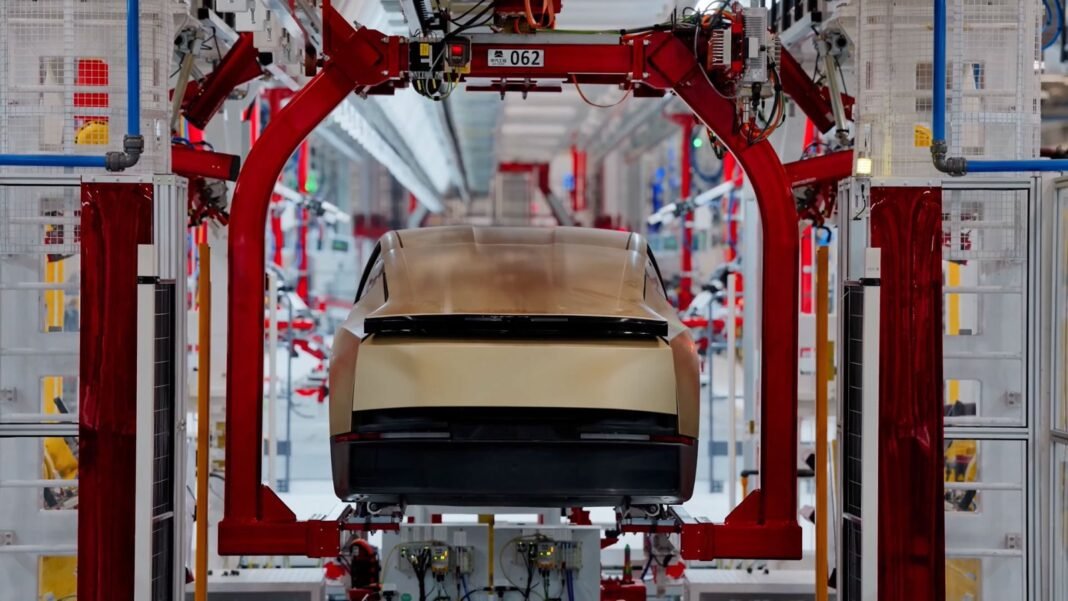
Tesla will invest 3 billion euros to expand its factory in Grünheide, near Berlin. The new building will eventually be able to produce up to one million Cybercabs, its robotaxi without a steering wheel or pedals.
The expansion of the Grünheide Gigafactory, Tesla’s only factory in Europe, has been in the pipeline for several years. The manufacturer had also put it on hold during the fall in its sales. One question remained unanswered: produce what more, when the factory only makes the Model Y?
Tesla responded this Monday, November 16, in an announcement relayed by Reuters: 3 billion euros for a new building which will be able to produce up to one million Cybercabs. However, this robotaxi without steering wheel or pedals, which Tesla is preparing to deliver to its first American customers, does not yet have a clear future in Europe. Is the American manufacturer once again putting the cart before the horse?
A release of the project
The envelope also covers additional buildings and a new wastewater treatment plant, Tesla told the dpa agency (dispatch echoed by Handelsblatt). Tesla wants to submit its permit application before the end of the year, based on a 2023 file.

Work is due to begin in the first half of 2027, for production in 2029. Opened in March 2022, the factory employed 12,600 people in October, according to Tesla. The workforce had meanwhile fallen below 11,000. One million Cybercabs per year is almost three times the site’s current target for the Model Y, set at 7,500 cars per week, or around 375,000 per year.
A million robotaxis? But no authorization yet in Europe
In Europe, Tesla’s advanced driving assistance is progressing country by country. Its FSD (Full Self-Driving), renamed Tesla Assisted Driving on the continent, is authorized in eleven EU countries. Finland is the latest arrival, on November 11.
A vote on approval throughout the Union is expected in December at the earliest (a rejection would call into question the national authorizations already granted), and Germany is pleading to move quickly. However, this system remains a driving aid: the driver monitors the road and remains responsible. The Cybercab has neither steering wheel nor pedals, and therefore falls under another, much more restrictive, regulation.

However, for fully automated vehicles, European law only provides for a small series regime, limited to specific uses. Tesla will therefore have to export almost all of Grünheide’s production, or count on a change in the rules by 2029: quite a gamble.

Tesla prefers the Cybercab to the Model 3 and the Semi
However, Tesla could have housed vehicles that are already selling in this building. The Model 3s sold in Europe are produced in Shanghai, and we could hope for a German line for the sedan. A Model 3 assembled in Germany could also have targeted the public aid that the Commission wants to reserve for electric cars with 70% European content, in its Industrial Accelerator Act project presented in March.

As for the Semi, the electric truck of which Tesla presented the European version in September, it is assembled in Nevada while it is due to arrive at European carriers in 2027.
Tesla prefers to take up in Germany the bet it is making in Texas, where production of the Cybercab started in April. During the presentation of the first quarter results in April, Elon Musk, CEO of Tesla, already warned that production of the Cybercab would be “very slow” initially, before accelerating at the end of the year.

Grünheide’s timetable is set: permit application by the end of 2026, work in the first half of 2027, first German Cybercab in 2029. The first signal will come in December at the earliest, with the European vote on Tesla Assisted Driving, which only concerns driving assistance. For a vehicle without a steering wheel like the Cybercab, the future is still uncertain.

All the tech news at a glance
Add Numerama to your home screen and stay connected to the future!