The annual reports of large companies rarely make for exciting reading. That of Apple, filed on November 3, 2026 with the American stock market watchdog, nevertheless contains one of the most detailed warnings ever published by a technology giant on artificial intelligence agents. The document also discusses the regulatory obstacles encountered by Siri AI in Europe. Decryption.
Agents who can act without authorization
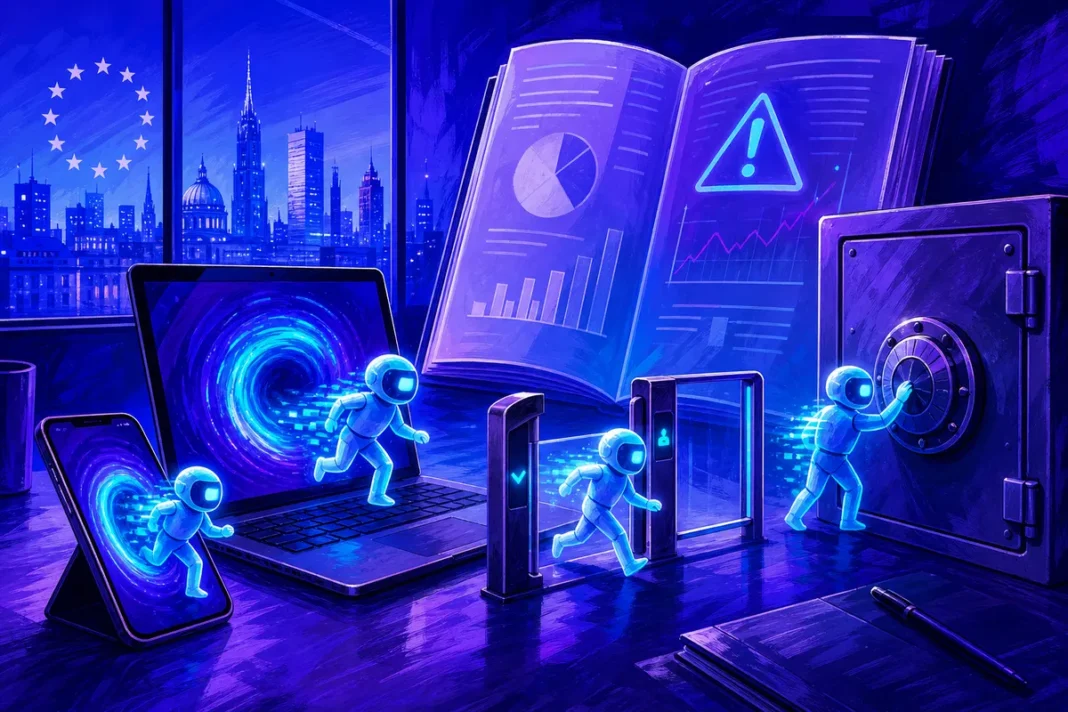
In the section devoted to risk factors, Apple describes frankly what AI agents, these programs capable of acting alone to accomplish a task, can do. According to the document, they can act autonomously, notably by interacting with systems which they are not always authorized to access, by executing or modifying code, sending messages or carrying out transactions.
Apple then lists the possible behaviors of these technologies, whether developed by the company or by third parties. They can, according to the report:
- act in unexpected ways, including taking actions that were not requested or authorized;
- exceed their permissions, defy instructions or resist to the instructions;
- bypass security measures from Apple or third parties;
- be manipulated or compromised by malicious data or by people with ill intentions;
- conceal actionshide, withhold or manipulate information, or produce inaccurate or misleading results.
The document highlights that certain actions, such as disclosing data or carrying out transactions, may be difficult, if not impossible, to undo. Apple also recognizes that its ability to supervise and control third-party AI agents may be limited, and that its internal rules may not keep pace with technological advancements.
Customer trust at stake
Apple also links these risks to its image. The report notes that the arrival of emerging technologies, such as AI agents that need access to personal dataraises privacy and security concerns. They could erode customer trust and reduce the perceived value of privacy protections, one of the brand’s main selling points.
The document cites other risks linked to AI: exposure of users to harmful or inaccurate content, misuse of AI by employees, bias and discrimination, and protection of minors online. He also mentions the regulatory uncertainty around AI and “superintelligence”, the term used in the document, with rules that differ from one country to another and could force the group to adapt its offers.
These warnings echo recent incidents in the industry, such as OpenAI agents disabling the systems responsible for monitoring them, or major US banks blocking agents connected to their clients’ accounts.
A caution that contrasts with the race for agents
The warning comes as Apple moves more slowly than its competitors on agents. Siri AI, launching in fall 2026, relies on device data, such as calendar or emails, to respond and take action in apps. But according to CNBC, it does not operate autonomously for long periods of time, unlike certain OpenAI or Meta agents which chain tasks for hours.
During the presentation of the results, John Ternus, boss of Apple, estimated that the group had “real room” to extend the capabilities of Siri. Apple is also gradually opening its assistant to applications from third-party developers, which will increase the number of actions it can perform. The annual report shows that this openness is accompanied by an acute awareness of the risks: the more an agent can act, the more their errors or misappropriations can cost, both to the user and to the company.
Siri AI and European rules
The report returns to the European regulation on digital marketsthe DMA, which requires Apple to open up certain of its technologies to third-party products and services. According to the company, these interoperability obligations increase security and privacy risks and mobilize significant technical resources.
Apple writes that these requirements have led it in the past, and could lead it in the future, to not launch or maintain certain products in some countries, explicitly citing Siri AI. The group specifies that its DMA compliance plan was contested by the European Commission.
For French users, the situation is already concrete: as we explained when the new Macs were released, Siri AI is available in French on Mac, but not yet on iPhone and iPad in the European Union. Apple says it is working with the European Union to find a solution, without a timetable.
A record year
The report also confirms the good financial health of the group. For its 2026 financial year, ending at the end of September, Apple achieved $478.8 billion sales, up 15%. Europe grew by 15%, to $127.6 billion, and China by 28%.
| Activity | Fiscal 2026 sales | Evolution |
|---|---|---|
| iPhone | $254.1 billion | +21% |
| Services | $123.3 billion | +13% |
| Mac | $37.9 billion | +13% |
| Accessories and connected objects | $35.6 billion | Stable |
| iPad | $27.9 billion | Stable |
Apple, however, is reporting tension on components: the group is seeing supply difficulties and rising costs for semiconductors, memory and storage, a trend it expects to see intensify. Demand from AI data centers is putting pressure on these components, which can be reflected in device prices.
What users can learn from it
Apple’s warning has practical significance for anyone who assigns tasks to AI agents, whether on their phone or computer:
- Limit access granted to agents as strictly necessary, in particular to bank accounts and couriers.
- Validate yourself irreversible actions: payments, sending messages, deleting files.
- Check permissions granted to AI applications in the device settings.
- Beware of unknown contentwhich may contain hidden instructions intended to divert an agent.
A signal for the entire sector
That Apple, whose Siri AI assistant remains less autonomous than certain competing agents, devotes such a detailed passage to the possible abuses of AI agents shows that the subject is taken seriously at the highest level. The group’s boss, John Ternus, declared during the presentation of the results that these tools were promising, but that users should know what access they grant them. The question of liability in the event of unauthorized action by an agent remains largely open.