
This Wednesday, November 18, 2026, NASA’s Voyager 1 probe passed the Earth’s light day mark, or approximately 25.9 billion kilometers. Launched in 1977, it took 49 years to travel the distance that light covers in 24 hours.
When it comes to understanding the absolutely colossal distances in the universe, the reference measurement is the light year. It is this which usually makes it possible to indicate the distance between objects that are incredibly distant from each other. And it is sometimes almost insufficient, like this signal having crossed 10 billion light years before reaching us.
The concept of light year is actually quite simple to understand: this unit of length determines the distance traveled by light in a vacuum in one year. As a result, we easily understand the logic of a light day. It’s the same thing, but in 24 hours. But in concrete terms, what does this mean?
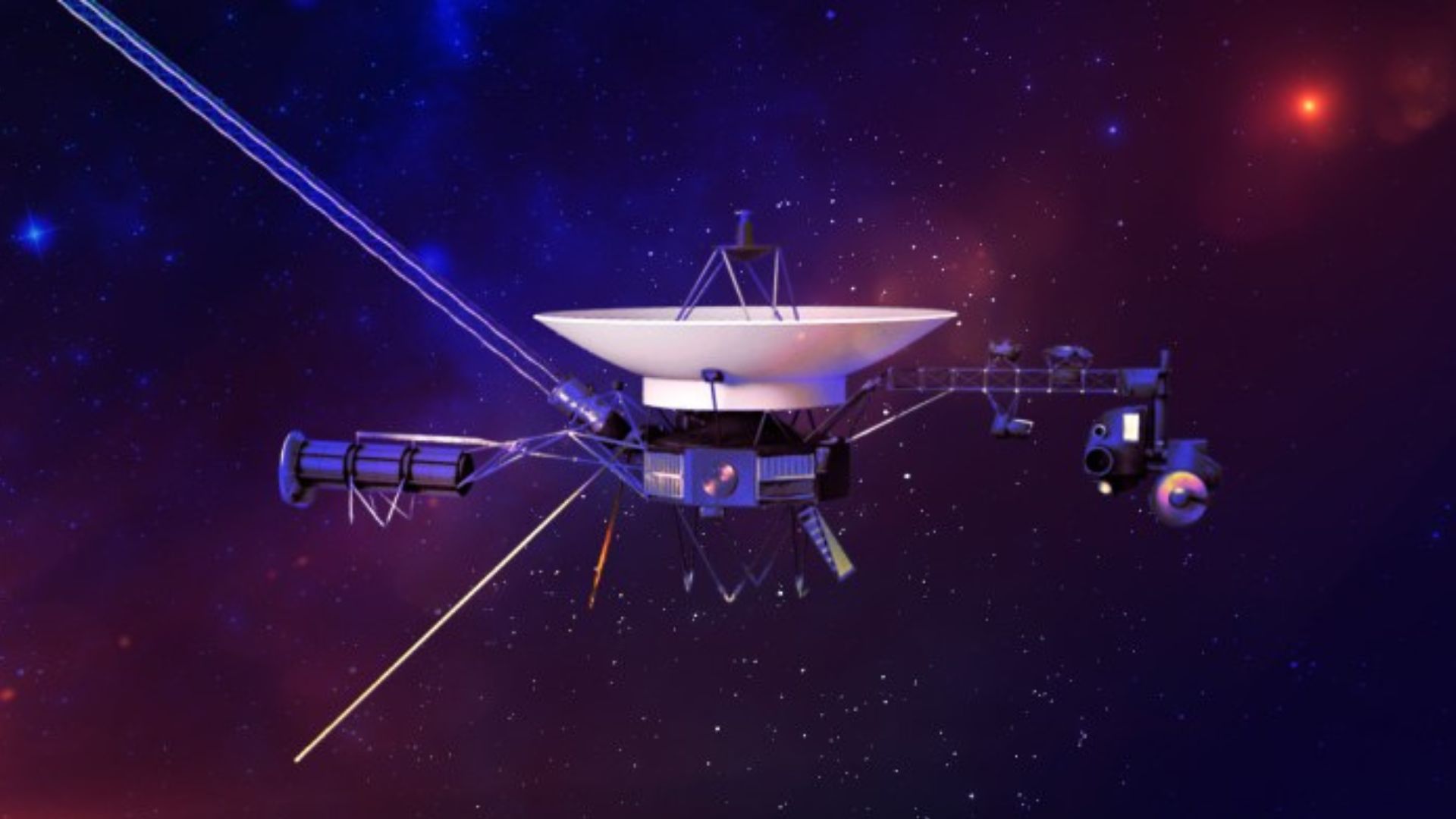
This question arises forcefully, because the light day is at the heart of the news today: in fact, this November 18, around 11:16 a.m. (Paris time), NASA’s Voyager 1 probe crossed this bar of one light day of distance from the Earth. No other object made by humanity has gone this far: Voyager 1 has held this record since February 1998, when it passed the Pioneer 10 probe. Until now, its distance was measured in light hours.
In 24 hours, therefore, light travels a distance of 25.9 billion kilometers in a vacuum. The consequence? An instruction sent by radio from Earth takes a full day to reach the probe. His response takes just as long to come back. A simple exchange therefore takes two long days. And it’s only going to get worse.
Because the probe, launched on September 5, 1977, continues its odyssey without return in the cosmos.
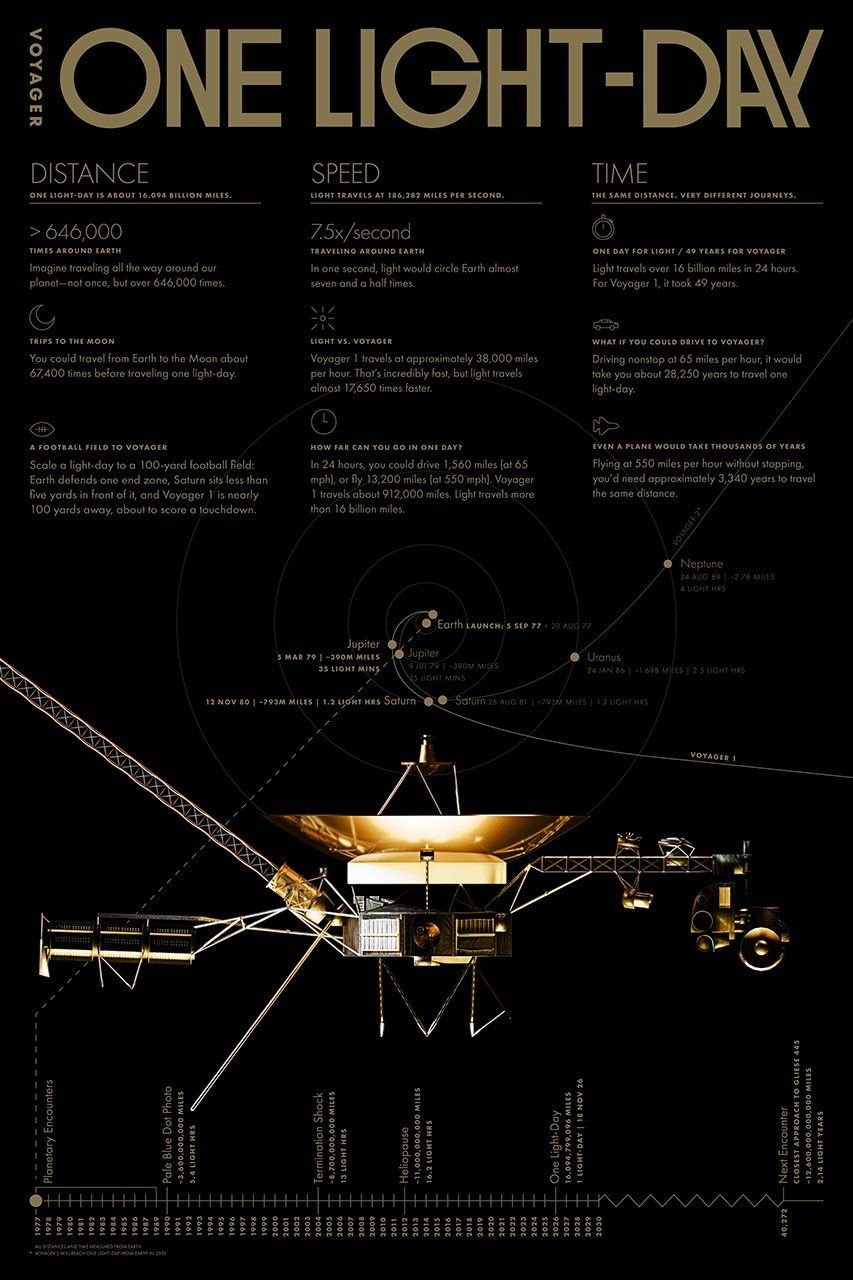
But to make this light-day distance more meaningful, NASA published an infographic with a series of equivalences on November 16. For those who wish, the American space agency also invites the public, the day before the passage, to say “hello” to the probe in Morse code with their smartphone. A mostly symbolic initiative.
More than 67,000 trips to the Moon
The equivalences are dizzying: 25.9 billion kilometers, that’s more than 646,000 revolutions of the Earth at the equator. An average human life spans approximately 30,000 days (based on a life expectancy of around 82 to 83 years). To complete these 646,000 laps in a lifetime, you would have to do almost 22 per day.
It’s also about 67,400 trips between the Earth and the Moon, with the two bodies separated by about 384,400 kilometers. Traveling at 299,792 km/s, light circles the Earth almost 7 and a half times, and this in a single second. Despite this speed, space is so large that light takes time to pass through it.
To take a more down to earth comparison, NASA also offers a version on the scale of an American football field, 91.4 meters long. Earth is defending an end zone and Voyager 1 is on the other end of the field, ready to score. Saturn, which the probe flew by in November 1980, would be less than 4.6 meters from Earth.

28,250 years in car, 49 years for Voyager 1
If light is unbeatable in terms of speed, Voyager 1 defends itself well. The probe is even quite fast: it travels at around 61,155 kilometers per hour, or almost 1.47 million kilometers per day (light still goes almost 17,650 times faster, in comparison). By reducing the matter to km/h, it is easier to understand things.
A car driving non-stop at around 105 kilometers per hour would travel around 2,510 kilometers per day. It would therefore take approximately 28,250 years to cover one light day. An airliner launched at 885 km/h would still take around 3,340 years. Voyager 1 took almost half a century to get there, at a high speed that varied throughout the journey.
The probe is only partially functioning: two scientific instruments, a magnetometer and a plasma wave detector, are still on; the others broke down or were cut off to save energy. Voyager 1 provided insight into the interstellar environment, but perhaps its most significant legacy is symbolic.
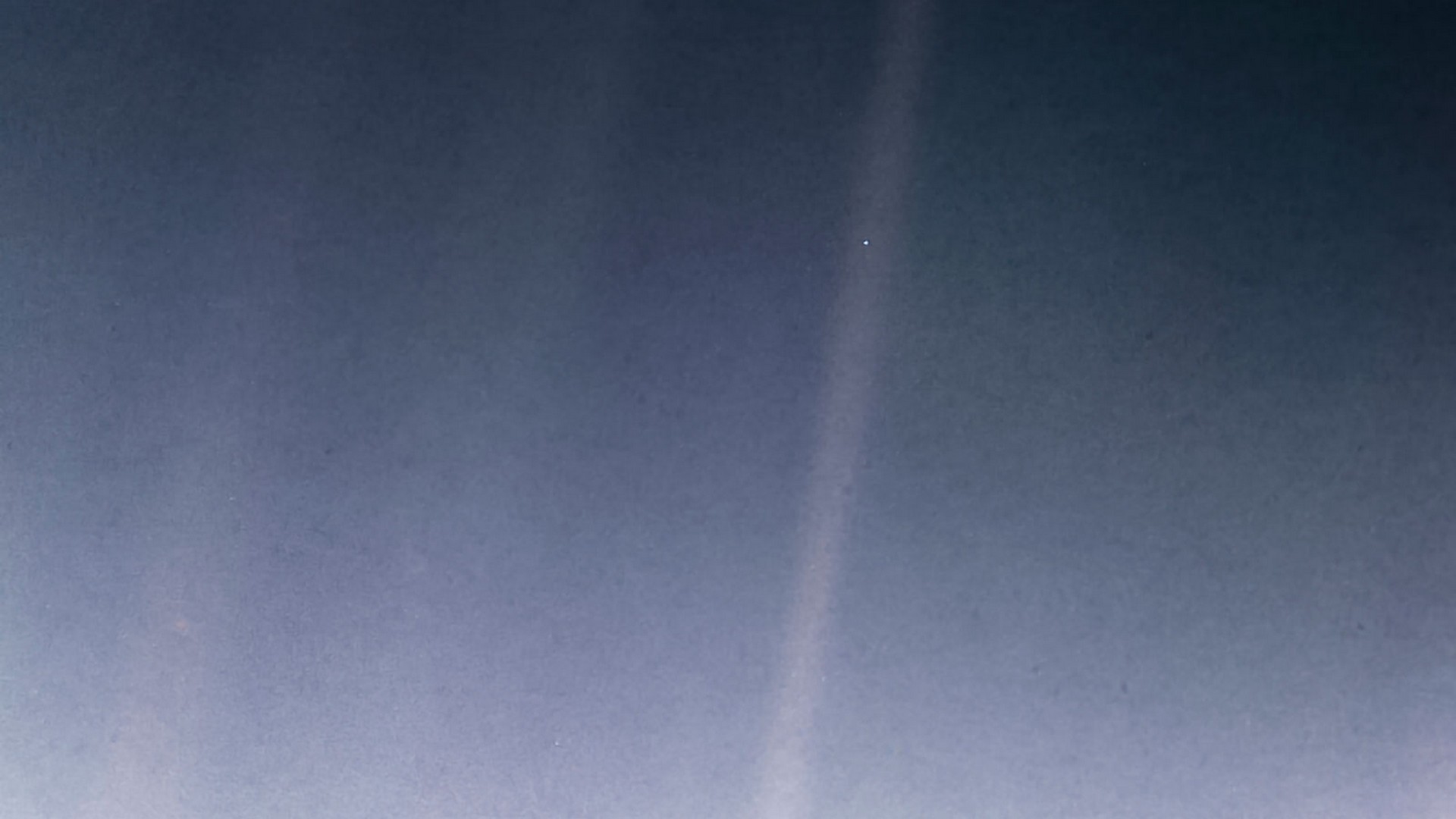
On February 14, 1990, Voyager 1 took the photo of the “pale blue dot,” where Earth is just a tiny dot. The probe was then about 6 billion kilometers from the Sun, and the photo inspired a very famous comment from astronomer Carl Sagan, a member of the Voyager imaging team and the originator of the photo. In his book Pale Blue Dot (1994), he sees it as a reminder of humanity’s tiny place in the universe.
On August 25, 2012, the probe crossed the heliopause, the boundary of the bubble of particles and magnetic field created by the Sun, about 18 billion kilometers from the Sun. Voyager 1 then entered interstellar space, which remains, on the scale of the universe, our very close neighborhood.
On the scale of stars, a light day remains tiny. A light year contains just over 365, and Proxima Centauri, the closest star to the Sun, is 4.24 light years away. NASA estimates that Voyager 1 will pass within 1.7 light years of the star Gliese 445 in about 40,000 years. According to the infographic, the probe will then be some 2.14 light years from Earth, or approximately 780 light days.

All the tech news at a glance
Add Numerama to your home screen and stay connected to the future!