- →Released this May 28, 2026available immediately everywhere: claude.ai, Claude Code, APIApplication Programming Interface, the programmatic access channel to a service or model. and Cowork. API identifier:
claude-opus-4-8. - →Base price unchanged compared to Opus 4.7 ($5 / $25 per million tokens). THE Fast Mode is 3x cheaper and 2.5x faster.
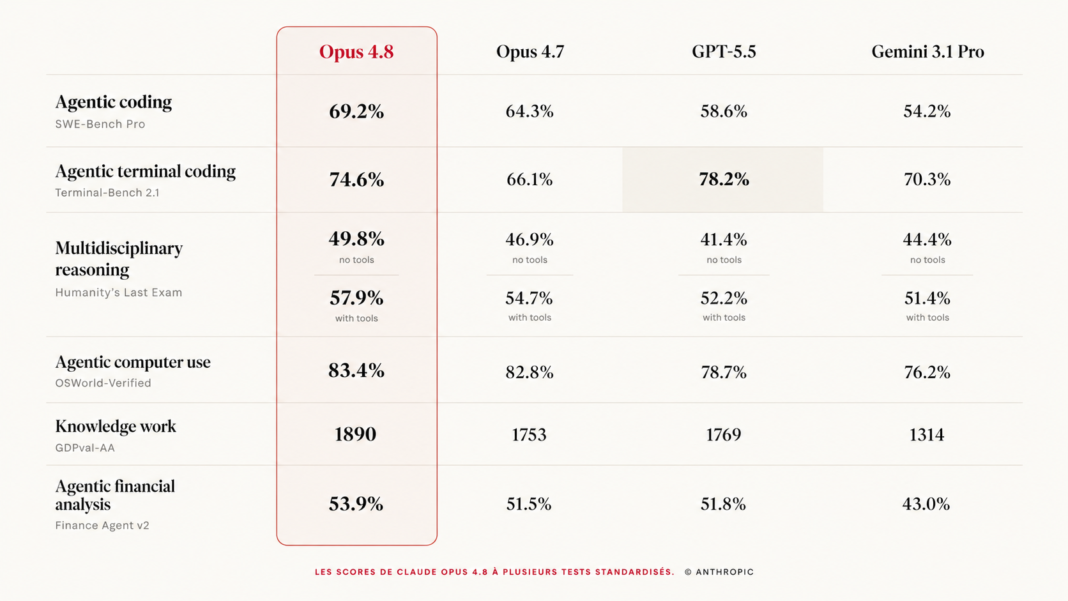
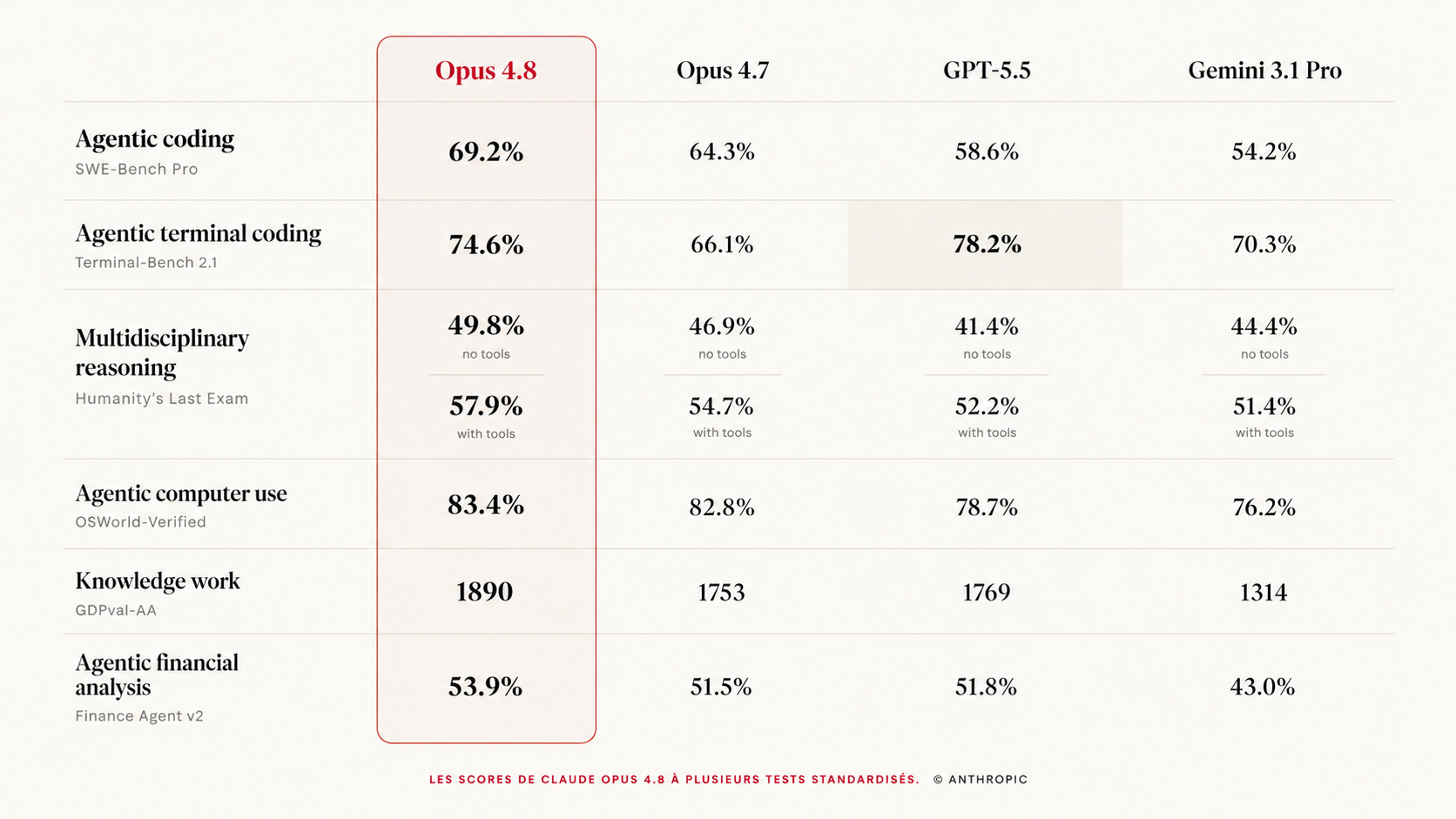
- →+5 points on SWE Bench Pro (64.3% → 69.2%), +1.4 pts on OSWorld, +137 pts on office tasks (1753 → 1890).
- →Four times fewer hidden bugs. Opus 4.8 points out its uncertainties instead of hiding them. Honesty becomes a sales argument.
- →Dynamic Workflows arrives in Claude Code: a model can now drive several hundred sub-agents in parallel and complete entire codebase migrations alone.
Anthropic has just published Claude Opus 4.8its new flagship version. The announcement, made this Thursday, May 28, 2026, marks the fastest pace ever observed at the company only 41 days after Opus 4.7. For comparison, the Sonnet and Haiku models have been waiting 3 and 7 months respectively.
This acceleration is not a coincidence. Opus 4.7 had received a mixed reception (verbosity of comments, clumsy tool calls) at the time OpenAI had just refreshed Codex And Google released Gemini 3.5 Flash. Anthropic had to respond, and quickly.
Beyond the figures, Opus 4.8 introduces two strategic new features: a functionality “Dynamic Workflows” capable of orchestrating armies of sub-agents in Claude Code, and a fast fashion three times cheaper which changes the economic equation of massive uses. Decryption.
The biggest upgrade in Claude Opus 4.8 isn’t speed and it isn’t the benchmarks. It’s that it finally stopped pretending the code works when it doesn’t.
01, The model
Claude Opus 4.8, what is it exactly?
Claude Opus 4.8 is the most capable version of Anthropic’s model familythe American publisher of Claude, direct competitor of ChatGPT (OpenAI) and Gemini (Google). In the Anthropic range, Opus plays the role of the high-end model, where Sonnet occupies the middle (speed/quality balance) and Haiku the base (light, economical model).
Concretely, Opus 4.8 succeeds Opus 4.7 released on April 15, 2026. This is an incremental update, not a major architectural change. Anthropic itself describes Opus 4.8 as “a modest but tangible improvement” compared to its predecessor. At the same time, management is preparing a more significant generational leap with a new model called Claude Mythosalready in preview with a few organizations (see below).
Where to use it today
claude.ai general public web and mobile application. Pro ($20/month) and Max ($100/month) subscribers can select Opus 4.8 in the selector.
Claude Code Command line agent for developers. Opus 4.8 becomes the default model on Max and Enterprise plans.
Anthropic API for application integration. Identifier: claude-opus-4-8.
Cowork collaborative work environment launched by Anthropic in spring 2026.
02, Numbers
Opus 4.7 vs Opus 4.8 benchmarks
Anthropic publishes a series of comparative benchmarks. Rather than a long table, here are the six key metrics visualized:
How to read these figures?
-
SWE Bench Pro is the gold standard for evaluating a model on authentic code problems from projects open sourceSoftware whose source code, and sometimes the model weights, are freely published and reusable.. A jump of almost five points in six weeks is considerable. As a benchmark, GPT-5.5 (OpenAI) scores 83.4% on Terminal-Bench 2.1 (similar test) with its Codex CLI harness. The two models play in the same league.
-
OSWorld-Verified measures the ability to control an operating system: click, type, navigate, fill out forms. Opus 4.8 takes the lead on Online-Mind2Web (web version of benchmarkA standardized test that measures the performance of models on a task (e.g. SWE-bench for coding, MMLU for general knowledge).) with a score that GPT-5.5 and Gemini do not match for the moment.
-
The 1890 score on office tasks is on a proprietary scale, but Anthropic says it’s the highest ever by a commercial model on this sequel.
Testimonials from Launch Partners
The Anthropic announcement is accompanied byeleven testimonials from partner companies. They all converge on two qualities: reliability on long tasks and sharper judgment.
On CursorBench, Opus 4.8 outperforms previous versions on all effort levels. Tool calls use fewer steps to achieve the same result.
AI IDE for developers
Opus 4.8 fixes comments verbosity and tool call issues observed on Opus 4.7. This is the implicit admission of the faults of the previous version.
Agent Devin Editor
With Genie, Opus 4.8 delivers a 61% reduction in token costs for multimodal analyzes on PDFs and diagrams, at equal quality.
Corporate data agent
For legal and financial workflows, citation accuracy improves significantly and token recovery efficiency works very well on dense filings.
Documentary orchestration
03, The bet
Honesty, Anthropic’s new obsession
It’s probably the most unusual angle of communication of this announcement. Rather than emphasizing only speed or benchmarks, Anthropic highlights the reliability of the model when it encounters uncertainty.
Opus 4.8 approximately four times less likely than his predecessor to let defects slip through in the code he wrote without reporting them.
Anthropic, official announcement Opus 4.8
Concretely, what does this change for a user? Three things:
-
In assisted codingthe model more often raises areas that it could not validate, instead of producing a fix that “seems” to work but introduces a silent regression.
-
In data or document analysishe points out the contradictions in the sources provided, where Opus 4.7 tended to silently harmonize the discrepancies.
-
In long research workhe puts explicit markers on the hypotheses he had to make due to lack of proof.
This orientation brings Opus 4.8 closer to the expected operation of a conscientious human collaborator who says “I don’t know” when it is, rather than an assistant who wants to please at all costs. It is also a response to a recurring criticism of generative models: their tendency tohallucinationThe generation by an AI of inaccurate or invented information, presented as if it were fact. confident.
Anthropic transforms a universal defect into a differentiating argument
Where OpenAI and Google work on raw capacity, Anthropic relies on trust. For regulated sectors (banking, health, legal), a model which signals its doubts is worth much more than a more powerful model which masks them.
When Opus 4.8 declines unethical action, it appears to do so out of fear of getting caught, not out of internalized ethics. The Claudes before Opus 4.6 motivated their refusals differently. A subtle but important signal.
Anthropic’s alignment team, which audits each model before publication, concludes that positive features of Opus 4.8 reach new records on measures such as “supporting user autonomy” and “acting in their best interests”. Rates of problematic behavior are substantially lower than on Opus 4.7, at a level similar to that of Claude Mythos Preview.
04, The agents
Dynamic Workflows: Claude Code pilots armies of sub-agents
If you don’t use Claude Code on a daily basis, this section may seem technical. But it’s probably the most structuring novelty of the day.
What are we talking about?
AI models, even very powerful ones, remain limited by the length of a single session. Beyond a certain volume of contextThe context window: the maximum number of tokens that a model can process in a single request (eg: 200k, 1M).their ability to reason coherently deteriorates. To get around this wall, AI agent developers have been using a technique called “sub-agent orchestration” : we divide a large problem into sub-tasks, we launch a Claude sub-agent per sub-task, and a supervising agent summarizes the results.
The problem: until now, this orchestration had to be hand coded with tools like LangGraph, AutoGen or in-house frameworks. Expensive to set up, fragile, difficult to debug.
Dynamic Workflows integrates this logic directly into Claude Code. In a single session:
Official Anthropic demo: Dynamic Workflows in action in Claude Code with Opus 4.8 (3 min).
- Claude plans the subtask tree.
- He throws up several hundred sub-agents in parallel.
- Each sub-agent works independently, sometimes for several hours.
- Claude checks the results before sending them back to the user.
The emblematic use case
Anthropic gives the following example in its official post: with Dynamic Workflows and Opus 4.8, Claude Code can conduct a full repository-wide codebase migrationover hundreds of thousands of lines, from task launch to final merge, using the existing test suite as a guardrail.
Concretely: transformThe neural architecture introduced in 2017 by Google, the basis of almost all modern LLMs. all pages of a React 17 application to React 19, or migrate a Python 2 backend to Python 3 on a project of 200,000 lines, becomes a single order. All under human supervision if desired, or in completely autonomous mode with final validation.
For whom? At what price?
The functionality is in research previewavailable only on Claude Code plans Enterprise, Team and Max. Classic Pro users do not have access to it at this time. This is consistent with Anthropic’s philosophy: test first with organizations capable of absorbing possible accidents, then expand.
Anthropic has increased rate limits by Claude Code to accompany the explosive consumption that this mode entails. Count several million tokens for a typical migration.
05, Prices
Fast Mode, 2.5 times faster, 3 times cheaper
The “Fast Mode” of Opus 4.8 is probably the new thing that will have the greatest impact on budgets AI teams. Quick reminder: Fast Mode is a variation of the model optimized for speed, which sacrifices a little quality in exchange for a faster response time.
On Opus 4.7, Fast Mode cost around 3 times more than standard mode. On Opus 4.8, this ratio collapses :
Standard Opus 4.8
$5
$25
Reference
Fast Mode Opus 4.8
$10
$50
2.5x faster
Fast Mode Opus 4.7
$30
$75
2x faster
Fast Mode is now twice as fast as before for three times cheaper. This unlocks two uses that were previously economically impossible:
Claude Opus 4.8 is incredible for thinking. But it is expensive. Opus 4.8 costs $5 per 1M input tokens and $25 per 1M output tokens. Kimi K2.6 is much cheaper for similar reasoning quality.
This criticism is shared by part of the developer community: for equivalent benchmarks, Chinese models like Kimi K2.6 Or DeepSeek V4 are 5 to 10x cheaper. Anthropic focuses on reliability and the ecosystem (Claude Code, Dynamic Workflows), not on low cost.
- THE real-time chatbots (customer chat, technical support) where every second counts.
- THE self-correcting loops in Claude Code, where an agent can try several hypotheses quickly before choosing the correct one.
Effort control arrives on claude.ai
Small UX revolution on the general public side: a effort control slider appears next to the template selector on claude.ai and Cowork. Three levels:
Standard
Good quality balance / latencyThe time elapsed between sending a request and receiving the full response from a model.. Recommended for most uses.
Extra
For difficult tasks or long asynchronous workflows. xhigh in Claude Code.
Max
The model thinks as much as necessary. Accuracy > response time.
The idea: let the user arbitrates between speed and quality, rather than imposing a fixed compromise. This feature is available on all plansincluding free with quotas.
Please note: on higher levels, the model consumes more tokens, which can exhaust your monthly quota on Claude Pro more quickly. For intensive users, consider the Max plan or API use.
A discreet but major novelty for developers
If you integrate Claude into an application via the API, take two minutes to read this section. Anthropic has changed a technical detail that changes a lot of things for complex agents.
So far, system instruction of Claude (the promptWritten instructions or questions sent to an AI model to elicit a response. which defines its role, its constraints, its tone) had to be passed before the conversation beginsand could not be changed mid-stream without breaking the prompt cache (the mechanism that makes repeated calls cheaper).
With Opus 4.8, The Messages API now accepts system inputs inside the messages tableat any point in the conversation.
Three things finally become possible without breaking the prompt cache
Update an agent’s permissions during a session (authorize access to a new file).
Adjust remaining token budget or format constraints along the way.
Change the environment context (switch from dev to prod) without starting from scratch.
This is the icing on the cake for anyone building AI agents in Python or TypeScript on top of Claude.
06, The market
Claude Opus 4.8 prices: how much does it cost?
Clear recap as of May 28, 2026:
Claude Pro, $20/month. Access to Opus 4.8 on claude.ai and mobile, generous quotas for personal or light professional use. Includes Sonnet and Haiku. Monthly or annual billing (~17% reduction).
Claude Max, $100/month. 5x higher quotas, priority access during peak hours, Claude Code + Dynamic Workflows access. Target: developers and power users.
Anthropic API, $5/$25 per M tokens (input/output). For very high volumes: batch (~50% savings) and prompt caching (up to 90% on repetitions).
Fast Mode API, $10/$50 per M tokens. Reserved for uses where speed is a priority. Three times cheaper than at the launch of Opus 4.7.
Claude Code Enterprise, personalized quote. For teams of 50+ developers. Dynamic Workflows, SSO, audit, contractual guarantees.
For comparison, OpenAI’s GPT-5.5 is priced at $5/$30 per million tokensAnd Gemini 3.5 Flash from Google at around $0.30/$2.50. Opus remains the most expensive of the trio in terms of output, but the gap has been narrowing over the past eighteen months.
Opus 4.8 versus GPT-5.5 and Gemini 3.5 Flash
How does Opus 4.8 position itself against its competitors? Here is our summary reading, based on published benchmarks and partner feedback.
Where Opus 4.8 takes the lead
- Complex agentic coding and codebase migrations. Dynamic Workflows + ability to run very long sessions put Opus 4.8 ahead of the competition on projects with more than 100,000 lines.
- Legal and financial work. Anthropic highlights records on Legal Agent Benchmark (“first model to exceed 10% on the all-pass standard”) and on Finance Agent v2. CoCounsel Legal (Thomson Reuters) and Hebbia confirm this.
- Browser agent. 84% on Online-Mind2Web, compared to lower scores for GPT-5.5 and Gemini.
- Honesty and reporting uncertainties. The qualitative advantage that stands out the most in partner feedback.
Where the competition stays ahead
- Cost per request for simple uses. Gemini 3.5 Flash remains 5 to 10 times cheaper for short tasks (writing, summary, translation). For a high-volume consumer chatbot, the economic calculation still leans towards Google.
- Latency on short tasks. GPT-5.5 maintains a marginal advantage in the first second of response.
- Native multimodality. Gemini remains more efficient when analyzing very large videos or large illustrated PDF documents.
In summary
If your use case revolves around code, autonomous agents, long analyzes or legal/financial workflowsOpus 4.8 is the best choice on the market today. For high volume daily office usesGemini 3.5 Flash remains unbeatable in terms of quality/price ratio. GPT-5.5 remains the most versatile for those looking for a balance in all categories. Our detailed comparison of the four big AIs in 2026 digs into each dimension.
07, The future
Claude Mythos in ambush
Anthropic takes advantage of this announcement to teaser his next level.
We plan to release a new class of models with higher intelligence than Opus. As part of Project Glasswing, a small number of organizations are currently using Claude Mythos Preview for cybersecurity work.
Anthropic, official announcement
Reading : Claude Mythos will likely arrive during the summer of 2026probably before the Anthropic conference planned for the fall. Its first official vocation is offensive and defensive cybersecurity, a field which requires specific technical barriers to avoid malicious uses. Anthropic follows a pattern that OpenAI popularized with GPT-5: closed preview first, gradual opening later.
For those who follow the ecosystem of large American AI, this is a clear signal: the next wave will arrive quickly. Anthropic does not intend to let GPT-5.5 or Gemini 3.5 Pro (June) take the lead alone in the ultra-high-end segment.
For whom is Opus 4.8 a real game-changer?
Rather than answering “everyone”, here is a breakdown by profile.
Developers and engineering teams. The jump to SWE Bench Pro, the correction of tool-calling defects and the arrival of Dynamic Workflows make this the most impactful update in 2026. If you are on Cursor, Claude Code or an IDE that integrates the Anthropic API, switch today.
Legal firms and financial services. The Legal Agent and Finance Agent v2 benchmarks are progressing significantly. The precision of citations on dense documents, highlighted by Hebbia and CoCounsel Legal, makes it a serious tool for regulatory monitoring, contract auditing and analysis of SEC filings.
Data and analytics teams. With Genie from Databricks announcing 61% savings on multimodal analysis, Opus 4.8 becomes relevant for automated reporting pipelines.
Content creators and writers. The jump to office tasks (1753 → 1890) reflects better retention of style and voice over long sessions. Several partners describe it as “the model we return to for serious creative work”.
Individuals and occasional users. If you use Claude once or twice a week for summaries, translations or writing assistance, the change will be marginal. Stay on your current plan.
Three scenarios.
On claude.ai
The model selector, at the top left, offers “Claude Opus 4.8” from May 28, 2026. No need for manual switching for Pro and Max users: this is the new default model. If you still see “Opus 4.7”, refresh the tab. The effort control slider appears just to the right.
In Claude Code
If Claude Code is already installed, the update is automatic on the next launch. To check the version: claude --version in your terminal. Minimum compatible version: 2.0.6. To test Dynamic Workflows (Max or Enterprise): claude dynamic-workflow.
Via the Anthropic API
The identifier to use is claude-opus-4-8. Minimalist example in Python:
from anthropic import Anthropic

client = Anthropic()

response = client.messages.create(
    model="claude-opus-4-8",
    max_tokens=1024,
    messages=[
        {"role": "user", "content": "Explique-moi Dynamic Workflows en 3 lignes."}
    ]
)
print(response.content[0].text)
No code changes needed if you were on claude-opus-4-7 : just update the model string.
A pace that questions the pace of the market
Forty-one days between Opus 4.7 and Opus 4.8. Six months earlier, Anthropic delivered one Opus version per quarter. At this rate, the Opus family could experience three to four versions per year in 2026.
For the AI teams in businessthe cadence becomes a challenge: do you have to repeat your evaluations each time you go out? Anthropic responds in part by publishing detailed System Cards with each release.
For the agent developersspeed is good news: identified defects are corrected quickly. But it imposes a versioning discipline : pin claude-opus-4-7 rather than using claude-opus-latest in production, the time to validate the regressions on its own tests.
For the general publicthe pace is largely transparent, but it reflects a technological competition of unprecedented intensity. As of late spring 2026, OpenAI, Anthropic, and Google are releasing on average one major update per monthwhich had never been the case since the arrival of ChatGPT in November 2022.
To watch in the coming weeks : the exit of Claude Mythos (coming weeks according to Anthropic), the arrival of Gemini 3.5 Pro (June announced by Google) and the next iteration of GPT-5.5 at OpenAI. NewsIA tracks every major release in its AI News section.