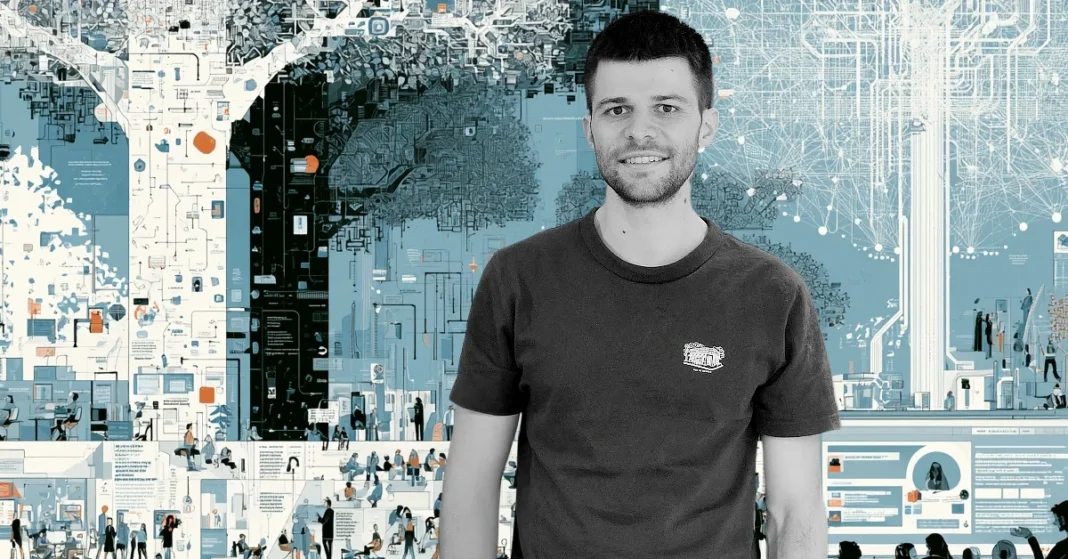
PIERRE-LOUIS CEDOZ, HAMZA BENCHEKROUN and AXEL MOYAL worked together on the Holo models at H COMPANY. With REMANENCE, they want to help companies train their own models based on tasks already performed by their AI agents. The Parisian startup announces a $30 million seed round, co-led by EQT VENTURES and FIRSTMARK.
To teach a model to use software, you must be able to make it repeat a task and verify the result. At H COMPANY, the three future founders of REMANENCE worked on this problem with Holo models. The agent had to learn to spot the right elements on the screen, choose an action, then observe its effect before continuing. The lab built interactive environments to train its models and measure their ability to accomplish these tasks.
REMANENCE wants to transpose this method to the procedures specific to each company. A support agent who views an order, checks the return conditions and offers a refund leaves a log of the operations carried out. The startup wants to use it to recreate training situations. Its clients could thus adapt a model to their procedures and retrain it when they evolve.
From Holo to business procedures
The three co-founders’ backgrounds include GOOGLE DEEPMIND, INSTADEEP and META, according to the press release. PIERRE-LOUIS CEDOZ and HAMZA BENCHEKROUN are among the authors of the Holo3 technical publication, devoted to the model’s ability to act in computer interfaces. FIRSTMARK already knows this terrain. The fund was included in the $220 million funding round announced at the launch of H COMPANY in May 2024. It is co-leading the REMANENCE seed round with EQT VENTURES.
The execution log may indicate that a refund was triggered. To verify that the decision was correct, you must know the applicable rule, the amount to which the customer was entitled and any exceptions. The platform must recreate the situations in which the model is practiced and define the criteria which make it possible to verify whether the task has been correctly executed.
A model that the customer can deploy
REMANENCE indicates that its customers will have their own version of the model, adapted to their procedures. They will be able to choose where to train and deploy it, and keep their data in their infrastructure. The possibility of exporting the model and continuing its training will depend in particular on the license of the starting model.
The cost per successful task will guide the choice of companies
REMANENCE’s first potential customers are companies whose agents already perform a large number of repetitive tasks with verifiable results. Customer support lends itself to this when the task follows precise rules. In the legal field, a verification of compliance with an internal procedure and the evaluation of complex advice call for very different criteria. REMANENCE says it works with design partners in support, legal and enterprise software, in Europe and the United States. At this stage, it does not publish their identity, nor production figures, nor pricing conditions.
For a buyer, the calculation concerns the full cost of a properly performed task. A specialized model may cost less to run. The economy then depends on the volume processed, the cost of training and updates, as well as the files which still require a general model or human intervention. FIRSTMARK envisages a hybrid architecture, in which companies retain access to models from large laboratories and operate their own models for certain uses. The subject ties in with that of infrastructure control, already visible in MISTRAL AI’s strategy around open models and calculation.
Competitors are already covering training and simulation
ADAPTIVE ML is the most direct competitor among the offers examined. Its Adaptive Engine platform covers evaluation, post-training and improvement based on production feedback. The company announced that AT&T had chosen it to develop models adapted to its tools and data. VERIS AI cross-references the supply upstream. Its platform simulates a company’s tools and systems and transforms production traces into test scenarios. An internal team can also assemble part of this chain with open tools like ARTthe OPENPIPE training framework.
The trio’s experience on Holo gives REMANENCE a technical point of support. Its commercial advantage will be measured by the time necessary to pass the traces to the first usable model, then by the part of this work that it can reuse with a second client. If each deployment mobilizes specialists to reconstruct the procedures and their exceptions, these services will weigh on the cost of the product. If the same tools make it possible to deploy a second comparable procedure more quickly, REMANENCE will be able to sell a platform that the client reuses as its agents evolve.
A dedicated GPU cluster and recruitment in Paris
The funding is to be used to develop a dedicated GPU cluster, training environments and evaluation systems. The company plans to recruit primarily in Paris and establish an initial presence in London and San Francisco. A first documented deployment would make it possible to compare, on the same procedure, the success rate, the cost per successful task and the share of files taken over by a human.
REMANENCE in brief
Creation and headquarters · SAS incorporated in September 2026, in Paris.
Activity · Platform for post-training specialized AI models from agent execution traces.
Founding team · PIERRE-LOUIS CEDOZ, HAMZA BENCHEKROUN and AXEL MOYAL. The press release presents CEDOZ as CEO. The announcement of the formation of the Parisian SAS designates BENCHEKROUN as president and MOYAL as general manager.
Announced on November 17, 2026the priming round of $30 millionor approximately 25.5 million eurosis co-led by EQT VENTURES And FIRSTMARKwith ZERO PRIME, EMBLEM, DRYSDALE, GLOBAL FOUNDERS CAPITAL And YELLOW. Individual investors cited in the press release include OLIVIER POMEL (DATADOG), PHILIPPE CORROT (MIRAKL), ROMAIN NICCOLI (PIGMENT), VICTOR RIPARBELLI and STEFFEN TJERRILD (SYNTHESIA), as well as MEHDI GHISSASSI (AI71).