European Cyber Week (Rennes) – A critical flaw lying dormant in the PHP source code since 2004, discovered several times by researchers, but left unpatched for 22 years due to a lack of a known functional exploit. Then, the emergence of AI models capable of transforming these theoretical bugs into vectors for remote code execution without authentication, suddenly threatening more than 70% of the world’s websites.
It is with this reminder that Delphine Longuet, researcher at Thales CortAIx Labs, set the scene during a brilliant presentation at ECW of a very urgent industrial transformation. That of securing critical code.
“Before AI, we could live with these kinds of bugs for 22 years. But today we can no longer ignore them. We need to strengthen our software, and that starts with rigorous testing,” she says.
And to protect systems against attacks, the software industry can no longer rely on black box testing, where we simply check whether the system meets specified requirements. It is at the heart of the white box, that is to say the exhaustive analysis of the source code, its branches and its logical conditions, that the tracking must take place. A mission comparable to the methodical exploration of a huge dungeon full of traps.
 © Thales
Dwarves, hobbit and elf on the test bench
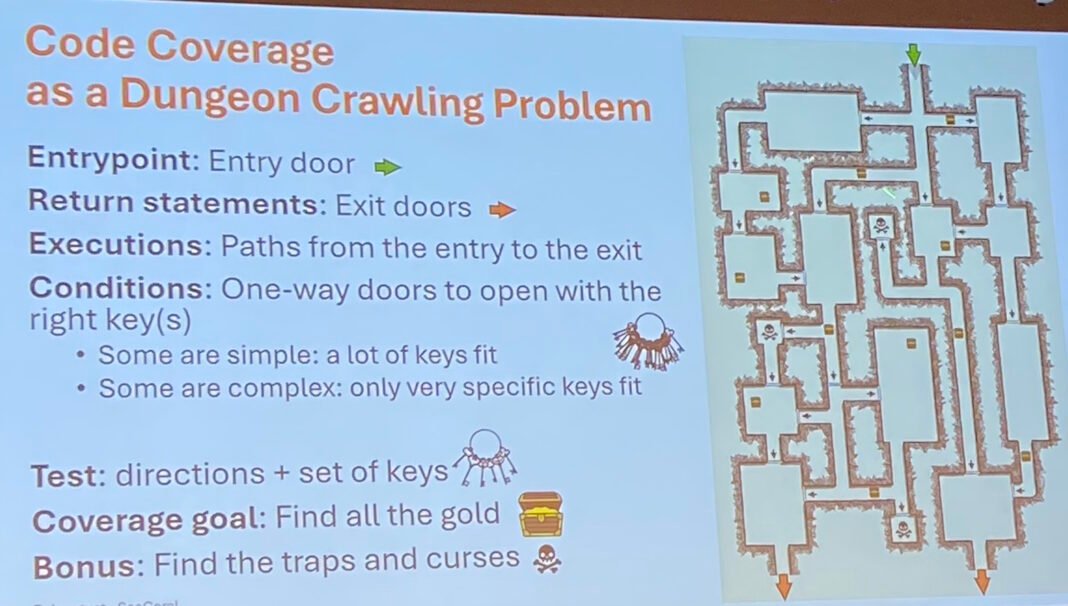
To popularize the mechanisms of structural code coverage (lines, branches, decisions, multi-conditions), Delphine Longuet uses a medieval-fantasy analogy. The computer program becomes a fortified dungeon (see illustration above), with its entrances, exits, branched corridors and one-way armored doors.
Coverage objectives, these are the treasure chests scattered throughout the rooms (covering the lines) or placed in each corridor after a branching (covering the branches).
And critical incidents, these are death traps which crash the program, or more pernicious spells, which discreetly corrupt the memory state without immediately stopping the system (for example a buffer overflow or buffer overflow).
And to win the gold and secure the dungeon, the development teams traditionally relied on three profiles of explorers with opposing philosophies:
| Explorer Profile | Related software technique | Strengths | Boundaries |
|---|---|---|---|
| The dwarves | Coverage-guided fuzzing (e.g. libfuzzer, AFL++) | Extremely fast, tireless, quickly discovers obvious flaws | Stumble on doors with complex locks |
| The hobbit | Symbolic execution (e.g. Klee) | Methodical, explores without duplicates | Reduced speed, running out of steam due to the saturation of solvers |
| The elf | Model checking (e.g. CBMC) | Global vision of the map, provides formal proof of unattainability | Memory Explosion on Great Dungeons |
 © Thales
SeaCoral: when the Fellowship of the Ring unifies the test
For years, the industry has compartmentalized these approaches, says the researcher. Google with OSS-Fuzz and Microsoft with OneFuzz have made it easier to orchestrate multiple fuzzers, while other work has attempted to merge the algorithms.
Inspired in particular by experiments by Mitsubishi Electric R&D aimed at the collaboration of heterogeneous tools, the consortium bringing together Thales and Titagone designed SeaCoral.
His credo? “One tool to rule them all.” Rather than developing yet another solver, SeaCoral brings together the best open source specialists under a single banner:
- Annotation with Frama-C: The platform instruments the C code by inserting labels. Each label represents a unit coverage objective (a line, a decision, or one of the Boolean combinations of the multi-condition criterion).
- Sharing objectives: These labels are automatically translated into virtual branches for libfuzzerand in formal assertions for Klee And CBMC.
- Dynamic collaboration: The tools exchange their discoveries while they are running. If libFuzzer and Klee discover a path, the satisfied labels are immediately removed from the CBMC work list, which only intervenes at the end to resolve the most difficult points.

Wall of complexity and the emergence of AI
However, when tackling dense industrial components, formal methods encounter a glass ceiling. On an X.509 certificate and signature parser of 9,000 lines, the alliance of the three tools proves powerless.
This is where the magician comes in: the LLM. The Thales teams subjected this same recalcitrant parser to an AI model (deepseek-4.1-flash driven via OpenCode), with a disarmingly simple prompt: “Can you generate tests for this function in this file to achieve maximum line coverage?” »
And the result is quite spectacular. In just 24 minutes, the LLM manages to cover the entire parser.
But above all, when faced with uncovered lines, the model formulates hypotheses of unreachability in natural language. Then invited to pilot CBMC to validate his statements, he developed a strategy on his own. And in 40 minutes, the formal proof of unattainability is completed.
“During the first attempt with CBMC, the model failed due to lack of memory. On the second try, he thought about it and implemented a real strategy: he divided the proof into several smaller sub-proofs,” explains Delphine Longuet.
SeaCoral vs LLM: the clash of cultures
Should we therefore store traditional tools in the museum? The test bench data presented by Delphine Longuet reveals a much more nuanced reality:
| Industrial use cases | SeaCoral approach (libFuzzer + Klee + CBMC) | LLM approach (DeepSeek via OpenCode) |
|---|---|---|
| X.509 parser (9,000 lines) | Parse failed (Out of Memory / Deadlines exceeded) | Success in 24 min (generation and coverage) |
| — Proof of unattainability | Impossible to establish | Success in 40 min (while piloting CBMC) |
| State machine (600 lines) | 100% resolved in 2 minutes | 35 min (generation and minimization of tests) |
| — Proof of unattainability | A few seconds | Additional 20 min (CBMC configuration) |
| Overall assessment | ~2 mins | ~55 minutes |
On a state machine with 600 lines of code, the superiority of SeaCoral is very clear. The tool takes care of the matter in two minutes with the watch in hand. The LLM takes 35 minutes to work on and an additional 20 minutes to formalize its proofs with CBMC.
“LLMs are clearly ahead of very large programs, but they sorely lack guarantees: these only come from third-party tools to which they have access” explains Delphine Longuet.
Furthermore, the experiment raises fundamental questions about the biases of the models. On the X.509 parser, DeepSeek clearly had excellent business knowledge of certificate structure in its training data. Enough to allow it to intuitively infer valid and invalid entries without having to deduce all the internal logic of the code.
“Observing the model’s thoughts during its exploration, it is clear that it used its prior knowledge. We still have to test these models on proprietary business codes that they do not know” continues Delphine Longuet.
Sovereignty, defense and MCP protocols: towards hybridization
For highly sensitive environments, such as defense systems or avionics software developed at Thales, delegation to AI models therefore encounters a few problems:
Industrial confidentiality
No question of sending critical code to frontier model APIs hosted abroad.
The execution must therefore be done on open models (open-weight) hosted locally, which are often several months late in maturity.
Frugality
In computing centers with limited hardware resources, running giant model inferences for hours when a solver like SeaCoral solves the problem in two minutes is nonsense.
The need for formal guarantees
An LLM produces plausible text. Not mathematical truth. It can therefore only certify the absence of flaws if it relies on third-party verification tools.
Symbiosis
And it is precisely in this symbiosis between testing tools and AI that the future of software engineering is taking shape, assures the Thalès researcher.
Prospective work around SeaCoral is therefore moving towards the integration of standardized context protocols, such as Model Context Protocol (MCP) servers.
And in this logic, AI is not intended to replace solvers, but to become their orchestrator. For them, it is about automatically configuring the parameters, or even breaking down the architectures.
“AI needs formal methods to verify what it produces, but it also greatly simplifies the use of these tools. AI will be both a prescriber and an accelerator, hybridization is the key to obtaining trusted software” concludes Delphine Longuet.
The verification bottleneck
At a time when generative AI makes it possible to produce code at unprecedented speed, the bottleneck in tech is no longer programming, but verification.
By reconciling the cunning of dwarves, the precision of hobbits, the rigor of elves and the orchestration power of language models, the software industry may have the weapons to close the flaws before attackers take them.
European Cyber Week (Rennes) – A critical flaw lying dormant in the PHP source code since 2004, discovered several times by researchers, but left unpatched for 22 years due to a lack of a known functional exploit. Then, the emergence of AI models capable of transforming these theoretical bugs into vectors for remote code execution without authentication, suddenly threatening more than 70% of the world’s websites.
It is with this reminder that Delphine Longuet, researcher at Thales CortAIx Labs, set the scene during a brilliant presentation at ECW of a very urgent industrial transformation. That of securing critical code.
“Before AI, we could live with these kinds of bugs for 22 years. But today we can no longer ignore them. We need to strengthen our software, and that starts with rigorous testing,” she says.
And to protect systems against attacks, the software industry can no longer rely on black box testing, where we simply check whether the system meets specified requirements. It is at the heart of the white box, that is to say the exhaustive analysis of the source code, its branches and its logical conditions, that the tracking must take place. A mission comparable to the methodical exploration of a huge dungeon full of traps.
© Thales
Dwarves, hobbit and elf on the test bench
To popularize the mechanisms of structural code coverage (lines, branches, decisions, multi-conditions), Delphine Longuet uses a medieval-fantasy analogy. The computer program becomes a fortified dungeon (see illustration above), with its entrances, exits, branched corridors and one-way armored doors.
Coverage objectives, these are the treasure chests scattered throughout the rooms (covering the lines) or placed in each corridor after a branching (covering the branches).
And critical incidents, these are death traps which crash the program, or more pernicious spells, which discreetly corrupt the memory state without immediately stopping the system (for example a buffer overflow or buffer overflow).
And to win the gold and secure the dungeon, the development teams traditionally relied on three profiles of explorers with opposing philosophies:
| Explorer Profile | Related software technique | Strengths | Boundaries |
|---|---|---|---|
| The dwarves | Coverage-guided fuzzing (e.g. libfuzzer, AFL++) | Extremely fast, tireless, quickly discovers obvious flaws | Stumble on doors with complex locks |
| The hobbit | Symbolic execution (e.g. Klee) | Methodical, explores without duplicates | Reduced speed, running out of steam due to the saturation of solvers |
| The elf | Model checking (e.g. CBMC) | Global vision of the map, provides formal proof of unattainability | Memory Explosion on Great Dungeons |
© Thales
SeaCoral: when the Fellowship of the Ring unifies the test
For years, the industry has compartmentalized these approaches, says the researcher. Google with OSS-Fuzz and Microsoft with OneFuzz have made it easier to orchestrate multiple fuzzers, while other work has attempted to merge the algorithms.
Inspired in particular by experiments by Mitsubishi Electric R&D aimed at the collaboration of heterogeneous tools, the consortium bringing together Thales and Titagone designed SeaCoral.
His credo? “One tool to rule them all.” Rather than developing yet another solver, SeaCoral brings together the best open source specialists under a single banner:
- Annotation with Frama-C: The platform instruments the C code by inserting labels. Each label represents a unit coverage objective (a line, a decision, or one of the Boolean combinations of the multi-condition criterion).
- Sharing objectives: These labels are automatically translated into virtual branches for libfuzzerand in formal assertions for Klee And CBMC.
- Dynamic collaboration: The tools exchange their discoveries while they are running. If libFuzzer and Klee discover a path, the satisfied labels are immediately removed from the CBMC work list, which only intervenes at the end to resolve the most difficult points.
Wall of complexity and the emergence of AI
However, when tackling dense industrial components, formal methods encounter a glass ceiling. On an X.509 certificate and signature parser of 9,000 lines, the alliance of the three tools proves powerless.
This is where the magician comes in: the LLM. The Thales teams subjected this same recalcitrant parser to an AI model (deepseek-4.1-flash driven via OpenCode), with a disarmingly simple prompt: “Can you generate tests for this function in this file to achieve maximum line coverage?” »
And the result is quite spectacular. In just 24 minutes, the LLM manages to cover the entire parser.
But above all, when faced with uncovered lines, the model formulates hypotheses of unreachability in natural language. Then invited to pilot CBMC to validate his statements, he developed a strategy on his own. And in 40 minutes, the formal proof of unattainability is completed.
“During the first attempt with CBMC, the model failed due to lack of memory. On the second try, he thought about it and implemented a real strategy: he divided the proof into several smaller sub-proofs” explains Delphine Longuet.
SeaCoral vs LLM: the clash of cultures
Should we therefore store traditional tools in the museum? The test bench data presented by Delphine Longuet reveals a much more nuanced reality:
| Industrial use cases | SeaCoral approach (libFuzzer + Klee + CBMC) | LLM approach (DeepSeek via OpenCode) |
|---|---|---|
| X.509 parser (9,000 lines) | Parse failed (Out of Memory / Deadlines exceeded) | Success in 24 min (generation and coverage) |
| — Proof of unattainability | Impossible to establish | Success in 40 min (while piloting CBMC) |
| State machine (600 lines) | 100% resolved in 2 minutes | 35 min (generation and minimization of tests) |
| — Proof of unattainability | A few seconds | Additional 20 min (CBMC configuration) |
| Overall assessment | ~2 mins | ~55 minutes |
On a state machine with 600 lines of code, the superiority of SeaCoral is very clear. The tool takes care of the matter in two minutes with the watch in hand. The LLM takes 35 minutes to work on and an additional 20 minutes to formalize its proofs with CBMC.
“LLMs are clearly ahead of very large programs, but they sorely lack guarantees: these only come from third-party tools to which they have access” explains Delphine Longuet.
Furthermore, the experiment raises fundamental questions about the biases of the models. On the X.509 parser, DeepSeek clearly had excellent business knowledge of certificate structure in its training data. Enough to allow it to intuitively infer valid and invalid entries without having to deduce all the internal logic of the code.
“Observing the model’s thoughts during its exploration, it is clear that it used its prior knowledge. We still have to test these models on proprietary business codes that they do not know” continues Delphine Longuet.
Sovereignty, defense and MCP protocols: towards hybridization
For highly sensitive environments, such as defense systems or avionics software developed at Thales, delegation to AI models therefore encounters some problems:
Industrial confidentiality
No question of sending critical code to frontier model APIs hosted abroad.
The execution must therefore be done on open models (open-weight) hosted locally, which are often several months late in maturity.
Frugality
In computing centers with limited hardware resources, running giant model inferences for hours when a solver like SeaCoral solves the problem in two minutes is nonsense.
The need for formal guarantees
An LLM produces plausible text. Not mathematical truth. It can therefore only certify the absence of flaws if it relies on third-party verification tools.
Symbiosis
And it is precisely in this symbiosis between testing tools and AI that the future of software engineering is taking shape, assures the Thalès researcher.
Prospective work around SeaCoral is therefore moving towards the integration of standardized context protocols, such as Model Context Protocol (MCP) servers.
And in this logic, AI is not intended to replace solvers, but to become their orchestrator. For them, it is about automatically configuring the parameters, or even breaking down the architectures.
“AI needs formal methods to verify what it produces, but it also greatly simplifies the use of these tools. AI will be both a prescriber and an accelerator, hybridization is the key to obtaining trusted software” concludes Delphine Longuet.
The verification bottleneck
At a time when generative AI makes it possible to produce code at unprecedented speed, the bottleneck in tech is no longer programming, but verification.
By reconciling the cunning of dwarves, the precision of hobbits, the rigor of elves and the orchestration power of language models, the software industry may have the weapons to close the flaws before attackers take them.
https://www.zdnet.fr/wp-content/uploads/zdnet/2026/11/trois.jpg https://www.zdnet.fr/actualites/lia-au-secours-delfes-de-nains-et-dhobbits-a-lallais-des-failles-dans-le-code-508243.htm?utm_source=rss_feed&utm_medium=link&utm_campaign=unknown